

Culture and faith
The Bactrian oasis towns
Farmers built fortified towns around oases on the edge of the desert. They traded with the Indus valley and Mesopotamia.
- Where
- Bactria

A crossroads of the Silk Road with Bactrian kingdoms and the Buddhas of Bamiyan, Ghaznavid and Timurid courts, three Anglo-Afghan wars, the Soviet invasion and decades of war after.
Independent from Britain since 19 August 1919
The Buddhas of Bamiyan are destroyed, 2001. Image: James Gordon · CC BY 4.0, via Wikimedia Commons
Chapter I

Story 1 of 25 · Ancient Afghanistan
Culture and faith
Farmers built fortified towns around oases on the edge of the desert. They traded with the Indus valley and Mesopotamia.
About 1,700 years later
c. 2000 BC to c. 321 BC

Story 2 of 25 · Ancient Afghanistan
States and rulers
Chandragupta overthrew the Nanda kings of Magadha and went on to rule most of the subcontinent. His grandson Ashoka ruled from Afghanistan to Karnataka.

Story 3 of 25 · Ancient Afghanistan
States and rulers
Greek settlers left behind by Alexander ruled Bactria and invaded northern India, mixing Greek and Buddhist art.

Story 5 of 25 · Ancient Afghanistan
Science, trade and industry
The Han envoy Zhang Qian travelled west to Central Asia, was held captive for years, and returned with reports that opened trade routes across Asia.
About 170 years later
c. 138 BC to c. 30
About 790 years later
c. 30 to 819
Chapter II

Story 7 of 25 · Islamic empires
States and rulers
The Samanids ruled Central Asia and Persia from Bukhara and Samarkand and revived Persian culture.

Story 8 of 25 · Islamic empires
States and rulers
From Ghazni the sultans raided India and made their court a centre of Persian poetry and learning.
About 260 years later
962 to 1219

Story 9 of 25 · Islamic empires
War and conflict
Genghis Khan's armies destroyed the Khwarazmian Empire, massacring the people of cities such as Nishapur.
About 150 years later
1219 to 1370

Story 10 of 25 · Islamic empires
States and rulers
Timur's descendants made Herat a capital of art and science, with miniature painting and poetry.
About 160 years later
1370 to 1526

Story 11 of 25 · Islamic empires
States and rulers
Babur won at Panipat and founded a dynasty that at its height ruled almost the whole subcontinent. The British formally ended it after the rebellion of 1857.
About 220 years later
1526 to 1747
Chapter III

Story 12 of 25 · Durrani state and kingdom
States and rulers
A Pashtun commander was chosen king at Kandahar and built an empire from Persia to Delhi. He is called father of the nation.
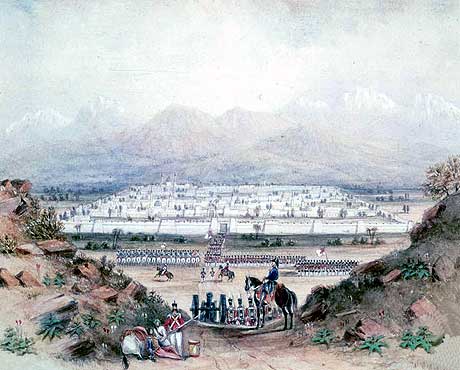
Story 13 of 25 · Durrani state and kingdom
War and conflict
A British army occupied Kabul and had to retreat in the winter of 1842. Almost everyone in the column was killed.

Story 14 of 25 · Durrani state and kingdom
War and conflict
Britain invaded after the emir received a Russian mission, and fixed control of Afghan foreign policy.

Story 15 of 25 · Durrani state and kingdom
States and rulers
Britain and the Afghan emir drew a border that split Pashtun lands. Afghanistan has never accepted it fully.

Story 16 of 25 · Durrani state and kingdom
War and conflict
After a short war, Britain recognised Afghanistan's full independence in the Treaty of Rawalpindi.
Chapter IV

Story 17 of 25 · War and the Taliban
States and rulers
Mohammed Daoud overthrew his cousin, King Zahir Shah, and made Afghanistan a republic.

Story 18 of 25 · War and the Taliban
States and rulers
Communist officers killed Daoud and seized power, and their land reforms caused rebellion.

Story 19 of 25 · War and the Taliban
War and conflict
The Soviet army invaded to prop up its allies, and fought mujahideen backed by the US, Pakistan and others. A million Afghans died.

Story 20 of 25 · War and the Taliban
War and conflict
After the communist government fell, mujahideen factions fought for Kabul and destroyed much of the city.

Story 21 of 25 · War and the Taliban
States and rulers
The Taliban took Kabul and proclaimed an Islamic Emirate. They banned girls' education and hosted al-Qaeda.

Story 22 of 25 · War and the Taliban
Culture and faith
The Taliban dynamited two huge sixth-century Buddhas carved into a cliff.

Story 23 of 25 · War and the Taliban
War and conflict
After the 11 September attacks the US and allies invaded to remove the Taliban. The war lasted twenty years.

Story 24 of 25 · War and the Taliban
States and rulers
Hamid Karzai won the first direct election for president.

Story 25 of 25 · War and the Taliban
States and rulers
As US forces withdrew, the Taliban took Kabul, and the elected government collapsed.
Journey complete
25 stories, c. 2000 BC to 2021. More events are being researched and added.
Culture and faith
Farmers built fortified towns around oases on the edge of the desert. They traded with the Indus valley and Mesopotamia.

States and rulers
Chandragupta overthrew the Nanda kings of Magadha and went on to rule most of the subcontinent. His grandson Ashoka ruled from Afghanistan to Karnataka.

States and rulers
Greek settlers left behind by Alexander ruled Bactria and invaded northern India, mixing Greek and Buddhist art.
States and rulers
About 200 BC Demetrius I of Bactria invaded the north-west of the subcontinent and founded Greek-ruled kingdoms, with royal seats at places such as Taxila. The best known Indo-Greek king, Menander I, ruled from Sakala, now Sialkot.

Science, trade and industry
The Han envoy Zhang Qian travelled west to Central Asia, was held captive for years, and returned with reports that opened trade routes across Asia.
Silk, ideas and religions began to flow along the Silk Road.
States and rulers
The Yuezhi founded the Kushan Empire early in the 1st century AD in Bactria. It spread over Afghanistan, Pakistan and northern India, and under Kanishka its rulers backed Buddhism, which travelled from Gandhara over the Karakoram to China.

States and rulers
The Samanids ruled Central Asia and Persia from Bukhara and Samarkand and revived Persian culture.

States and rulers
From Ghazni the sultans raided India and made their court a centre of Persian poetry and learning.

War and conflict
Genghis Khan's armies destroyed the Khwarazmian Empire, massacring the people of cities such as Nishapur.
Iran's population and cities took centuries to recover.

States and rulers
Timur's descendants made Herat a capital of art and science, with miniature painting and poetry.

States and rulers
Babur won at Panipat and founded a dynasty that at its height ruled almost the whole subcontinent. The British formally ended it after the rebellion of 1857.

States and rulers
A Pashtun commander was chosen king at Kandahar and built an empire from Persia to Delhi. He is called father of the nation.
War and conflict
A British army occupied Kabul and had to retreat in the winter of 1842. Almost everyone in the column was killed.
War and conflict
Britain invaded after the emir received a Russian mission, and fixed control of Afghan foreign policy.

States and rulers
Britain and the Afghan emir drew a border that split Pashtun lands. Afghanistan has never accepted it fully.

War and conflict
After a short war, Britain recognised Afghanistan's full independence in the Treaty of Rawalpindi.
States and rulers
Mohammed Daoud overthrew his cousin, King Zahir Shah, and made Afghanistan a republic.

States and rulers
Communist officers killed Daoud and seized power, and their land reforms caused rebellion.

War and conflict
The Soviet army invaded to prop up its allies, and fought mujahideen backed by the US, Pakistan and others. A million Afghans died.

War and conflict
After the communist government fell, mujahideen factions fought for Kabul and destroyed much of the city.

States and rulers
The Taliban took Kabul and proclaimed an Islamic Emirate. They banned girls' education and hosted al-Qaeda.

Culture and faith
The Taliban dynamited two huge sixth-century Buddhas carved into a cliff.

War and conflict
After the 11 September attacks the US and allies invaded to remove the Taliban. The war lasted twenty years.

States and rulers
Hamid Karzai won the first direct election for president.

States and rulers
As US forces withdrew, the Taliban took Kabul, and the elected government collapsed.