Augustine becomes bishop of Hippo

All countries

Algeria

Rock art in the Sahara, Numidian kings and Roman cities, Berber and Ottoman states, then French colonisation, a bitter war of independence and a republic that has survived civil war and mass protest.

Independent from France since 5 July 1962

Stories
27
Distance
11,020 years
Route
c. 9000 BC to 2021
  1. Ancient Algeria11 stories
  2. Berber and Ottoman states4 stories
  3. French Algeria5 stories
  4. Independent Algeria7 stories
Begin the journey

Augustine becomes bishop of Hippo, 396. Image: Philippe de Champaigne · Public domain, via Wikimedia Commons

  1. Chapter I

    Ancient Algeria

    11 stories in this chapter

  2. The Ibero-Maurisian Culture, in the Maghreb and Sahara of North Africa

    Story 1 of 27 · Ancient Algeria

    Culture and faith

    The Capsian culture

    The Capsian culture of Algeria and Tunisia, named after Capsa, now Gafsa, lasted from about 9000 to 5400 BC. Its people hunted aurochs, hartebeest and hares, gathered snails, and made beads and containers from ostrich eggshell.

    Next storyc. 8000 BC · Painters of the Tassili n'Ajjer
  3. About 1,000 years later

    c. 9000 BC to c. 8000 BC

  4. Algerian desert - Tassili National Park

    Story 2 of 27 · Ancient Algeria

    Culture and faith

    Painters of the Tassili n'Ajjer

    Herders and hunters covered the sandstone cliffs of the central Sahara with thousands of paintings of cattle, antelope and dancing figures, made when the desert was still green.

    Next storyc. 6300 BC · The cattle herders' rock art
  5. About 1,700 years later

    c. 8000 BC to c. 6300 BC

  6. Story 3 of 27 · Ancient Algeria

    Culture and faith

    The cattle herders' rock art

    From about 6300 to 700 BC, artists of the central Sahara, in the Tassili n'Ajjer and the Acacus, painted and engraved herders with their cattle, sheep, goats and dogs. It is the most common kind of Saharan rock art.

    Next story12th century BC · Phoenicians at Hippo
  7. About 5,100 years later

    c. 6300 BC to 12th century BC

  8. Site of Hippo Regius, Africa Proconsularis

    Story 4 of 27 · Ancient Algeria

    Science, trade and industry

    Phoenicians at Hippo

    Phoenicians from Tyre first settled Hippo, near today's Annaba, around the 12th century BC. It later became a prosperous Roman colony and the home of Augustine of Hippo.

    Next storyc. 300 BC · The Medracen
  9. About 900 years later

    12th century BC to c. 300 BC

  10. Imedghasen is a royal mausoleum-temple of the Berber Numidian Kings which stands near Batna city in Aurasius Mons in Numidia - Algeria

    Story 5 of 27 · Ancient Algeria

    States and rulers

    The Medracen

    Near Batna in north-eastern Algeria, the Medracen is a huge round royal tomb of the Berber kingdom of Numidia. Scholars date it either to the 4th century BC or to the reign of King Masinissa around 200 BC.

    Next storyc. 225 BC · The kingdom of Mauretania
  11. The kingdom of Mauretania

    Story 6 of 27 · Ancient Algeria

    States and rulers

    The kingdom of Mauretania

    Mauretania was a Berber kingdom in what is now northern Morocco and western Algeria. It was an ally and then a client of Rome before it became Roman provinces.

    Next story202 BC · The Numidian kingdom
  12. Ancien possesseur : Vogüé, Melchior (1829-1916 ; marquis de)

    Story 7 of 27 · Ancient Algeria

    States and rulers

    The Numidian kingdom

    Berber kings, beginning with Masinissa, ruled northern Algeria as allies of Rome against Carthage and then as its dependants, until Caesar annexed the kingdom.

    Next story112 BC · Rome fights Jugurtha
  13. An incident in the Jugurthine War (Cassell's Illustrated Universal History, vol

    Story 8 of 27 · Ancient Algeria

    War and conflict

    Rome fights Jugurtha

    The Numidian king Jugurtha seized power by murder and bribed Roman senators, until Rome sent Marius to bring him down and Jugurtha's father-in-law handed him over.

    Next story100 · Trajan's town of Timgad
  14. About 210 years later

    112 BC to 100

  15. Territoires et monuments de l'antique Thamugadi

    Story 9 of 27 · Ancient Algeria

    Culture and faith

    Trajan's town of Timgad

    Veterans of Trajan's army laid out Thamugadi on a strict grid in the foothills of the Aurès. Its arch, library and forum still stand.

    Next story396 · Augustine becomes bishop of Hippo
  16. About 300 years later

    100 to 396

  17. Augustine becomes bishop of Hippo

    Story 10 of 27 · Ancient Algeria

    Culture and faith

    Augustine becomes bishop of Hippo

    A teacher born at Thagaste in Numidia became bishop of Hippo Regius, and his Confessions and City of God shaped Western Christianity. He died as the Vandals besieged his city.

    Next story647 · Arab armies conquer North Africa
  18. About 250 years later

    396 to 647

  19. Arab armies conquer North Africa

    Story 11 of 27 · Ancient Algeria

    States and rulers

    Arab armies conquer North Africa

    Arab armies pushed west from Egypt over sixty years and met fierce Berber resistance, including from the queen al-Kahina. The Berbers then converted to Islam and joined the march on Spain.

    Next story776 · The Rustamid imamate of Tahert
  20. Chapter II

    Berber and Ottoman states

    4 stories in this chapter

  21. Map of approximate Rustamid territory in the 9th century

    Story 12 of 27 · Berber and Ottoman states

    States and rulers

    The Rustamid imamate of Tahert

    A Persian-born imam founded a state at Tahert, a city of scholars and traders that tolerated different Muslim sects as well as Christians and Jews.

    Next story1147 · The Almohads take Marrakesh
  22. About 370 years later

    776 to 1147

  23. Almohad dynasty, was a ruling dynasty of Morocco, then Caliphate since 1147, at its greatest extent (early 13th century)

    Story 13 of 27 · Berber and Ottoman states

    States and rulers

    The Almohads take Marrakesh

    A reforming Berber movement from the Atlas overthrew the Almoravids and ruled Morocco and Muslim Spain from Marrakesh.

    Next story1235 · The kingdom of Tlemcen
  24. Map showing the Zayyanid kingdom, also known as the kingdom of Tlemcen, at the beginning of the fourteenth century

    Story 14 of 27 · Berber and Ottoman states

    States and rulers

    The kingdom of Tlemcen

    From their capital Tlemcen, the Zayyanid dynasty ruled western Algeria for three centuries as a trading state between the Mediterranean and the Sahara.

    Next story1516 · Ottoman Algiers
  25. About 280 years later

    1235 to 1516

  26. View of Algiers in 1828

    Story 15 of 27 · Berber and Ottoman states

    States and rulers

    Ottoman Algiers

    The corsair brothers Aruj and Hayreddin Barbarossa took Algiers and placed it under the Ottoman sultan. For three centuries a largely self-governing state ruled from the city.

    Next story1830 · France conquers Algeria
  27. About 310 years later

    1516 to 1830

  28. Chapter III

    French Algeria

    5 stories in this chapter

  29. France conquers Algeria

    Story 16 of 27 · French Algeria

    War and conflict

    France conquers Algeria

    A French army landed near Algiers, took the city within weeks and then fought for seventeen years to subdue the interior, until the emir Abd al-Qadir surrendered.

    Next story1870 · The Crémieux decree
  30. Décret Crémieux N° 136 Photocopie du Bulletin des Lois de la République Française

    Story 17 of 27 · French Algeria

    States and rulers

    The Crémieux decree

    A French decree made Algeria's Jews French citizens but left its Muslims as subjects, dividing communities that had lived side by side for centuries.

    Next story1871 · The Mokrani revolt
  31. Gravure publiée dans l'Illustration en 1871 et représentant l'insurrection de Bordj Bou Aririj

    Story 18 of 27 · French Algeria

    War and conflict

    The Mokrani revolt

    The largest uprising since the conquest, led by the chiefs Mokrani and Cheikh Haddad, rose across Kabylia. It was crushed and its lands were seized for settlers.

    Next story1945 · The Sétif and Guelma massacres
  32. Carte des massacres de mai/juin 1945 à Sétif, Guelma et Kherrata

    Story 19 of 27 · French Algeria

    War and conflict

    The Sétif and Guelma massacres

    Nationalist marches on the day Germany surrendered turned into attacks on settlers. French troops and militias killed thousands of Algerians in reprisal.

    Next story1954 · The war of independence
  33. Collage made by me using screenshots from two Public Domain videos

    Story 20 of 27 · French Algeria

    War and conflict

    The war of independence

    The National Liberation Front attacked targets across Algeria on All Saints' Day. Eight years of guerrilla war, torture and bombings followed and ended in the Évian Accords.

    Next story1962 · Algeria votes for independence
  34. Chapter IV

    Independent Algeria

    7 stories in this chapter

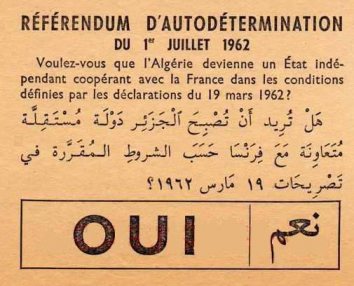
  35. Bulletin "OUI" du référendum d'autodétermination de l'Algérie

    Story 21 of 27 · Independent Algeria

    States and rulers

    Algeria votes for independence

    Almost every voter backed independence in a referendum held after the ceasefire. Independence was proclaimed on 5 July, and most of the settlers left within months.

    Next story1963 · Ben Bella becomes president
  36. Official picture of the first president of Algeria

    Story 22 of 27 · Independent Algeria

    States and rulers

    Ben Bella becomes president

    A leader of the independence war was elected president as the only candidate. He led a one-party socialist state until his own comrades turned on him.

    Next story1965 · Boumédiène overthrows Ben Bella
  37. Ahmed Ben Bella, Algeria's first president, who was overthrown in 1965

    Story 23 of 27 · Independent Algeria

    States and rulers

    Boumédiène overthrows Ben Bella

    Defence minister Houari Boumédiène seized power in a bloodless coup, and ruled by decree until his death in 1978.

    Next story1991 · The civil war
  38. Algiers, January 12, C.E.1992

    Story 24 of 27 · Independent Algeria

    War and conflict

    The civil war

    The army cancelled elections that an Islamist party was poised to win. A decade of fighting between the state and armed groups followed, and killed an estimated 100,000 or more people.

    Next story1999 · Bouteflika elected president
  39. Bouteflika elected president

    Story 25 of 27 · Independent Algeria

    States and rulers

    Bouteflika elected president

    He ended the civil war with an amnesty and stayed in office for twenty years, even after a stroke in 2013 left him rarely seen.

    Next story2019 · The Hirak protests
  40. The Hirak protests

    Story 26 of 27 · Independent Algeria

    States and rulers

    The Hirak protests

    Weekly mass marches against a fifth term for Bouteflika forced him to resign in April 2019 and pressed for a deeper change of government.

    Next story2019 · Tebboune elected president
  41. Poster announcing the Algerian presidential elections

    Story 27 of 27 · Independent Algeria

    States and rulers

    Tebboune elected president

    A former prime minister won an election that most protesters boycotted, and that the protest movement called a charade.

    NextJourney's end

Journey complete

You travelled 11,020 years

27 stories, c. 9000 BC to 2021. More events are being researched and added.

Choose another countryBack to the start