Terracotta Army in Xi'an, China

All countries

China

Early humans and the first rice farmers, three thousand years of dynasties and inventions, revolution and the People's Republic.

Republic founded in 1912; the People's Republic since 1 October 1949

Stories
57
Distance
752,019 years
Route
c. 750,000 BC to 2019
  1. Early China11 stories
  2. Shang and Zhou4 stories
  3. The empire22 stories
  4. Modern China20 stories
Begin the journey

The Terracotta Army, c. 210 BC. Image: xiquinhosilva · CC BY 2.0, via Wikimedia Commons

  1. Chapter I

    Early China

    11 stories in this chapter

  2. First cranium of Homo erectus pekinensis ( Sinathropus pekinensis ) discovered in 1929 in Zhoukoudian, today missing (replica)

    Story 1 of 57 · Early China

    People and rights

    Peking Man

    Homo erectus lived for hundreds of thousands of years in caves at Zhoukoudian near Beijing. The original fossils, found in the 1920s, were lost in 1941.

    Next storyc. 7000 BC · Early farmers at Jiahu
  3. About 743,000 years later

    c. 750,000 BC to c. 7000 BC

  4. Neolithic bone flute (Henan Provincial Museum)

    Story 2 of 57 · Early China

    Science, trade and industry

    Early farmers at Jiahu

    Villagers by the Huai River grew rice, brewed a fermented drink of rice, honey and fruit, and played flutes made of crane bone.

    Next storyc. 6200 BC · The Xinglongwa villagers
  5. About 800 years later

    c. 7000 BC to c. 6200 BC

  6. Neolithic pottery jar, Xinglongwa Culture, Liaoning, 1990

    Story 3 of 57 · Early China

    Culture and faith

    The Xinglongwa villagers

    In the Liao river basin of north-east China, villagers made plain cylindrical pots, fired at low temperatures, between about 6200 and 5400 BC. The culture is found mainly around the Inner Mongolia and Liaoning border.

    Next storyc. 5500 BC · Hemudu, rice farmers on stilts
  7. About 700 years later

    c. 6200 BC to c. 5500 BC

  8. Hemudu, rice farmers on stilts

    Story 4 of 57 · Early China

    Science, trade and industry

    Hemudu, rice farmers on stilts

    South of Hangzhou Bay, the Hemudu people lived in stilt houses and long communal houses and farmed rice from about 5500 to 3300 BC. It was one of the earliest cultures to grow rice.

    Next storyc. 5000 BC · The Yangshao villages
  9. About 500 years later

    c. 5500 BC to c. 5000 BC

  10. The Yangshao villages

    Story 5 of 57 · Early China

    Culture and faith

    The Yangshao villages

    Farming villages along the middle Yellow River made painted pottery and grew millet between about 5000 and 3000 BC. The culture is named after a site at Yangshao in Henan, found in 1921.

    Next storyc. 4300 BC · The Dawenkou culture
  11. About 700 years later

    c. 5000 BC to c. 4300 BC

  12. The Dawenkou culture

    Story 6 of 57 · Early China

    Culture and faith

    The Dawenkou culture

    In Shandong, the Dawenkou people lived alongside the Yangshao from about 4300 to 2600 BC. Their sites hold turquoise, jade and ivory, and signs scratched on pots that may be related to later Chinese writing.

    Next storyc. 3400 BC · The Qujialing culture
  13. About 900 years later

    c. 4300 BC to c. 3400 BC

  14. The Qujialing culture

    Story 7 of 57 · Early China

    Culture and faith

    The Qujialing culture

    In the middle Yangtze region of Hubei and Hunan, the Qujialing culture lasted from about 3400 to 2500 BC. It followed the Daxi culture and left ceramic balls and painted spindle whorls.

    Next storyc. 3300 BC · The Liangzhu jade culture
  15. The Liangzhu jade culture

    Story 8 of 57 · Early China

    Culture and faith

    The Liangzhu jade culture

    On the Yangtze delta the Liangzhu built a city with dams and buried their elite with jade, silk, ivory and lacquer. Floods may have ended the culture. Its ruins joined the World Heritage list in 2019.

    Next storyc. 3000 BC · The Longshan black pottery
  16. About 300 years later

    c. 3300 BC to c. 3000 BC

  17. Black Pottery Goblet Shandong Longshan Culture Late Neolithic Period (ca

    Story 9 of 57 · Early China

    Culture and faith

    The Longshan black pottery

    Along the Yellow River, Longshan potters used wheels to make thin, highly polished black pottery from about 3000 to 1900 BC. Many of their settlements had rammed-earth walls.

    Next storyc. 2300 BC · Taosi and the oldest sun pole
  18. About 700 years later

    c. 3000 BC to c. 2300 BC

  19. A painted pottery jar Neolithic age (about 2500 year BC) Excavated from Taosi village, Xiangfen County, Shanxi Province

    Story 10 of 57 · Early China

    States and rulers

    Taosi and the oldest sun pole

    In southern Shanxi, the Taosi settlement flourished from about 2300 to 1900 BC. A painted pole from a tomb there is probably the oldest gnomon known in China, a rod whose shadow shows the time and the season.

    Next storyc. 1750 BC · Erlitou, the first palaces
  20. About 550 years later

    c. 2300 BC to c. 1750 BC

  21. Bronze Jue (wine-drinking vessel) Attributed to the real or mythical Xia Dynasty (2100-1600 B.C.)

    Story 11 of 57 · Early China

    States and rulers

    Erlitou, the first palaces

    At Erlitou on the Yellow River, archaeologists found palace buildings and bronze-casting workshops. Radiocarbon dates place the culture between about 1750 and 1500 BC, and some scholars link it to the legendary Xia dynasty.

    Next storyc. 1600 BC · The Shang dynasty
  22. About 150 years later

    c. 1750 BC to c. 1600 BC

  23. Chapter II

    Shang and Zhou

    4 stories in this chapter

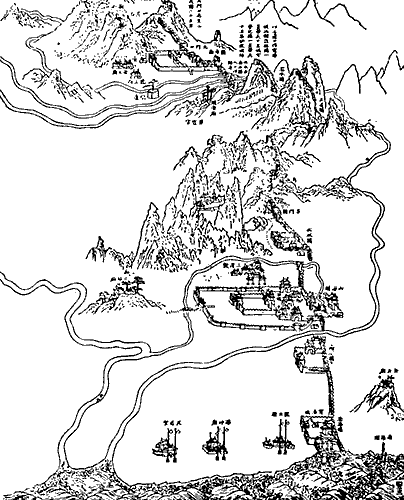
  24. Map of Shang Dynasty from Bamboo Annals

    Story 12 of 57 · Shang and Zhou

    States and rulers

    The Shang dynasty

    The Shang kings, also called the Yin dynasty, ruled the Yellow River valley in the second millennium BC. Modern scholars date the dynasty between the 16th and 11th centuries BC. The Zhou overthrew it.

    Next storyc. 1250 BC · The oracle bones
  25. About 350 years later

    c. 1600 BC to c. 1250 BC

  26. Chinese oracle bone Diviners of the Shang dynasty (16th-10th centuries B.C.) produced oracles by reading cracks on ox bones

    Story 13 of 57 · Shang and Zhou

    Culture and faith

    The oracle bones

    Shang kings had questions to their ancestors carved on ox bones and turtle shells, then cracked them with heat to read the answers.

    Next storyc. 1046 BC · The Zhou overthrow the Shang
  27. About 200 years later

    c. 1250 BC to c. 1046 BC

  28. Battle of Muye, the battle during which Zhou overthrew Shang dynasty

    Story 14 of 57 · Shang and Zhou

    States and rulers

    The Zhou overthrow the Shang

    King Wu of Zhou defeated the last Shang king and claimed the 'Mandate of Heaven', the idea that a ruler who governs badly loses the right to rule.

    Next storyc. 500 BC · Confucius teaches
  29. About 550 years later

    c. 1046 BC to c. 500 BC

  30. (071016) -- JINAN, Oct

    Story 15 of 57 · Shang and Zhou

    Culture and faith

    Confucius teaches

    Confucius taught that order came from virtue, respect for family, ritual and good government.

    Next story221 BC · Qin unifies China
  31. About 280 years later

    c. 500 BC to 221 BC

  32. Chapter III

    The empire

    22 stories in this chapter

  33. Map of the Qin Empire at its height, around 210 BC

    Story 16 of 57 · The empire

    States and rulers

    Qin unifies China

    After conquering the six rival states, the king of Qin took the title First Emperor. He standardised writing, weights and measures across the empire.

    Next storyc. 210 BC · The Terracotta Army
  34. Terracotta Army in Xi'an, China

    Story 17 of 57 · The empire

    Culture and faith

    The Terracotta Army

    About 8,000 life-size clay soldiers, each with its own face, were buried to guard the tomb of Qin Shi Huang, the first emperor of a united China. Farmers digging a well found them in 1974.

    Next story202 BC · Liu Bang founds the Han
  35. The ruins of the ancient Chinese Dunhuang watchtower from the Han Dynasty (202 BC—220 AD) — in Dunhuang , Gansu province, China

    Story 18 of 57 · The empire

    States and rulers

    Liu Bang founds the Han

    A rebel born a peasant defeated his rival and became Emperor Gaozu. With one short break, the Han ruled for four centuries.

    Next storyc. 138 BC · The Silk Road opens
  36. Zhang Qian leaving emperor Han Wudi around 130 BCE, for his expedition to Central Asia

    Story 19 of 57 · The empire

    Science, trade and industry

    The Silk Road opens

    The Han envoy Zhang Qian travelled west to Central Asia, was held captive for years, and returned with reports that opened trade routes across Asia.

    Next story105 · Paper
  37. About 240 years later

    c. 138 BC to 105

  38. Paper

    Story 20 of 57 · The empire

    Science, trade and industry

    Paper

    The court official Cai Lun presented the emperor with an improved method of making paper from bark, hemp, rags and old fishing nets.

    Next story220 · The Han ends and China splits in three
  39. Map of the Three Kingdoms of Wei, Shu and Wu around AD 262

    Story 21 of 57 · The empire

    States and rulers

    The Han ends and China splits in three

    Cao Pi forced the last Han emperor to give up the throne. Wei, Shu and Wu then fought each other for sixty years.

    Next story581 · The Sui reunify China
  40. About 360 years later

    220 to 581

  41. Map of the Sui dynasty in 581

    Story 22 of 57 · The empire

    States and rulers

    The Sui reunify China

    After centuries of division Yang Jian founded the Sui and conquered the south in 589. His son built the Grand Canal.

    Next story605 · The Grand Canal
  42. The Grand Canal

    Story 23 of 57 · The empire

    Science, trade and industry

    The Grand Canal

    The Sui emperors linked older waterways into a canal system running more than 1,700 kilometres from the Yangtze to the north.

    Next story618 · The Tang dynasty begins
  43. Tang Dynasty circa 700 AD

    Story 24 of 57 · The empire

    States and rulers

    The Tang dynasty begins

    Li Yuan took the throne after the Sui collapsed. Under the Tang, Chang'an was among the largest cities in the world.

    Next story755 · The An Lushan rebellion
  44. Map showing the An Lushan Rebellion

    Story 25 of 57 · The empire

    War and conflict

    The An Lushan rebellion

    A frontier general, An Lushan, rebelled against the Tang emperor and captured both capitals. Years of war and famine followed.

    Next story868 · The Diamond Sutra is printed
  45. Frontispiece, Diamond Sutra from Cave 17, Dunhuang, ink on paper

    Story 26 of 57 · The empire

    Culture and faith

    The Diamond Sutra is printed

    A Buddhist scripture was printed from carved wooden blocks onto a scroll more than five metres long. It was found sealed in a cave at Dunhuang in 1900.

    Next story960 · Zhao Kuangyin founds the Song
  46. Carte représentant le territoire de la dynastie Song au XI

    Story 27 of 57 · The empire

    States and rulers

    Zhao Kuangyin founds the Song

    A general whom his soldiers had dressed in a yellow robe became emperor, ending the chaos of the Five Dynasties.

    Next story1271 · Kublai Khan founds the Yuan dynasty
  47. About 310 years later

    960 to 1271

  48. Provinces of Yuan Dynasty as of 1330 A.D

    Story 28 of 57 · The empire

    States and rulers

    Kublai Khan founds the Yuan dynasty

    The Mongol khan took a Chinese dynastic name and made Beijing his capital. He finished conquering the Song in 1279.

    Next story1368 · The Ming drive out the Mongols
  49. Ming Empire cca 1580

    Story 29 of 57 · The empire

    States and rulers

    The Ming drive out the Mongols

    Zhu Yuanzhang, born a peasant, proclaimed the Ming dynasty at Nanjing and drove the Mongols out later that year.

    Next story1405 · Zheng He's voyages
  50. Zheng He's Treasure Ship

    Story 30 of 57 · The empire

    Science, trade and industry

    Zheng He's voyages

    The admiral Zheng He led seven great fleets of treasure ships across the Indian Ocean as far as East Africa.

    Next story1406 · The Forbidden City
  51. The Forbidden City

    Story 31 of 57 · The empire

    Culture and faith

    The Forbidden City

    The Ming emperor Yongle moved his capital to Beijing and built a palace of about 980 buildings behind high walls.

    Next story1556 · The Shaanxi earthquake
  52. 150 years later

    1406 to 1556

  53. Terraced loess hills in Shaanxi, where cave homes dug into the soft earth collapsed

    Story 32 of 57 · The empire

    Disasters and epidemics

    The Shaanxi earthquake

    An earthquake collapsed cave dwellings in the loess hills of Shaanxi. About 830,000 people are recorded as killed.

    Next story1644 · The Qing take Beijing
  54. The Qing take Beijing

    Story 33 of 57 · The empire

    States and rulers

    The Qing take Beijing

    Rebels took Beijing and the last Ming emperor hanged himself. Manchu armies then swept in and founded the Qing dynasty.

    Next story1839 · The First Opium War
  55. About 200 years later

    1644 to 1839

  56. The East India Company iron steam ship Nemesis , commanded by Lieutenant W

    Story 34 of 57 · The empire

    War and conflict

    The First Opium War

    When China tried to stop British merchants selling opium, Britain went to war and forced it to open ports and give up Hong Kong.

    Next story1850 · The Taiping Rebellion
  57. A map showing the extent of the Taiping Heavenly Kingdom

    Story 35 of 57 · The empire

    War and conflict

    The Taiping Rebellion

    Hong Xiuquan, who believed he was the brother of Jesus, led a rebellion that ruled much of southern China from Nanjing. Some 20 to 30 million people died.

    Next story1899 · The Boxer Rebellion
  58. Company of Boxers, Tien-Tsin, China

    Story 36 of 57 · The empire

    War and conflict

    The Boxer Rebellion

    Anti-foreign militias known as Boxers attacked missionaries and Chinese Christians and besieged the foreign legations in Beijing until eight foreign powers sent troops.

    Next story1911 · The 1911 Revolution
  59. Nanjing Road during Xinhai Revolution

    Story 37 of 57 · The empire

    States and rulers

    The 1911 Revolution

    An army mutiny in Wuchang spread across southern China. The last emperor, the six-year-old Puyi, abdicated in February 1912.

    Next story1912 · The Republic of China is founded
  60. Chapter IV

    Modern China

    20 stories in this chapter

  61. Sun Yat-sen standing with his staff in front of the presidential offices on 1 January 1912, the day he took office as provisional president

    Story 38 of 57 · Modern China

    States and rulers

    The Republic of China is founded

    Sun Yat-sen was sworn in as provisional president in Nanjing, ending two thousand years of imperial rule.

    Next story1915 · Yuan Shikai declares himself emperor
  62. Yuan Shikai in a plumed military hat and decorated uniform in 1915

    Story 39 of 57 · Modern China

    States and rulers

    Yuan Shikai declares himself emperor

    The president tried to restore the monarchy with himself as emperor. Revolts in the provinces forced him to give up within months.

    Next story1916 · The Warlord Era
  63. Soldiers of the Beiyang Army

    Story 40 of 57 · Modern China

    States and rulers

    The Warlord Era

    After Yuan's death, regional military leaders ran their own parts of China while the central government in Beijing was weak.

    Next story1919 · The May Fourth Movement
  64. Protestors at the May Fourth Movement , dissatisfied with Article 156 of the Treaty of Versailles for China ( Shandong Problem )

    Story 41 of 57 · Modern China

    People and rights

    The May Fourth Movement

    Students protested in Beijing against the Versailles peace treaty handing German rights in Shandong to Japan.

    Next story1926 · Chiang Kai-shek unifies China
  65. The route taken by the Northern Expedition during 1926–28

    Story 42 of 57 · Modern China

    States and rulers

    Chiang Kai-shek unifies China

    The Nationalist army marched north from Guangzhou and defeated or won over most of the warlords. The Nationalists made Nanjing their capital.

    Next story1932 · Japan creates Manchukuo
  66. Puyi in a military uniform with medals and a sash as emperor of Manchukuo

    Story 43 of 57 · Modern China

    States and rulers

    Japan creates Manchukuo

    After seizing Manchuria in 1931, Japan set up a puppet state under the last Qing emperor, Puyi.

    Next story1934 · The Long March
  67. A Communist cadre leader addressing survivors

    Story 44 of 57 · Modern China

    War and conflict

    The Long March

    Encircled by Nationalist armies, the Communists retreated some 10,000 kilometres to the north-west. Most did not survive, but Mao Zedong emerged as leader.

    Next story1937 · The Nanjing Massacre
  68. The monument in front of the Nanjing Massacre Memorial Hall

    Story 45 of 57 · Modern China

    War and conflict

    The Nanjing Massacre

    Japanese troops who captured Nanjing murdered tens of thousands, probably far more, of Chinese soldiers and civilians, and raped many thousands of women.

    Next story1949 · The People's Republic is founded
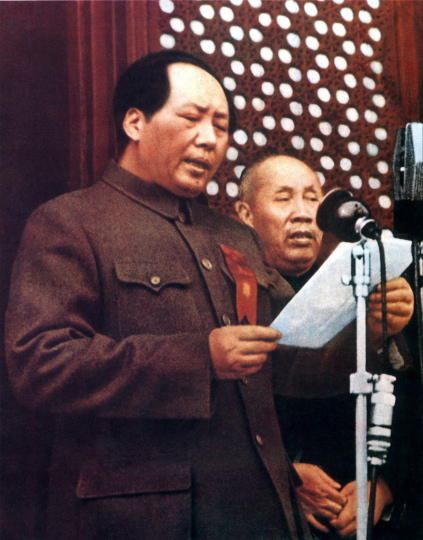
  69. Mao Zedong proclaiming the People's Republic from Tiananmen on 1 October 1949

    Story 46 of 57 · Modern China

    States and rulers

    The People's Republic is founded

    After victory in the civil war, Mao Zedong proclaimed the People's Republic of China. The Nationalists retreated to Taiwan.

    Next story1949 · The Nationalist government moves to Taipei
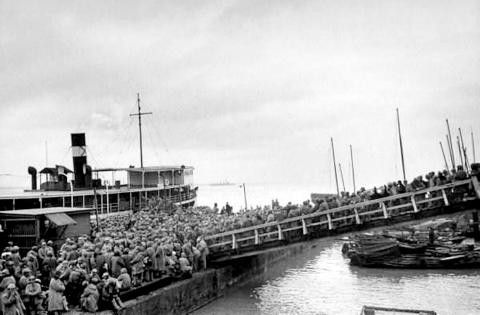
  70. Members of the Republic of China Army board a ship bound for Taiwan in 1949

    Story 47 of 57 · Modern China

    States and rulers

    The Nationalist government moves to Taipei

    As the Communists won the civil war, the Nationalist government relocated to Taipei, still claiming to represent all of China.

    Next story1959 · The Great Famine
  71. A backyard furnace for making steel during the Great Leap Forward, 1958

    Story 48 of 57 · Modern China

    Disasters and epidemics

    The Great Famine

    The Great Leap Forward forced peasants into communes and backyard steel-making, while officials exaggerated harvests and grain was taken away. Tens of millions starved.

    Next story1966 · The Cultural Revolution
  72. The Cultural Revolution

    Story 49 of 57 · Modern China

    People and rights

    The Cultural Revolution

    Mao launched a campaign against 'bourgeois' enemies. Red Guards persecuted teachers, officials and families, destroyed temples and books, and hundreds of thousands or more died.

    Next story1976 · The Gang of Four is arrested
  73. "Gang of Four" on trial in November 1980

    Story 50 of 57 · Modern China

    States and rulers

    The Gang of Four is arrested

    A month after Mao died, his widow Jiang Qing and three allies were arrested. The Cultural Revolution was over.

    Next story1978 · Reform and opening up
  74. Statue of Deng Xiaoping in Shenzhen, the first special economic zone

    Story 51 of 57 · Modern China

    Science, trade and industry

    Reform and opening up

    Under Deng Xiaoping, China let farmers sell their surplus, opened special economic zones and welcomed foreign investment.

    Next story1989 · Tiananmen Square
  75. Tiananmen Square

    Story 52 of 57 · Modern China

    People and rights

    Tiananmen Square

    Students and workers occupied Tiananmen Square calling for reform. On the night of 3 to 4 June the army cleared the area, killing hundreds, perhaps thousands.

    Next story1989 · A new leader after Tiananmen
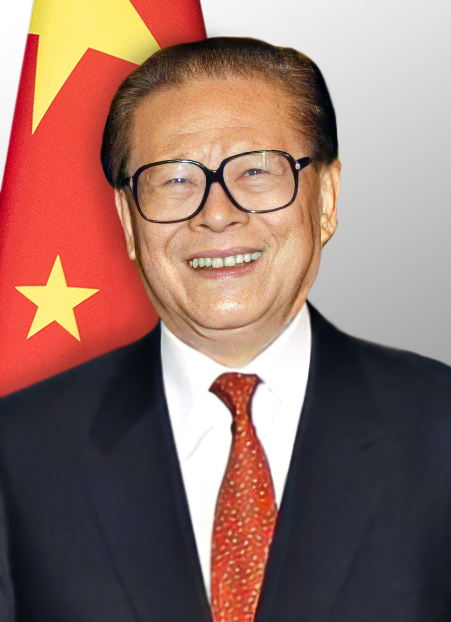
  76. Jiang Zemin: General Secretary of the Chinese Communist Party (1989-2002)

    Story 53 of 57 · Modern China

    States and rulers

    A new leader after Tiananmen

    The party removed its general secretary Zhao Ziyang for opposing martial law, and chose the Shanghai party chief Jiang Zemin.

    Next story1997 · Hong Kong returns to China
  77. Golden Bauhinia Square in Hong Kong, which marks the handover

    Story 54 of 57 · Modern China

    States and rulers

    Hong Kong returns to China

    Britain handed Hong Kong back to China under 'one country, two systems', promising it a high degree of autonomy for 50 years.

    Next story2008 · The Sichuan earthquake
  78. Map showing the epicentre of the 2008 Sichuan earthquake with no labels

    Story 55 of 57 · Modern China

    Disasters and epidemics

    The Sichuan earthquake

    A magnitude 7.9 earthquake killed about 87,000 people, including thousands of children in poorly built schools.

    Next story2012 · Xi Jinping becomes party leader
  79. Portrait of Xi Jinping

    Story 56 of 57 · Modern China

    States and rulers

    Xi Jinping becomes party leader

    Xi took over as general secretary from Hu Jintao and became president in 2013. A 2018 amendment removed the two-term limit on the presidency.

    Next story2019 · COVID-19 is identified
  80. An empty bridge in Wuhan during the lockdown of 2020

    Story 57 of 57 · Modern China

    Disasters and epidemics

    COVID-19 is identified

    A new coronavirus was identified in Wuhan. The city was locked down in January 2020, but the virus spread around the world.

    NextJourney's end

Journey complete

You travelled 752,019 years

57 stories, c. 750,000 BC to 2019. More events are being researched and added.

Choose another countryBack to the start