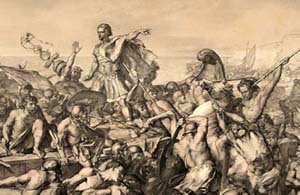
Prise de la Bastille by Jean-Pierre-Louis-Laurent Houel

All countries

France

Ice Age cave painters, Gauls and Romans, the Frankish and French kings, the Revolution, two world wars and the Fifth Republic.

A kingdom from 987; a republic, for the fifth time, since 1958

Stories
62
Distance
36,018 years
Route
c. 34,000 BC to 2019
  1. Prehistoric France14 stories
  2. Roman Gaul and the Franks10 stories
  3. Kingdom of France9 stories
  4. Revolutions and empires12 stories
  5. Modern France17 stories
Begin the journey

The storming of the Bastille, 1789. Image: Jean-Pierre Houël · Public domain, via Wikimedia Commons

  1. Chapter I

    Prehistoric France

    14 stories in this chapter

  2. The Chauvet Cave paintings

    Story 1 of 62 · Prehistoric France

    Culture and faith

    The Chauvet Cave paintings

    Ice Age artists painted lions, rhinoceroses, horses and mammoths on the walls of a cave in the Ardèche gorge, some more than 30,000 years ago.

    Next storyc. 15,000 BC · Lascaux
  3. About 19,000 years later

    c. 34,000 BC to c. 15,000 BC

  4. Aurochs, horses and deer painted on a cave

    Story 2 of 62 · Prehistoric France

    Culture and faith

    Lascaux

    Hunters painted hundreds of animals, including aurochs, horses and deer, in the chambers of Lascaux cave. Teenagers found the cave in 1940.

    Next storyc. 6000 BC · Cardial pottery along the Mediterranean
  5. About 9,000 years later

    c. 15,000 BC to c. 6000 BC

  6. Cardium pottery of Tajos de Cacín cave ( Granada , Spain )

    Story 3 of 62 · Prehistoric France

    Culture and faith

    Cardial pottery along the Mediterranean

    Pots impressed with cockle shells spread from Greece in the seventh millennium BC. By about 5500 BC the Cardial culture had spread 2,000 km, from the Gulf of Genoa to Portugal, in perhaps 100 to 200 years.

    Next storyc. 5500 BC · The Linear Pottery farmers
  7. About 500 years later

    c. 6000 BC to c. 5500 BC

  8. The Linear Pottery farmers

    Story 4 of 62 · Prehistoric France

    Culture and faith

    The Linear Pottery farmers

    From about 5500 to 4500 BC early farmers of the Linear Pottery culture spread over 1,500 km along European rivers in about 360 years, from the middle Danube to the Rhine and the Elbe, keeping cattle and pigs.

    Next storyc. 4500 BC · The Carnac stones
  9. About 1,000 years later

    c. 5500 BC to c. 4500 BC

  10. France, Morbihan, Carnac, Kermario

    Story 5 of 62 · Prehistoric France

    Culture and faith

    The Carnac stones

    Neolithic people set up more than 3,000 standing stones in long rows near Carnac.

    Next storyc. 4100 BC · Gavrinis
  11. About 400 years later

    c. 4500 BC to c. 4100 BC

  12. Gavrinis, island in Morbihan, noted megalithic cairn and carvings

    Story 6 of 62 · Prehistoric France

    Culture and faith

    Gavrinis

    On a small island in the Gulf of Morbihan, the Gavrinis passage tomb was built around 4200 to 4000 BC. Carved stones line its passage, and it is one of the oldest surviving buildings in the world.

    Next storyc. 2800 BC · The Bell Beaker culture
  13. About 1,300 years later

    c. 4100 BC to c. 2800 BC

  14. Bell Beaker artefacts, Spain

    Story 7 of 62 · Prehistoric France

    Culture and faith

    The Bell Beaker culture

    From as early as 2800 BC, people across Europe, from Iberia to the British Isles and beyond, made inverted-bell drinking cups, used at the start of the European Bronze Age.

    Next storyc. 2150 BC · The Armorican barrows
  15. About 650 years later

    c. 2800 BC to c. 2150 BC

  16. The Little Mount, Arzhon Rewis, Morbihan, Brittany

    Story 8 of 62 · Prehistoric France

    Culture and faith

    The Armorican barrows

    In western Brittany, Bronze Age chiefs of about 2150 to 1350 BC were buried under more than a thousand mounds. Some of their richly furnished graves match those of the Wessex culture in England.

    Next storyc. 1300 BC · The Atlantic Bronze Age
  17. About 850 years later

    c. 2150 BC to c. 1300 BC

  18. Bronze age hut reproduction, in Campo Lameiro , Galicia

    Story 9 of 62 · Prehistoric France

    Culture and faith

    The Atlantic Bronze Age

    Atlantic Bronze Age is a loose label for the period from about 1300 to 700 BC along the Atlantic coast of Britain, France, Ireland, Portugal and Spain. The term has never been formally defined.

    Next storyc. 1300 BC · The Urnfield culture
  19. Distribution map of the Urnfield culture (Late Bronze Age) in Europe

    Story 10 of 62 · Prehistoric France

    Culture and faith

    The Urnfield culture

    Across central Europe, the Urnfield people cremated their dead and buried the ashes in urns between about 1300 and 750 BC. By the end of the second millennium BC the tradition reached the Pyrenees and northern Italy.

    Next storyc. 800 BC · The Hallstatt culture
  20. About 500 years later

    c. 1300 BC to c. 800 BC

  21. The Hallstatt culture

    Story 11 of 62 · Prehistoric France

    Culture and faith

    The Hallstatt culture

    Salt miners in the Alps grew rich on the trade in salt. They gave their name to the early Iron Age in Europe.

    Next storyc. 600 BC · The Greeks found Marseille
  22. About 200 years later

    c. 800 BC to c. 600 BC

  23. Silver drachm (so-called heavy drachm) of Massilia, ca

    Story 12 of 62 · Prehistoric France

    Science, trade and industry

    The Greeks found Marseille

    Greek settlers from Phocaea in Asia Minor founded a trading colony at Massalia.

    Next storyc. 500 BC · La Tène
  24. DO NOT USE THIS MAP It was made in 2005 as a first draft and doesn't remotely satisfy inclusion criteria for Wikipedia

    Story 13 of 62 · Prehistoric France

    Culture and faith

    La Tène

    A site on Lake Neuchâtel gave its name to the later Iron Age culture of the Celts.

    Next storyc. 325 BC · Pytheas sails to the north
  25. About 180 years later

    c. 500 BC to c. 325 BC

  26. Statue of Pythéas made by Auguste Ottin (1811-1890) and placed on the facade of the Palais de la Bourse in Marseille

    Story 14 of 62 · Prehistoric France

    People and rights

    Pytheas sails to the north

    The Greek explorer Pytheas of Massalia made a voyage to northern Europe about 325 BC and explored the coast of Britain. His own account is lost and survives only in the writings of others.

    Next story55 BC · Caesar invades Britain
  27. About 270 years later

    c. 325 BC to 55 BC

  28. Chapter II

    Roman Gaul and the Franks

    10 stories in this chapter

  29. Caesar invades Britain

    Story 15 of 62 · Roman Gaul and the Franks

    War and conflict

    Caesar invades Britain

    In 55 and 54 BC Julius Caesar crossed to Britain during his Gallic Wars. The first landing, with two legions, achieved little beyond a foothold in Kent. The second invasion was larger.

    Next story52 BC · The siege of Alesia
  30. Sketch of the Battle of Alesia , drawn by Muriel Gottrop in December 2004

    Story 16 of 62 · Roman Gaul and the Franks

    War and conflict

    The siege of Alesia

    Julius Caesar besieged the Gaulish leader Vercingetorix at Alesia and beat off a huge relief army. Vercingetorix surrendered.

    Next story1st century · The Pont du Gard
  31. Pont du Gard , in Vers-Pont-du-Gard, Gard department, South France

    Story 17 of 62 · Roman Gaul and the Franks

    Science, trade and industry

    The Pont du Gard

    In the 1st century AD the Romans built an aqueduct bridge over the Gardon to carry water more than 50 km to their colony at Nîmes. It is one of the best preserved Roman aqueduct bridges and a World Heritage Site since 1985.

    Next story260 · The Gallic Empire
  32. About 260 years later

    1st century to 260

  33. Story 18 of 62 · Roman Gaul and the Franks

    States and rulers

    The Gallic Empire

    In 260, in the crisis of the third century, the general Postumus set up a breakaway state that at its height held Gaul, Germania, Britain and Hispania. Emperor Aurelian took it back after the battle of Châlons in 274.

    Next story451 · Attila is stopped in Gaul
  34. About 190 years later

    260 to 451

  35. "The Huns at the Battle of Chalons" from page 135 of A Popular History of France From The Earliest Times Volume I of VI ( en:Project Gutenberg e-text)

    Story 19 of 62 · Roman Gaul and the Franks

    War and conflict

    Attila is stopped in Gaul

    On 20 June 451 a Roman and Visigothic army under Aetius and King Theodoric I fought Attila's Huns on the Catalaunian Plains. It was one of the last great campaigns of the Western Roman Empire.

    Next storyc. 496 · Clovis is baptised
  36. Jean Du Tillet - Clovis Ier roy crestien - Recueil des rois de France - Bibliothèque nationale de France

    Story 20 of 62 · Roman Gaul and the Franks

    States and rulers

    Clovis is baptised

    Clovis, king of the Franks, who united most of Gaul, was baptised a Catholic Christian at Reims.

    Next story732 · The Battle of Tours
  37. About 240 years later

    c. 496 to 732

  38. Charles Martel in the Battle of Tours

    Story 21 of 62 · Roman Gaul and the Franks

    War and conflict

    The Battle of Tours

    Frankish forces under Charles Martel defeated an Umayyad army that had advanced from Spain.

    Next story751 · The Carolingians take the throne
  39. A nineteenth-century painting of Pepin the Short

    Story 22 of 62 · Roman Gaul and the Franks

    States and rulers

    The Carolingians take the throne

    Pepin, with the pope's blessing, deposed the last Merovingian king and became king of the Franks.

    Next story800 · Charlemagne is crowned emperor
  40. Appartient à l’ensemble documentaire : MonnFrCar

    Story 23 of 62 · Roman Gaul and the Franks

    States and rulers

    Charlemagne is crowned emperor

    Pope Leo III crowned the Frankish king emperor in Rome on Christmas Day. It revived the imperial title in the West for the first time since 476.

    Next story843 · The Treaty of Verdun
  41. The Treaty of Verdun

    Story 24 of 62 · Roman Gaul and the Franks

    States and rulers

    The Treaty of Verdun

    Charlemagne's grandsons split his empire into three kingdoms. Charles the Bald's western kingdom became France.

    Next story987 · Hugh Capet becomes king
  42. Chapter III

    Kingdom of France

    9 stories in this chapter

  43. The Coronation of Hugues Capet (941-996), 988

    Story 25 of 62 · Kingdom of France

    States and rulers

    Hugh Capet becomes king

    Nobles elected Hugh Capet king of the West Franks, beginning the Capetian dynasty.

    Next story1163 · Notre-Dame is begun
  44. About 180 years later

    987 to 1163

  45. Cathedral Notre Dame de Paris, West view, Paris, France

    Story 26 of 62 · Kingdom of France

    Culture and faith

    Notre-Dame is begun

    Bishop Maurice de Sully began a great Gothic cathedral on the Île de la Cité. It took about a century to build.

    Next story1209 · The Albigensian Crusade
  46. The Albigensian Crusade

    Story 27 of 62 · Kingdom of France

    War and conflict

    The Albigensian Crusade

    The pope called a crusade against the Cathars of southern France. Northern French knights massacred towns such as Béziers.

    Next story1428 · Joan of Arc at Orléans
  47. 220 years later

    1209 to 1428

  48. Jules Eugène Lenepveu's painting of Joan of Arc at the siege of Orléans

    Story 28 of 62 · Kingdom of France

    War and conflict

    Joan of Arc at Orléans

    A teenage peasant, Joan of Arc, rallied the French army to lift the English siege of Orléans in the Hundred Years' War.

    Next story1572 · The St Bartholomew's Day massacre
  49. La topographie, manipulée, est adaptée au désir de montrer ensemble les lieux principaux de cette tragédie

    Story 29 of 62 · Kingdom of France

    War and conflict

    The St Bartholomew's Day massacre

    Catholic mobs, encouraged by the court, killed thousands of Protestant Huguenots in Paris and other cities during the Wars of Religion.

    Next story1589 · The Bourbons inherit the throne
  50. Portrait of Henry IV of France by Frans Pourbus the Younger

    Story 30 of 62 · Kingdom of France

    States and rulers

    The Bourbons inherit the throne

    The last Valois king was murdered, and the Protestant Henry of Navarre became king. He turned Catholic in 1593 to end the Wars of Religion.

    Next story1598 · The Edict of Nantes
  51. Édit de Nantes, première page

    Story 31 of 62 · Kingdom of France

    Culture and faith

    The Edict of Nantes

    King Henry IV granted Protestants freedom of worship, ending decades of religious war.

    Next story1659 · The Treaty of the Pyrenees
  52. Traité des Pyrénées signé par le cardinal Mazarin et Luis de Haro et mettant fin à la guerre entre la France et l'Espagne

    Story 32 of 62 · Kingdom of France

    States and rulers

    The Treaty of the Pyrenees

    France and Spain divided Catalonia. Andorra stayed on the border, with France inheriting the Count of Foix's role.

    Next story1682 · The court moves to Versailles
  53. Aerial view of the Domain of Versailles , France

    Story 33 of 62 · Kingdom of France

    States and rulers

    The court moves to Versailles

    Louis XIV moved his court and government to a vast palace outside Paris, keeping the nobility close and dazzled.

    Next story1789 · The storming of the Bastille
  54. Chapter IV

    Revolutions and empires

    12 stories in this chapter

  55. Prise de la Bastille by Jean-Pierre-Louis-Laurent Houel

    Story 34 of 62 · Revolutions and empires

    States and rulers

    The storming of the Bastille

    Crowds seized the royal fortress and prison of the Bastille in Paris.

    Next story1789 · The Rights of Man
  56. La Déclaration des droits de l'homme et du citoyen de 1789, une des premières consécration juridiques de droits fondamentaux

    Story 35 of 62 · Revolutions and empires

    People and rights

    The Rights of Man

    The National Assembly declared that men are born free and equal in rights, with liberty, property and freedom of speech and religion.

    Next story1792 · France becomes a republic
  57. Map of the French departments in 1801

    Story 36 of 62 · Revolutions and empires

    States and rulers

    France becomes a republic

    On its first day the new National Convention abolished the monarchy. The republic lasted until Napoleon was made emperor.

    Next story1793 · Louis XVI is guillotined
  58. Execution of Louis XVI – copperplate engraving 1793

    Story 37 of 62 · Revolutions and empires

    States and rulers

    Louis XVI is guillotined

    The Convention convicted the king of treason and he was executed in Paris. The monarchies of Europe went to war with France.

    Next story1794 · Robespierre falls
  59. Valery Jacobi (1834-1902) Ninth Thermidor

    Story 38 of 62 · Revolutions and empires

    States and rulers

    Robespierre falls

    Fearing arrest, members of the Convention turned on Robespierre, who was guillotined the next day. The Terror came to an end.

    Next story1799 · Napoleon seizes power
  60. Bonaparte before the Council of Five Hundred at Saint-Cloud, painted by Bouchot

    Story 39 of 62 · Revolutions and empires

    States and rulers

    Napoleon seizes power

    Napoleon Bonaparte and his allies dissolved the Directory and made him First Consul, with sweeping powers.

    Next story1804 · Napoleon is crowned
  61. Napoleon is crowned

    Story 40 of 62 · Revolutions and empires

    States and rulers

    Napoleon is crowned

    Napoleon Bonaparte crowned himself emperor of the French in Notre-Dame, with the pope looking on.

    Next story1814 · The Bourbons return
  62. Engraving of Louis XVIII's carriage and mounted escort arriving at the Paris Hôtel de Ville on 29 August 1814

    Story 41 of 62 · Revolutions and empires

    States and rulers

    The Bourbons return

    After Napoleon's abdication, the allies put Louis XVIII on the throne. A short return of Napoleon in 1815 ended at Waterloo.

    Next story1830 · Charles X is overthrown
  63. Fighting in the rue de Rohan, Paris, on 29 July 1830

    Story 42 of 62 · Revolutions and empires

    States and rulers

    Charles X is overthrown

    Three days of street fighting in Paris drove out Charles X. His cousin Louis-Philippe became 'King of the French'.

    Next story1848 · The Second Republic
  64. Lamartine rejecting the red flag in front of the Paris town hall, a painting by Philippoteaux

    Story 43 of 62 · Revolutions and empires

    States and rulers

    The Second Republic

    A revolt in Paris forced Louis-Philippe to abdicate. The new republic gave all men the vote and elected Louis-Napoleon Bonaparte president.

    Next story1848 · Slavery is abolished
  65. François-Auguste Biard's painting of the proclamation of the abolition of slavery in the French colonies

    Story 44 of 62 · Revolutions and empires

    People and rights

    Slavery is abolished

    Days after a revolution set up the Second Republic, a decree drafted by Victor Schœlcher abolished slavery in all French colonies.

    Next story1852 · Napoleon III becomes emperor
  66. Engraving of soldiers drawn up in a square before the Paris Hôtel de Ville for the proclamation of the Second Empire in December 1852

    Story 45 of 62 · Revolutions and empires

    States and rulers

    Napoleon III becomes emperor

    Louis-Napoleon seized power in a coup the year before. A plebiscite then made him emperor.

    Next story1870 · The Third Republic is proclaimed
  67. Chapter V

    Modern France

    17 stories in this chapter

  68. A painting of the end of the Empire in the Corps législatif on 4 September 1870

    Story 46 of 62 · Modern France

    States and rulers

    The Third Republic is proclaimed

    After Napoleon III was captured at Sedan, crowds in Paris proclaimed a republic. It lasted 70 years.

    Next story1871 · The Paris Commune
  69. The Paris Commune

    Story 47 of 62 · Modern France

    War and conflict

    The Paris Commune

    After France's defeat by Prussia, radicals and workers took over Paris and ran it as a commune, until the army stormed the city and killed thousands.

    Next story1889 · The Eiffel Tower
  70. Eiffel Tower , seen from the Champ de Mars , Paris, France

    Story 48 of 62 · Modern France

    Science, trade and industry

    The Eiffel Tower

    Gustave Eiffel's company finished a 300-metre wrought-iron tower for the World's Fair marking the centenary of the Revolution.

    Next story1894 · The Dreyfus affair
  71. "The traitor: Degradation of Alfred Dreyfus, degradation in the Morland Court of the military school in Paris"

    Story 49 of 62 · Modern France

    People and rights

    The Dreyfus affair

    A Jewish army captain, Alfred Dreyfus, was wrongly convicted of spying. Émile Zola's open letter 'J'accuse' split France between his defenders and opponents.

    Next story1895 · The first cinema show
  72. Portrait of the Lumière brothers

    Story 50 of 62 · Modern France

    Culture and faith

    The first cinema show

    The Lumière brothers showed ten short films to a paying audience in a Paris café.

    Next story1916 · The Battle of Verdun
  73. The Battle of Verdun

    Story 51 of 62 · Modern France

    War and conflict

    The Battle of Verdun

    German and French armies fought for ten months around the fortress city of Verdun. About 300,000 soldiers were killed.

    Next story1940 · Pétain takes power at Vichy
  74. Marshal Pétain and the first government of the Vichy regime, July 1940

    Story 52 of 62 · Modern France

    States and rulers

    Pétain takes power at Vichy

    After France's defeat, deputies voted full powers to Marshal Pétain, ending the Third Republic. His 'French State' collaborated with Germany.

    Next story1944 · D-Day
  75. A LCVP (Landing Craft, Vehicle, Personnel) from the U.S

    Story 53 of 62 · Modern France

    War and conflict

    D-Day

    About 156,000 Allied soldiers landed on the beaches of Normandy, the largest seaborne invasion in history.

    Next story1944 · Paris is liberated
  76. A photograph from the liberation of Paris in August 1944

    Story 54 of 62 · Modern France

    States and rulers

    Paris is liberated

    Resistance fighters and the Free French Second Armoured Division freed Paris. Charles de Gaulle led a provisional government.

    Next story1946 · The Fourth Republic
  77. Green : Fourth French Republic Lime : French possessions

    Story 55 of 62 · Modern France

    States and rulers

    The Fourth Republic

    A new constitution gave parliament most of the power. Governments fell every six months on average.

    Next story1958 · The Fifth Republic
  78. President Charles de Gaulle in 1966

    Story 56 of 62 · Modern France

    States and rulers

    The Fifth Republic

    Amid the crisis of the Algerian War, Charles de Gaulle returned to power and a new constitution gave France a strong president.

    Next story1968 · May 68
  79. Posters on a wall - the remnants of May 1968

    Story 57 of 62 · Modern France

    People and rights

    May 68

    Student protests in Paris grew into a general strike of some 10 million workers that nearly brought down de Gaulle.

    Next story1969 · De Gaulle resigns
  80. Map of the results of the French constitutional referendum in 1969

    Story 58 of 62 · Modern France

    States and rulers

    De Gaulle resigns

    The president lost a referendum on reforming the Senate and regions and stepped down at once, ten years after founding the Fifth Republic.

    Next story1981 · The left wins the presidency
  81. Résultats du second tour de l'élection présidentielle de 1981 en Ille-et-Vilaine par commune

    Story 59 of 62 · Modern France

    States and rulers

    The left wins the presidency

    Mitterrand unseated the sitting president, Giscard d'Estaing. For the first time since the Fifth Republic began in 1958, the presidency went to the left.

    Next story2015 · The Paris attacks
  82. Camion de police devant la salle du Bataclan, le lendemain des attaques terroristes

    Story 60 of 62 · Modern France

    War and conflict

    The Paris attacks

    Islamic State gunmen and suicide bombers attacked a concert hall, cafés and the national stadium, killing 130 people.

    Next story2017 · Macron wins without the old parties
  83. Map of the results by department and region of the first round of the 2017 french presidential election

    Story 61 of 62 · Modern France

    States and rulers

    Macron wins without the old parties

    Emmanuel Macron, who had founded his own movement a year before, beat Marine Le Pen. Neither of the two traditional parties reached the second round.

    Next story2019 · Notre-Dame burns
  84. Fire in the roof of Notre Dame photographed from Square René-Viviani at 19:51

    Story 62 of 62 · Modern France

    Disasters and epidemics

    Notre-Dame burns

    Fire destroyed the roof and spire of Notre-Dame cathedral. It was rebuilt and reopened in December 2024.

    NextJourney's end

Journey complete

You travelled 36,018 years

62 stories, c. 34,000 BC to 2019. More events are being researched and added.

Choose another countryBack to the start