People atop the Berlin Wall near the Brandenburg Gate on 9 November 1989

All countries

Germany

Ice Age carvers, Romans and Franks, the Reformation and the Thirty Years' War, unification, two world wars, division and reunification.

Unified in 1871; reunited on 3 October 1990

Stories
56
Distance
602,024 years
Route
c. 600,000 BC to 2025
  1. Early peoples13 stories
  2. Romans and Franks5 stories
  3. The Holy Roman Empire6 stories
  4. Unification and empire9 stories
  5. Weimar and Nazi Germany6 stories
  6. Divided and reunited17 stories
Begin the journey

The Wall falls, 1989. Image: Sue Ream , photographer (San Francisco, California) · CC BY 3.0, via Wikimedia Commons

  1. Chapter I

    Early peoples

    13 stories in this chapter

  2. Mandible (lower jaw) of the type specimen of Homo heidelbergenis from Mauer near Heidelberg, Germany (replika, Museum Mauer)

    Story 1 of 56 · Early peoples

    People and rights

    The Mauer jaw

    A sand-pit worker found the lower jaw of an early human in 1907. It became the type fossil of Homo heidelbergensis, about 600,000 years old.

    Next storyc. 38,000 BC · The Venus of Hohle Fels
  3. About 562,000 years later

    c. 600,000 BC to c. 38,000 BC

  4. Paleolithic figure Venus of Hohlefels (of mammooth ivory)

    Story 2 of 56 · Early peoples

    Culture and faith

    The Venus of Hohle Fels

    An Ice Age carver made a small figure of a woman from mammoth ivory, found in a cave in the Swabian Jura in 2008 near flutes made of bird bone.

    Next storyc. 5500 BC · The Linear Pottery farmers
  5. About 32,500 years later

    c. 38,000 BC to c. 5500 BC

  6. The Linear Pottery farmers

    Story 3 of 56 · Early peoples

    Culture and faith

    The Linear Pottery farmers

    From about 5500 to 4500 BC early farmers of the Linear Pottery culture spread over 1,500 km along European rivers in about 360 years, from the middle Danube to the Rhine and the Elbe, keeping cattle and pigs.

    Next storyc. 4600 BC · The Rössen culture
  7. About 900 years later

    c. 5500 BC to c. 4600 BC

  8. The Rössen culture

    Story 4 of 56 · Early peoples

    Culture and faith

    The Rössen culture

    The Rössen culture was a Central European culture of the middle Neolithic, between about 4600 and 4300 BC, named after Rössen in Germany.

    Next storyc. 4100 BC · The Funnelbeaker culture
  9. About 500 years later

    c. 4600 BC to c. 4100 BC

  10. Map of the Funnelbeaker culture , based on map printed at page 596 in Encyclopedia of Indo-European Culture , which was edited by J

    Story 5 of 56 · Early peoples

    Culture and faith

    The Funnelbeaker culture

    From about 4100 to 2800 BC the Funnelbeaker culture lived across north-central Europe. Later it shrank to northern Germany and southern Scandinavia, and the Single Grave culture replaced it.

    Next storyc. 3400 BC · The Globular Amphora culture
  11. About 700 years later

    c. 4100 BC to c. 3400 BC

  12. Map of the Globular Amphora culture , based on map printed at page 226 in Encyclopedia of Indo-European Culture , which was edited by J

    Story 6 of 56 · Early peoples

    Culture and faith

    The Globular Amphora culture

    From about 3400 to 2800 BC the Globular Amphora culture lived in Central Europe. It replaced most of the eastern and southern Funnelbeaker groups, and its origin is still debated.

    Next storyc. 2900 BC · The Corded Ware culture
  13. About 500 years later

    c. 3400 BC to c. 2900 BC

  14. Map of the Corded Ware culture

    Story 7 of 56 · Early peoples

    Culture and faith

    The Corded Ware culture

    A broad horizon of pottery decorated with cord impressions spread across Europe from about 2900 to 2300 BC. Some DNA studies suggest it came from steppe herders who moved north and mixed with local farmers.

    Next storyc. 2800 BC · The Bell Beaker culture
  15. Bell Beaker artefacts, Spain

    Story 8 of 56 · Early peoples

    Culture and faith

    The Bell Beaker culture

    From as early as 2800 BC, people across Europe, from Iberia to the British Isles and beyond, made inverted-bell drinking cups, used at the start of the European Bronze Age.

    Next storyc. 2300 BC · The Únětice culture
  16. About 500 years later

    c. 2800 BC to c. 2300 BC

  17. Nebra sky disk

    Story 9 of 56 · Early peoples

    Culture and faith

    The Únětice culture

    The Únětice culture, from about 2300 to 1600 BC, marks the start of the Bronze Age in central Europe. It is named after a cemetery of more than 50 burials found in Bohemia in 1879.

    Next storyc. 1600 BC · The Nebra sky disc
  18. About 700 years later

    c. 2300 BC to c. 1600 BC

  19. Nebra Sky Disc - State Museum of Prehistory in Halle

    Story 10 of 56 · Early peoples

    Culture and faith

    The Nebra sky disc

    A bronze disc inlaid with gold shows the Sun or Moon, a crescent and stars, including the Pleiades.

    Next storyc. 1300 BC · The Urnfield culture
  20. About 300 years later

    c. 1600 BC to c. 1300 BC

  21. Distribution map of the Urnfield culture (Late Bronze Age) in Europe

    Story 11 of 56 · Early peoples

    Culture and faith

    The Urnfield culture

    Across central Europe, the Urnfield people cremated their dead and buried the ashes in urns between about 1300 and 750 BC. By the end of the second millennium BC the tradition reached the Pyrenees and northern Italy.

    Next storyc. 800 BC · The Hallstatt culture
  22. About 500 years later

    c. 1300 BC to c. 800 BC

  23. The Hallstatt culture

    Story 12 of 56 · Early peoples

    Culture and faith

    The Hallstatt culture

    Salt miners in the Alps grew rich on the trade in salt. They gave their name to the early Iron Age in Europe.

    Next storyc. 500 BC · La Tène
  24. About 300 years later

    c. 800 BC to c. 500 BC

  25. DO NOT USE THIS MAP It was made in 2005 as a first draft and doesn't remotely satisfy inclusion criteria for Wikipedia

    Story 13 of 56 · Early peoples

    Culture and faith

    La Tène

    A site on Lake Neuchâtel gave its name to the later Iron Age culture of the Celts.

    Next story9 · The Teutoburg Forest
  26. About 510 years later

    c. 500 BC to 9

  27. Chapter II

    Romans and Franks

    5 stories in this chapter

  28. The Teutoburg Forest

    Story 14 of 56 · Romans and Franks

    War and conflict

    The Teutoburg Forest

    Germanic tribes led by Arminius ambushed and destroyed three Roman legions under Varus.

    Next story260 · The Gallic Empire
  29. About 250 years later

    9 to 260

  30. Story 15 of 56 · Romans and Franks

    States and rulers

    The Gallic Empire

    In 260, in the crisis of the third century, the general Postumus set up a breakaway state that at its height held Gaul, Germania, Britain and Hispania. Emperor Aurelian took it back after the battle of Châlons in 274.

    Next storyc. 796 · Charlemagne's chapel at Aachen
  31. About 540 years later

    260 to c. 796

  32. Panoramablick vom Rathaus

    Story 16 of 56 · Romans and Franks

    Culture and faith

    Charlemagne's chapel at Aachen

    Charlemagne built an eight-sided chapel at his palace in Aachen, where he was buried and German kings were crowned for 600 years.

    Next story800 · Charlemagne is crowned emperor
  33. Appartient à l’ensemble documentaire : MonnFrCar

    Story 17 of 56 · Romans and Franks

    States and rulers

    Charlemagne is crowned emperor

    Pope Leo III crowned the Frankish king emperor in Rome on Christmas Day. It revived the imperial title in the West for the first time since 476.

    Next story955 · The Battle of Lechfeld
  34. About 160 years later

    800 to 955

  35. The Battle of Lechfeld on an illustration in Sigmund Meisterlin' codex about the history of Nuremberg

    Story 18 of 56 · Romans and Franks

    War and conflict

    The Battle of Lechfeld

    King Otto I defeated the raiding Magyars near Augsburg. Seven years later the pope crowned him emperor.

    Next story962 · Otto I is crowned emperor
  36. Chapter III

    The Holy Roman Empire

    6 stories in this chapter

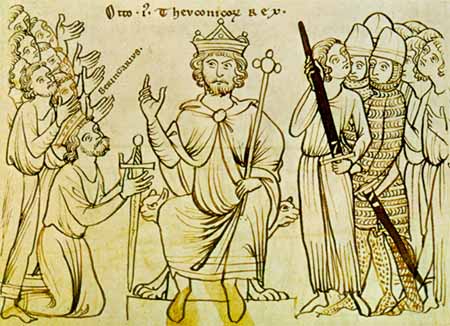
  37. Otto I , Holy Roman Emperor , Manuscriptum Mediolanense (Chronicle of Bishop Otto of Freising), ca

    Story 19 of 56 · The Holy Roman Empire

    States and rulers

    Otto I is crowned emperor

    The Saxon king, who had beaten the Magyars at the Lechfeld, was crowned in Rome. The Holy Roman Empire, centred on Germany, lasted until 1806.

    Next storyc. 1455 · Gutenberg's printing press
  38. About 490 years later

    962 to c. 1455

  39. The Gutenberg Bible [Bible, Latin Vulgate

    Story 20 of 56 · The Holy Roman Empire

    Science, trade and industry

    Gutenberg's printing press

    Johannes Gutenberg printed the Bible in Mainz with movable metal type.

    Next story1517 · Luther's Ninety-five Theses
  40. Luther's Ninety-five Theses

    Story 21 of 56 · The Holy Roman Empire

    Culture and faith

    Luther's Ninety-five Theses

    The monk Martin Luther wrote his Ninety-five Theses against the sale of indulgences. He was excommunicated, and translated the Bible into German.

    Next story1618 · The Thirty Years' War
  41. The Thirty Years' War

    Story 22 of 56 · The Holy Roman Empire

    War and conflict

    The Thirty Years' War

    A war between Catholic and Protestant states drew in most of Europe. Fighting, famine and plague killed perhaps a third of Germany's people.

    Next story1648 · The princes become sovereign
  42. Gerard ter Borch's painting of the oath that ratified the Peace of Münster in 1648

    Story 23 of 56 · The Holy Roman Empire

    States and rulers

    The princes become sovereign

    The treaties that ended the Thirty Years' War let the German states make their own alliances. The emperor was left with little real power.

    Next story1701 · Prussia becomes a kingdom
  43. Colour print of Frederick I in a red coat and ermine robe placing the crown on his own head at his coronation in 1701

    Story 24 of 56 · The Holy Roman Empire

    States and rulers

    Prussia becomes a kingdom

    The elector of Brandenburg, ruling from Berlin, took the title 'King in Prussia'. His kingdom grew into the strongest German state.

    Next story1806 · Liechtenstein becomes sovereign
  44. Chapter IV

    Unification and empire

    9 stories in this chapter

  45. Liechtenstein becomes sovereign

    Story 25 of 56 · Unification and empire

    States and rulers

    Liechtenstein becomes sovereign

    Napoleon's Confederation of the Rhine ended the Holy Roman Empire and made Liechtenstein sovereign.

    Next story1806 · The Holy Roman Empire ends
  46. Holy Roman Empire 1789

    Story 26 of 56 · Unification and empire

    States and rulers

    The Holy Roman Empire ends

    Under pressure from Napoleon, Francis II gave up the imperial crown after more than 800 years.

    Next story1813 · The Battle of the Nations
  47. Historic map of the battle of the nations by Leipzig (18.10.1813)

    Story 27 of 56 · Unification and empire

    War and conflict

    The Battle of the Nations

    Russian, Prussian, Austrian and Swedish armies defeated Napoleon in the largest battle in Europe before the First World War.

    Next story1815 · The German Confederation
  48. Map of the German Confederation in 1820

    Story 28 of 56 · Unification and empire

    States and rulers

    The German Confederation

    After Napoleon, 39 states formed a loose league led by Austria and Prussia.

    Next story1848 · The Frankfurt Parliament
  49. Paulskirche zur Zeit der Nationalversammlung

    Story 29 of 56 · Unification and empire

    States and rulers

    The Frankfurt Parliament

    After revolutions across Germany, an elected parliament met in Frankfurt to write a constitution for a united, liberal Germany. The Prussian king refused its crown.

    Next story1864 · The Second Schleswig War
  50. The Battle of Dybbøl , 1864

    Story 30 of 56 · Unification and empire

    War and conflict

    The Second Schleswig War

    Prussia and Austria defeated Denmark and took Schleswig-Holstein.

    Next story1866 · Unification
  51. The third version of the proclamation of Prussian king Wilhelm I as German Emperor at Versailles, by Anton von Werner

    Story 31 of 56 · Unification and empire

    States and rulers

    Unification

    Prussia's chancellor Otto von Bismarck united the German states through three wars, and the King of Prussia was proclaimed German emperor.

    Next story1886 · The first motor car
  52. The first motor car

    Story 32 of 56 · Unification and empire

    Science, trade and industry

    The first motor car

    Carl Benz patented a three-wheeled vehicle powered by a petrol engine. In 1888 Bertha Benz drove it 106 kilometres to prove it worked.

    Next story1890 · Bismarck is dismissed
  53. Otto von Bismarck-Schönhausen ( Reichskanzler of Germany , 1871 - 1890), after his resignation in 1890

    Story 33 of 56 · Unification and empire

    States and rulers

    Bismarck is dismissed

    Kaiser Wilhelm II, then 31, forced out the chancellor who had dominated German politics for 28 years.

    Next story1918 · The Weimar Republic
  54. Chapter V

    Weimar and Nazi Germany

    6 stories in this chapter

  55. Friedrich Ebert, the first president of the Weimar Republic

    Story 34 of 56 · Weimar and Nazi Germany

    States and rulers

    The Weimar Republic

    After defeat in the First World War, the Kaiser abdicated and a republic was proclaimed. Its constitution was drawn up in Weimar in 1919.

    Next story1923 · Hyperinflation
  56. 50 Billionen Mark Der höchste Wert, der von den Städten Eschweiler und Stolberg ausgegeben wurde

    Story 35 of 56 · Weimar and Nazi Germany

    Science, trade and industry

    Hyperinflation

    By November 1923 a loaf of bread cost about 200 billion marks. Savings were wiped out.

    Next story1933 · The Nazis take power
  57. Firefighters at the burning Reichstag, 27 February 1933, which the Nazis used to suspend civil rights

    Story 36 of 56 · Weimar and Nazi Germany

    States and rulers

    The Nazis take power

    Adolf Hitler was appointed chancellor. Within months the Nazis had banned other parties and opened the first concentration camps.

    Next story1934 · Hitler becomes Führer
  58. President of Germany Paul von Hindenburg pictured in 1933

    Story 37 of 56 · Weimar and Nazi Germany

    States and rulers

    Hitler becomes Führer

    When President Hindenburg died, Hitler merged the offices of president and chancellor and took the title Führer. Soldiers swore an oath to him personally.

    Next story1938 · Kristallnacht
  59. German citizens look the other way on nov

    Story 38 of 56 · Weimar and Nazi Germany

    People and rights

    Kristallnacht

    Nazi mobs burned synagogues, smashed Jewish shops and homes and killed scores of Jews; about 30,000 Jewish men were sent to camps.

    Next story1942 · The Wannsee Conference
  60. The Wannsee Conference

    Story 39 of 56 · Weimar and Nazi Germany

    People and rights

    The Wannsee Conference

    Senior Nazi officials met at a villa by the Wannsee lake to organise the murder of Europe's Jews.

    Next story1945 · The bombing of Dresden
  61. Chapter VI

    Divided and reunited

    17 stories in this chapter

  62. For documentary purposes the German Federal Archive often retained the original image captions , which may be erroneous, biased, obsolete or politically extreme

    Story 40 of 56 · Divided and reunited

    War and conflict

    The bombing of Dresden

    British and American bombers set off a firestorm in Dresden, killing about 25,000 people.

    Next story1945 · The Allies take over the government
  63. The four Allied commanders-in-chief in Germany standing together in 1945

    Story 41 of 56 · Divided and reunited

    States and rulers

    The Allies take over the government

    Britain, France, the United States and the Soviet Union assumed supreme authority and divided Germany into zones.

    Next story1948 · The Berlin Airlift
  64. For documentary purposes the German Federal Archive often retained the original image captions , which may be erroneous, biased, obsolete or politically extreme

    Story 42 of 56 · Divided and reunited

    War and conflict

    The Berlin Airlift

    The Soviet Union cut road and rail links to West Berlin. Western air forces flew in food and coal for nearly a year.

    Next story1949 · The Federal Republic is founded
  65. The Basic Law of the Federal Republic of Germany, 1949

    Story 43 of 56 · Divided and reunited

    States and rulers

    The Federal Republic is founded

    The Basic Law, written in Bonn, created a democratic West German state. Konrad Adenauer became its first chancellor in September.

    Next story1949 · The German Democratic Republic is founded
  66. Wilhelm Pieck and Otto Grotewohl laughing together at the founding of the German Democratic Republic in October 1949

    Story 44 of 56 · Divided and reunited

    States and rulers

    The German Democratic Republic is founded

    The Soviet zone became a one-party socialist state with East Berlin as its capital.

    Next story1961 · The Berlin Wall
  67. Berlin Wall at the Potsdamer Platz 1975 looking southeastwards into Stresemannstraße

    Story 45 of 56 · Divided and reunited

    States and rulers

    The Berlin Wall

    East Germany sealed off West Berlin overnight with barbed wire, then a concrete wall. More than 100 people were killed trying to cross it.

    Next story1969 · Brandt becomes chancellor
  68. Willy Brandt, the first Social Democratic chancellor of West Germany

    Story 46 of 56 · Divided and reunited

    States and rulers

    Brandt becomes chancellor

    Willy Brandt became the first Social Democrat to lead West Germany and began a policy of opening to the East.

    Next story1982 · Kohl takes power by a no-confidence vote
  69. Depicted person: Helmut Kohl – Chancellor of West Germany and reunified Germany (1982–1998)

    Story 47 of 56 · Divided and reunited

    States and rulers

    Kohl takes power by a no-confidence vote

    Helmut Schmidt lost office when the Free Democrats switched sides. It is the only time a chancellor has been replaced by a constructive vote of no confidence.

    Next story1989 · The Pan-European Picnic
  70. Gedenkstätte Paneuropäisches Picknick: Grenzübergang St.Margarethen (Bgld) / Sopronköhida - Blick nach Österreich

    Story 48 of 56 · Divided and reunited

    States and rulers

    The Pan-European Picnic

    Hundreds of East Germans crossed the border gate into Austria during a picnic, the first mass escape.

    Next story1989 · Honecker is forced out
  71. Portrait of Erich Honecker, leader of East Germany

    Story 49 of 56 · Divided and reunited

    States and rulers

    Honecker is forced out

    After weeks of mass protests, East Germany's own ruling party removed its leader of 18 years. The Wall fell three weeks later.

    Next story1989 · The Wall falls
  72. People atop the Berlin Wall near the Brandenburg Gate on 9 November 1989

    Story 50 of 56 · Divided and reunited

    States and rulers

    The Wall falls

    After weeks of protest, East Germany opened its border, and crowds poured through and climbed the Wall.

    Next story1990 · East Germany's only free election
  73. Results of the 1990 East German general election by district

    Story 51 of 56 · Divided and reunited

    States and rulers

    East Germany's only free election

    Voters chose a parliament that voted to end the state. It merged with the Federal Republic on 3 October.

    Next story1990 · Reunification
  74. For documentary purposes the German Federal Archive often retained the original image captions , which may be erroneous, biased, obsolete or politically extreme

    Story 52 of 56 · Divided and reunited

    States and rulers

    Reunification

    East Germany joined the Federal Republic, and Germany was one country again.

    Next story1998 · Schröder replaces Kohl
  75. Gerhard Schröder(cropped from the original)

    Story 53 of 56 · Divided and reunited

    States and rulers

    Schröder replaces Kohl

    Social Democrats and Greens beat Helmut Kohl after 16 years. It was the first time voters ousted a sitting government completely.

    Next story2005 · Merkel becomes chancellor
  76. 41st Munich Security Conference 2005: Impressions at the conference:The General Secretary of the United Nations, Kofi A

    Story 54 of 56 · Divided and reunited

    States and rulers

    Merkel becomes chancellor

    A close election led to a grand coalition. Angela Merkel became the first woman and the first East German to lead the government, and stayed for 16 years.

    Next story2021 · Scholz leads a three-party government
  77. Auszählung Bundestagswahl 2021 in der Messe Berlin

    Story 55 of 56 · Divided and reunited

    States and rulers

    Scholz leads a three-party government

    Merkel stepped down. Social Democrats, Greens and Free Democrats formed the first coalition of those three parties.

    Next story2025 · Merz becomes chancellor
  78. Reichstag building, seen from west

    Story 56 of 56 · Divided and reunited

    States and rulers

    Merz becomes chancellor

    After the three-party coalition broke up, an early election in February led to a deal between the conservatives and the Social Democrats. Friedrich Merz won the chancellor's vote on a second ballot.

    NextJourney's end

Journey complete

You travelled 602,024 years

56 stories, c. 600,000 BC to 2025. More events are being researched and added.

Choose another countryBack to the start