Taj Mahal , Agra , India

All countries

India

Rock painters and Indus cities, the Buddha and Ashoka, sultans and Mughals, British rule, partition and the world's largest democracy.

Independent from Britain since 15 August 1947; a republic since 1950

Stories
58
Distance
10,024 years
Route
c. 8000 BC to 2025
  1. Early India8 stories
  2. Ancient India9 stories
  3. Medieval India5 stories
  4. Mughal and British India18 stories
  5. Independent India18 stories
Begin the journey

The Taj Mahal, 1632. Image: Yann, edited by King of Hearts and Jbarta · CC BY-SA 3.0, via Wikimedia Commons

  1. Chapter I

    Early India

    8 stories in this chapter

  2. Looks pretty new right? This painting is from 1500-2000BC

    Story 1 of 58 · Early India

    Culture and faith

    The Bhimbetka rock paintings

    In rock shelters in the forests of central India, people painted hunting scenes, dancers and animals over thousands of years; the oldest are about 10,000 years old.

    Next story7th millennium BC · Rice at Lahuradewa
  3. About 1,000 years later

    c. 8000 BC to 7th millennium BC

  4. Story 2 of 58 · Early India

    Science, trade and industry

    Rice at Lahuradewa

    At Lahuradewa in the upper Ganges plain, rice grains have been dated to the 7th millennium BC, among the oldest known anywhere, though it is debated whether they were farmed or gathered wild. The site also has the subcontinent's oldest known pottery.

    Next storyc. 4600 BC · Rakhigarhi
  5. About 2,400 years later

    7th millennium BC to c. 4600 BC

  6. This is one of the Skeletons found from Rakhigarhi which is in Haryana which was a site of the Harappan Civilizations

    Story 3 of 58 · Early India

    Culture and faith

    Rakhigarhi

    Rakhigarhi in Haryana was settled before the Harappan era, from about 4600 BC or earlier, and grew into one of the five largest cities of the Indus civilisation.

    Next storyc. 3000 BC · Burzahom in Kashmir
  7. About 1,600 years later

    c. 4600 BC to c. 3000 BC

  8. Black earthenware from Burzahom, Kashmir

    Story 4 of 58 · Early India

    Culture and faith

    Burzahom in Kashmir

    At Burzahom in the Kashmir Valley, a village stood from about 3000 to 1000 BC. Excavations show four phases of culture there, and traces of wheat.

    Next storyc. 2650 BC · Dholavira, a planned Indus city
  9. About 350 years later

    c. 3000 BC to c. 2650 BC

  10. Circular houses with central support are characteristic of Dholavira

    Story 5 of 58 · Early India

    Science, trade and industry

    Dholavira, a planned Indus city

    Dholavira in Kutch was built to a geometric plan of citadel, middle town and lower town, between two storm-water channels. It flourished from about 2650 BC and was named a World Heritage Site in 2021.

    Next storyc. 2200 BC · The dock at Lothal
  11. About 450 years later

    c. 2650 BC to c. 2200 BC

  12. This is a photo of ASI monument number

    Story 6 of 58 · Early India

    Science, trade and industry

    The dock at Lothal

    A town of the Indus Valley Civilisation in Gujarat built a large brick basin that many archaeologists see as the world's earliest known dock, linked to the sea by a river channel.

    Next storyc. 1900 BC · The Cemetery H culture
  13. About 300 years later

    c. 2200 BC to c. 1900 BC

  14. Pottery urns from Harappa (Cemetery H period, c

    Story 7 of 58 · Early India

    Culture and faith

    The Cemetery H culture

    Named after a burial ground in area H at Harappa, this Bronze Age culture of the Punjab lasted from about 1900 to 1300 BC. It is seen as a late regional form of the Indus civilisation and also linked with the Indo-Aryan migrations.

    Next storyc. 1500 BC · The Rigveda
  15. About 400 years later

    c. 1900 BC to c. 1500 BC

  16. Rigveda MS in Sanskrit on paper, India, early 19th c., 4 vols., 795 ff

    Story 8 of 58 · Early India

    Culture and faith

    The Rigveda

    Priests composed the hymns of the Rigveda in early Vedic Sanskrit, probably between 1500 and 1000 BC, and passed them on by memory with great exactness. It is the oldest of the four Vedas.

    Next storyc. 600 BC · The sixteen Mahajanapadas
  17. About 900 years later

    c. 1500 BC to c. 600 BC

  18. Chapter II

    Ancient India

    9 stories in this chapter

  19. Map of places mentioned in ancient Buddhist Texts (like Anguttara Nikaya), Ramayana and Mahabharata

    Story 9 of 58 · Ancient India

    States and rulers

    The sixteen Mahajanapadas

    Sixteen kingdoms and republics, from Gandhara in the north-west to Magadha in the east, shared the northern Indian plains from the 6th to the 4th century BC. Cities grew again, and Magadha later became the core of the Maurya Empire.

    Next story5th century BC · The Buddha's enlightenment
  20. The Buddha's enlightenment

    Story 10 of 58 · Ancient India

    Culture and faith

    The Buddha's enlightenment

    According to tradition, Siddhartha Gautama meditated under a pipal tree at Bodh Gaya until he reached enlightenment and became the Buddha.

    Next storyc. 321 BC · Chandragupta founds the Maurya Empire
  21. About 180 years later

    5th century BC to c. 321 BC

  22. Maximum extent of the Maurya Empire, as shown by the location of Ashoka's inscriptions , and visualized by A.S.I

    Story 11 of 58 · Ancient India

    States and rulers

    Chandragupta founds the Maurya Empire

    Chandragupta overthrew the Nanda kings of Magadha and went on to rule most of the subcontinent. His grandson Ashoka ruled from Afghanistan to Karnataka.

    Next storyc. 261 BC · The Kalinga War
  23. Ashoka's rock edict at Dhauli, near the Kalinga battlefield

    Story 12 of 58 · Ancient India

    War and conflict

    The Kalinga War

    The Mauryan emperor Ashoka conquered Kalinga on the east coast. His own edicts say 100,000 were killed and 150,000 deported.

    Next storyc. 200 BC · The Indo-Greek kingdoms
  24. Story 13 of 58 · Ancient India

    States and rulers

    The Indo-Greek kingdoms

    About 200 BC Demetrius I of Bactria invaded the north-west of the subcontinent and founded Greek-ruled kingdoms, with royal seats at places such as Taxila. The best known Indo-Greek king, Menander I, ruled from Sakala, now Sialkot.

    Next storyc. 30 · The Kushan Empire
  25. About 230 years later

    c. 200 BC to c. 30

  26. Story 14 of 58 · Ancient India

    States and rulers

    The Kushan Empire

    The Yuezhi founded the Kushan Empire early in the 1st century AD in Bactria. It spread over Afghanistan, Pakistan and northern India, and under Kanishka its rulers backed Buddhism, which travelled from Gandhara over the Karakoram to China.

    Next storyc. 320 · The Gupta Empire
  27. About 290 years later

    c. 30 to c. 320

  28. Map of the Gupta Empire Reference: Map of the Gupta Empire circa 420 CE, according to Joseph E

    Story 15 of 58 · Ancient India

    States and rulers

    The Gupta Empire

    Chandragupta I founded a dynasty whose kings ruled northern India in an age remembered for mathematics, astronomy, literature and art.

    Next storyc. 427 · Nalanda
  29. Nalanda is an ancient center of higher learning in Bihar, India from 427 to 1197

    Story 16 of 58 · Ancient India

    Culture and faith

    Nalanda

    A great Buddhist monastery and university at Nalanda drew students from across Asia to study philosophy, medicine and astronomy. Invaders burned it around 1200.

    Next story499 · Aryabhata's astronomy
  30. Description of Kuttaka as given by Aryabhata in Aryabhatiya in Devanagari

    Story 17 of 58 · Ancient India

    Science, trade and industry

    Aryabhata's astronomy

    At 23, the mathematician Aryabhata wrote a work in verse explaining a place-value number system, estimating pi and arguing that the Earth spins on its axis.

    Next storyc. 750 · The Pala Empire
  31. About 250 years later

    499 to c. 750

  32. Chapter III

    Medieval India

    5 stories in this chapter

  33. Map of the Pala Empire

    Story 18 of 58 · Medieval India

    States and rulers

    The Pala Empire

    Buddhist kings ruled Bengal and Bihar for four centuries. They built the great monastery at Paharpur.

    Next story1010 · The Brihadeeswarar Temple
  34. About 260 years later

    c. 750 to 1010

  35. The Brihadeeswarar Temple

    Story 19 of 58 · Medieval India

    Culture and faith

    The Brihadeeswarar Temple

    The Chola king Rajaraja I completed a temple to Shiva whose granite tower rises about 66 metres.

    Next story1206 · The Delhi Sultanate
  36. About 200 years later

    1010 to 1206

  37. The Qutb Minar in Delhi, begun by the first sultan

    Story 20 of 58 · Medieval India

    States and rulers

    The Delhi Sultanate

    Turkic generals who had conquered northern India founded a sultanate in Delhi that ruled much of the subcontinent under five dynasties.

    Next story1336 · The Vijayanagara Empire
  38. The Virupaksha Temple at Hampi, seen from Hemakuta Hill

    Story 21 of 58 · Medieval India

    States and rulers

    The Vijayanagara Empire

    Two brothers founded a Hindu kingdom in the south whose capital, Vijayanagara, at Hampi, became one of the largest cities in the world. It was sacked in 1565.

    Next story1498 · Vasco da Gama reaches India
  39. About 160 years later

    1336 to 1498

  40. Vasco da Gama, anonymous portrait, c

    Story 22 of 58 · Medieval India

    Science, trade and industry

    Vasco da Gama reaches India

    The Portuguese captain Vasco da Gama sailed around Africa and landed near Calicut, a rich spice port.

    Next story1526 · The first Battle of Panipat
  41. Chapter IV

    Mughal and British India

    18 stories in this chapter

  42. Battle of Panipat (20 April 1526)

    Story 23 of 58 · Mughal and British India

    War and conflict

    The first Battle of Panipat

    Babur, a descendant of Timur and Genghis Khan, used cannon and cavalry to defeat the much larger army of the Delhi sultan Ibrahim Lodi.

    Next story1526 · Babur founds the Mughal Empire
  43. The Mughal Empire in 1700

    Story 24 of 58 · Mughal and British India

    States and rulers

    Babur founds the Mughal Empire

    Babur won at Panipat and founded a dynasty that at its height ruled almost the whole subcontinent. The British formally ended it after the rebellion of 1857.

    Next story1540 · Sher Shah drives out the Mughals
  44. Painting of Sher Shah Suri (alt

    Story 25 of 58 · Mughal and British India

    States and rulers

    Sher Shah drives out the Mughals

    After beating Humayun at Kannauj, the Afghan ruler took Delhi and governed for five years. He built the Grand Trunk Road and a land-tax system the Mughals later used.

    Next story1632 · The Taj Mahal
  45. Taj Mahal , Agra , India

    Story 26 of 58 · Mughal and British India

    Culture and faith

    The Taj Mahal

    The Mughal emperor Shah Jahan built a white marble mausoleum for his wife Mumtaz Mahal, who died in childbirth.

    Next story1674 · Shivaji is crowned
  46. Map of India around 1760, when Maratha power was at its height

    Story 27 of 58 · Mughal and British India

    States and rulers

    Shivaji is crowned

    At Raigad fort Shivaji took the title Chhatrapati, proclaiming an independent Maratha kingdom. His successors later dominated much of India.

    Next story1757 · The Battle of Plassey
  47. The Battle of Plassey

    Story 28 of 58 · Mughal and British India

    War and conflict

    The Battle of Plassey

    Robert Clive's East India Company army, helped by bribed generals, defeated the Nawab of Bengal.

    Next story1765 · The Company becomes ruler of Bengal
  48. The pictures made by Indian artists for the British in India are called Company paintings

    Story 29 of 58 · Mughal and British India

    States and rulers

    The Company becomes ruler of Bengal

    After its victory at Buxar the East India Company obtained from the Mughal emperor the right to collect taxes in Bengal, Bihar and Odisha.

    Next story1770 · The Bengal famine of 1770
  49. "Distressed Natives Going to the Relief Works The Famine in Bengal

    Story 30 of 58 · Mughal and British India

    Disasters and epidemics

    The Bengal famine of 1770

    A famine, made worse by East India Company taxes, killed around a third of the people of Bengal.

    Next story1814 · The Anglo-Nepalese War
  50. One of the Commanders of the Gurkha troops during the Nepal Wars

    Story 31 of 58 · Mughal and British India

    War and conflict

    The Anglo-Nepalese War

    The Gurkhas fought the East India Company to a draw, but Nepal lost a third of its land and kept its independence.

    Next story1857 · The rebellion of 1857
  51. Map, "North India: The Mutiny 1857-9" from "The Cambridge Modern History Atlas"

    Story 32 of 58 · Mughal and British India

    War and conflict

    The rebellion of 1857

    Indian soldiers of the East India Company mutinied at Meerut, and the rising spread across the north. Both sides committed massacres before the British regained control.

    Next story1858 · The Crown takes over from the Company
  52. The printed text of Queen Victoria's 1858 proclamation, which took over the government of India from the East India Company

    Story 33 of 58 · Mughal and British India

    States and rulers

    The Crown takes over from the Company

    After the rebellion of 1857 Parliament abolished the East India Company. Britain ruled India directly through a viceroy.

    Next story1864 · The Duar War
  53. The Duar War

    Story 34 of 58 · Mughal and British India

    War and conflict

    The Duar War

    Britain fought a short war for the foothills and took them in the Treaty of Sinchula.

    Next story1885 · The Congress is founded
  54. Open hand election symbol of INC in centre of Indian tricolours

    Story 35 of 58 · Mughal and British India

    States and rulers

    The Congress is founded

    Seventy-two delegates met in Bombay and founded the Indian National Congress.

    Next story1905 · The partition of Bengal
  55. Map of "Bengal" from Pope, G

    Story 36 of 58 · Mughal and British India

    States and rulers

    The partition of Bengal

    Lord Curzon split Bengal in two. Protests forced Britain to reverse it.

    Next story1910 · The Treaty of Punakha
  56. Punakha Dzong, Bhutan

    Story 37 of 58 · Mughal and British India

    States and rulers

    The Treaty of Punakha

    Britain agreed to let Bhutan keep its internal independence, and Bhutan agreed to be guided by Britain on foreign affairs. India later took over that role.

    Next story1919 · The Amritsar massacre
  57. Narrow passage from Jalianwala Bagh Garden through which people entered the park on the massacre of 13th April 1919

    Story 38 of 58 · Mughal and British India

    People and rights

    The Amritsar massacre

    British troops under General Reginald Dyer fired without warning on a crowd in a walled garden in Amritsar, killing hundreds.

    Next story1930 · The Salt March
  58. Gandhi at Dandi, South Gujarat, picking salt on the beach at the end of the Salt March, 5 April 1930

    Story 39 of 58 · Mughal and British India

    People and rights

    The Salt March

    Mahatma Gandhi walked 385 kilometres to the sea at Dandi and made salt, defying a British tax. Tens of thousands were jailed in the campaign that followed.

    Next story1943 · The Bengal famine
  59. Bengali famine 1943

    Story 40 of 58 · Mughal and British India

    Disasters and epidemics

    The Bengal famine

    War, a cyclone, rice imports cut off by Japan's conquest of Burma, and failures of the colonial government led to famine in Bengal. About 3 million people died.

    Next story1947 · Independence and Partition
  60. Chapter V

    Independent India

    18 stories in this chapter

  61. Jawaharlal Nehru addressing the nation from the Red Fort on Independence Day, 15 August 1947

    Story 41 of 58 · Independent India

    States and rulers

    Independence and Partition

    British India became independent as two countries, India and Pakistan. As millions crossed the new borders, violence killed perhaps a million people.

    Next story1947 · The princely states join India
  62. Map of the British Indian Empire from Imperial Gazetteer of India

    Story 42 of 58 · Independent India

    States and rulers

    The princely states join India

    Over 560 princely states, covering two-fifths of the land, were persuaded or pressed to join India. Hyderabad was taken by force in 1948.

    Next story1948 · Gandhi is assassinated
  63. Crowds at Mahatma Gandhi's funeral in January 1948

    Story 43 of 58 · Independent India

    States and rulers

    Gandhi is assassinated

    A Hindu nationalist shot Mahatma Gandhi at a prayer meeting.

    Next story1950 · India becomes a republic
  64. A meeting of the Constituent Assembly of India

    Story 44 of 58 · Independent India

    States and rulers

    India becomes a republic

    India's constitution, drafted by a committee led by B. R. Ambedkar, came into force, making it a republic with votes for every adult.

    Next story1964 · Nehru dies
  65. Jawaharlal Nehru, the first Prime Minister of India

    Story 45 of 58 · Independent India

    States and rulers

    Nehru dies

    India's first prime minister died in office after seventeen years. Lal Bahadur Shastri succeeded him.

    Next story1966 · Indira Gandhi becomes prime minister
  66. Indian Prime Minister Indira Gandhi at the Carlyle Hotel, New York City, March 31 1966

    Story 46 of 58 · Independent India

    States and rulers

    Indira Gandhi becomes prime minister

    After Shastri died in Tashkent, the Congress party chose Nehru's daughter. She became India's first woman prime minister.

    Next story1975 · The Emergency
  67. Black-and-white portrait of Indira Gandhi, photographed in 1977

    Story 47 of 58 · Independent India

    States and rulers

    The Emergency

    After a court found against her election, Indira Gandhi declared a state of emergency, jailed her opponents, censored newspapers and ruled by decree.

    Next story1977 · Congress loses for the first time
  68. Morarji Desai, Former Prime Minister of the Republic of India

    Story 48 of 58 · Independent India

    States and rulers

    Congress loses for the first time

    Voters threw out Indira Gandhi. Morarji Desai's Janata Party formed the first non-Congress government.

    Next story1984 · Indira Gandhi is assassinated
  69. Indira Gandhi - The location where Indira Gandhi was shot

    Story 49 of 58 · Independent India

    States and rulers

    Indira Gandhi is assassinated

    Her Sikh bodyguards shot her after the army raid on the Golden Temple. Riots killed thousands of Sikhs in Delhi. Her son Rajiv became prime minister that day.

    Next story1984 · The Bhopal gas disaster
  70. Exterior view of the Union Carbide pesticide factory in Bhopal, India, scene of the world's worst industrial disaster in 1985

    Story 50 of 58 · Independent India

    Disasters and epidemics

    The Bhopal gas disaster

    Toxic gas leaked from a Union Carbide pesticide plant over sleeping neighbourhoods, killing thousands within days.

    Next story1991 · The 1991 reforms
  71. Manmohan Singh, who as finance minister led the 1991 reforms

    Story 51 of 58 · Independent India

    Science, trade and industry

    The 1991 reforms

    Facing a debt crisis, Finance Minister Manmohan Singh cut tariffs, licences and controls and opened India to foreign investment.

    Next story1998 · The BJP forms a government
  72. Secretary of Defense Donald H

    Story 52 of 58 · Independent India

    States and rulers

    The BJP forms a government

    A coalition led by Atal Bihari Vajpayee took power. Two months later India tested nuclear weapons.

    Next story2004 · Sonia Gandhi declines the premiership
  73. Portrait of Sonia Gandhi in a teal sari, with greenery behind her

    Story 53 of 58 · Independent India

    States and rulers

    Sonia Gandhi declines the premiership

    Congress and its allies unexpectedly beat Vajpayee. Sonia Gandhi stepped aside and Manmohan Singh became prime minister.

    Next story2004 · The Indian Ocean tsunami
  74. The tsunami striking the coast on 26 December 2004

    Story 54 of 58 · Independent India

    Disasters and epidemics

    The Indian Ocean tsunami

    A tsunami set off by an earthquake off Sumatra struck India's south-east coast and islands, killing more than 10,000 people in India among about 230,000 around the Indian Ocean.

    Next story2014 · Modi's BJP wins a majority
  75. Map of India showing when each state voted in the 2014 general election

    Story 55 of 58 · Independent India

    States and rulers

    Modi's BJP wins a majority

    The BJP won the first single-party majority in 30 years, and Narendra Modi became prime minister.

    Next story2023 · Chandrayaan-3 sets off for the Moon
  76. The Vikram lander on the Moon, photographed by its rover

    Story 56 of 58 · Independent India

    Science, trade and industry

    Chandrayaan-3 sets off for the Moon

    India's Chandrayaan-3 was launched from Sriharikota. On 23 August it landed near the Moon's south pole, the first spacecraft to land in that region.

    Next story2024 · The BJP loses its majority
  77. Map of India's constituencies coloured orange and blue by the alliance that won each seat in the 2024 election

    Story 57 of 58 · Independent India

    States and rulers

    The BJP loses its majority

    The BJP fell short of 272 seats and relied on allies to form Modi's third government.

    Next story2025 · The May 2025 conflict
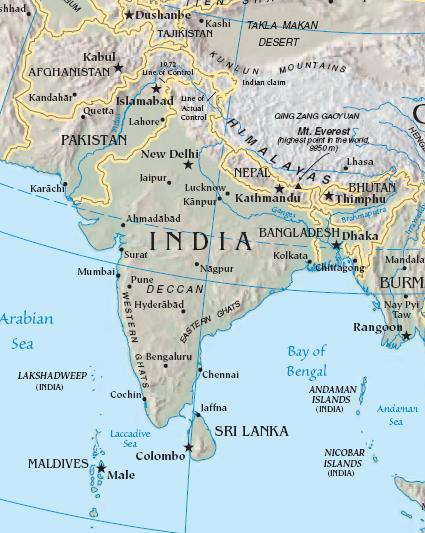
  78. Map of South Asia showing the Kashmir region at the centre of India and Pakistan's disputes

    Story 58 of 58 · Independent India

    War and conflict

    The May 2025 conflict

    After an attack on tourists at Pahalgam, India struck sites in Pakistan. Four days of drone, missile and air strikes followed until a ceasefire on 10 May.

    NextJourney's end

Journey complete

You travelled 10,024 years

58 stories, c. 8000 BC to 2025. More events are being researched and added.

Choose another countryBack to the start