

People and rights
Java Man
Homo erectus lived on Java for over a million years. Eugène Dubois found the first fossils by the Solo River in 1891.
- Where
- Trinil, Java
Why it matters
It was the first early human found outside Europe.

Java Man and the oldest cave art, Buddhist and Hindu kingdoms, sultanates and the Dutch spice trade, and the world's largest island nation.
Declared independence on 17 August 1945
Borobudur, c. 800. Image: Gunawan Kartapranata · Public domain, via Wikimedia Commons
Chapter I

Story 1 of 40 · Early humans
People and rights
Homo erectus lived on Java for over a million years. Eugène Dubois found the first fossils by the Solo River in 1891.
About 940,000 years later
c. 1,000,000 BC to c. 60,000 BC

Story 2 of 40 · Early humans
People and rights
A species of tiny humans, about a metre tall, lived on the island of Flores until about 50,000 years ago.
About 16,500 years later
c. 60,000 BC to c. 43,500 BC

Story 3 of 40 · Early humans
Culture and faith
In a limestone cave on Sulawesi, an artist painted a life-size warty pig in red ochre about 45,500 years ago.
About 40,500 years later
c. 43,500 BC to c. 3000 BC

Story 4 of 40 · Early humans
Science, trade and industry
Austronesian peoples spread by sea out of Taiwan between about 3000 and 1500 BC. They reached the Batanes Islands in the northern Philippines by about 2200 BC and later settled Island Southeast Asia, Polynesia and Madagascar.
About 2,000 years later
c. 3000 BC to c. 1000 BC

Story 5 of 40 · Early humans
Culture and faith
Bronze Age farmers in the Red River valley cast great bronze drums decorated with boats, birds and dancers.
About 700 years later
c. 1000 BC to c. 300 BC

Story 6 of 40 · Early humans
Culture and faith
In Bali, the Moon of Pejeng is the largest single-cast bronze kettle drum in the world. The Đông Sơn people are said to have made it around 300 BC, and local people regard it as sacred.
About 660 years later
c. 300 BC to c. 358

Story 7 of 40 · Early humans
States and rulers
In western Java, an early kingdom shaped by Indian culture left the oldest inscriptions found on the island, under its ruler Purnawarman. They are put at about 358 AD.
About 290 years later
c. 358 to c. 650
Chapter II

Story 8 of 40 · Hindu and Buddhist kingdoms
States and rulers
A maritime kingdom based in Sumatra controlled the Strait of Malacca and became a great centre of Buddhist learning.
About 150 years later
c. 650 to c. 800

Story 9 of 40 · Hindu and Buddhist kingdoms
Culture and faith
The Sailendra dynasty built Borobudur, a vast stepped Buddhist monument with more than 2,600 carved relief panels.
About 490 years later
c. 800 to 1293

Story 10 of 40 · Hindu and Buddhist kingdoms
States and rulers
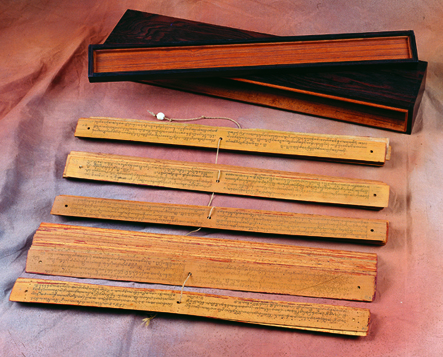
From East Java, the Hindu-Buddhist kingdom of Majapahit claimed authority across much of today's Indonesia, under the prime minister Gajah Mada.
Story 11 of 40 · Hindu and Buddhist kingdoms
Science, trade and industry
The Javanese court poem Nagarakretagama of 1365 lists Timor among the lands linked to Majapahit. It is one of the earliest written mentions of the island.
Chapter III

Story 12 of 40 · Sultanates and the Dutch
Culture and faith
Demak became the first Muslim state on Java. According to tradition, the Wali Songo, nine saints, spread Islam across the island.

Story 13 of 40 · Sultanates and the Dutch
States and rulers
Under Sultan Agung it controlled most of Java and fought the Dutch at Batavia.

Story 14 of 40 · Sultanates and the Dutch
States and rulers
The VOC had its own army, could make treaties and wage war. It ruled parts of the archipelago for nearly two centuries.

Story 15 of 40 · Sultanates and the Dutch
Science, trade and industry
Jan Pieterszoon Coen of the Dutch East India Company destroyed the town of Jayakarta and built Batavia as the company's Asian headquarters.

Story 16 of 40 · Sultanates and the Dutch
War and conflict
To control the world's only source of nutmeg, Coen's forces killed, enslaved or drove out most of the Banda islanders.
About 180 years later
1621 to 1800

Story 17 of 40 · Sultanates and the Dutch
States and rulers
The bankrupt VOC was dissolved and its possessions became a Dutch colony, ruled from Batavia.

Story 18 of 40 · Sultanates and the Dutch
Disasters and epidemics
The largest volcanic eruption in recorded history killed tens of thousands on Sumbawa and nearby islands.

Story 19 of 40 · Sultanates and the Dutch
States and rulers
Britain and the Netherlands divided Southeast Asia. Malaya went to Britain and Sumatra to the Dutch.

Story 20 of 40 · Sultanates and the Dutch
War and conflict
Prince Diponegoro led a war against Dutch rule. About 200,000 Javanese died before he was tricked into talks and arrested.

Story 21 of 40 · Sultanates and the Dutch
Disasters and epidemics
Krakatoa exploded with a sound heard nearly 5,000 kilometres away. Tsunamis killed more than 36,000 people.

Story 22 of 40 · Sultanates and the Dutch
People and rights
Young nationalists declared one motherland, one nation and one language: Indonesia.
Story 23 of 40 · Sultanates and the Dutch
War and conflict
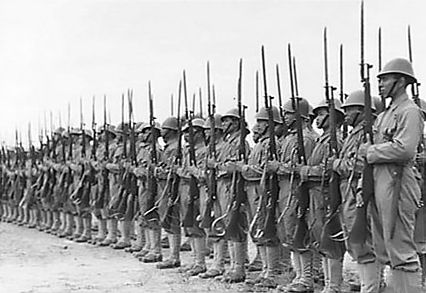
Japan conquered the Dutch colony. Millions of Indonesians were forced into labour and many died of famine.
Chapter IV

Story 24 of 40 · Independent Indonesia
War and conflict
The Netherlands tried to retake its colony. After four years of fighting and diplomacy, it handed over sovereignty.

Story 25 of 40 · Independent Indonesia
States and rulers
Two days after Japan surrendered, Sukarno and Mohammad Hatta read out a short declaration of independence.

Story 26 of 40 · Independent Indonesia
States and rulers
After four years of war and diplomacy, the Dutch recognised Indonesia as a federation. It became a unitary republic in August 1950.

Story 27 of 40 · Independent Indonesia
States and rulers
Leaders of 29 newly independent Asian and African countries met in Bandung to oppose colonialism.

Story 28 of 40 · Independent Indonesia
States and rulers
By decree Sukarno restored the 1945 constitution, dissolved the elected assembly and gave himself strong powers.

Story 29 of 40 · Independent Indonesia
States and rulers
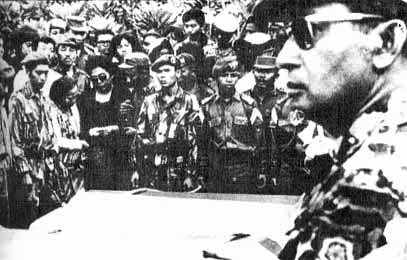
Officers kidnapped and killed six generals. General Suharto crushed the plot and blamed the Communists, and mass killings followed.
Story 30 of 40 · Independent Indonesia
People and rights
After a failed coup blamed on the Communist Party, the army and militias killed perhaps 500,000 or more suspected communists. General Suharto took power.

Story 31 of 40 · Independent Indonesia
States and rulers
Sukarno was stripped of power, and Suharto took over. He ruled for 31 years.

Story 32 of 40 · Independent Indonesia
Science, trade and industry
Thailand floated its currency and set off a financial crisis that spread across Asia.

Story 33 of 40 · Independent Indonesia
States and rulers
The Asian financial crisis, riots and student occupations of parliament forced Suharto to resign after 31 years.

Story 34 of 40 · Independent Indonesia
States and rulers
A year after Suharto fell, Indonesians voted in the first free parliamentary election in 44 years.

Story 35 of 40 · Independent Indonesia
War and conflict
Islamist militants bombed nightclubs in Kuta, killing 202 people, many of them Australian tourists.

Story 36 of 40 · Independent Indonesia
States and rulers
Susilo Bambang Yudhoyono won the first direct presidential election.

Story 37 of 40 · Independent Indonesia
Disasters and epidemics
A tsunami flooded most of the islands and killed 100 people, and caused huge damage.

Story 38 of 40 · Independent Indonesia
Disasters and epidemics
One of the largest earthquakes ever recorded, off Sumatra, sent a tsunami into Aceh that killed about 167,000 people in Indonesia alone.

Story 39 of 40 · Independent Indonesia
States and rulers
Joko Widodo, a furniture-maker's son and former mayor, became the first president from outside the political and military elite.

Story 40 of 40 · Independent Indonesia
States and rulers
Prabowo Subianto, a former general and Suharto's ex-son-in-law, won in the first round with about 58 percent.
Journey complete
40 stories, c. 1,000,000 BC to 2024. More events are being researched and added.
People and rights
Homo erectus lived on Java for over a million years. Eugène Dubois found the first fossils by the Solo River in 1891.
It was the first early human found outside Europe.

People and rights
A species of tiny humans, about a metre tall, lived on the island of Flores until about 50,000 years ago.
Their discovery in 2003 showed how varied human evolution was.

Culture and faith
In a limestone cave on Sulawesi, an artist painted a life-size warty pig in red ochre about 45,500 years ago.
It is one of the oldest known figurative paintings in the world.

Science, trade and industry
Austronesian peoples spread by sea out of Taiwan between about 3000 and 1500 BC. They reached the Batanes Islands in the northern Philippines by about 2200 BC and later settled Island Southeast Asia, Polynesia and Madagascar.

Culture and faith
Bronze Age farmers in the Red River valley cast great bronze drums decorated with boats, birds and dancers.
The drums are a symbol of early Vietnamese civilisation.

Culture and faith
In Bali, the Moon of Pejeng is the largest single-cast bronze kettle drum in the world. The Đông Sơn people are said to have made it around 300 BC, and local people regard it as sacred.

States and rulers
In western Java, an early kingdom shaped by Indian culture left the oldest inscriptions found on the island, under its ruler Purnawarman. They are put at about 358 AD.

States and rulers
A maritime kingdom based in Sumatra controlled the Strait of Malacca and became a great centre of Buddhist learning.
Its trade network linked China, India and the Arab world.

Culture and faith
The Sailendra dynasty built Borobudur, a vast stepped Buddhist monument with more than 2,600 carved relief panels.
It is the largest Buddhist temple in the world.

States and rulers
From East Java, the Hindu-Buddhist kingdom of Majapahit claimed authority across much of today's Indonesia, under the prime minister Gajah Mada.
Indonesians see it as a forerunner of their nation.
Science, trade and industry
The Javanese court poem Nagarakretagama of 1365 lists Timor among the lands linked to Majapahit. It is one of the earliest written mentions of the island.

Culture and faith
Demak became the first Muslim state on Java. According to tradition, the Wali Songo, nine saints, spread Islam across the island.
Indonesia is now the country with the most Muslims.

States and rulers
Under Sultan Agung it controlled most of Java and fought the Dutch at Batavia.

States and rulers
The VOC had its own army, could make treaties and wage war. It ruled parts of the archipelago for nearly two centuries.

Science, trade and industry
Jan Pieterszoon Coen of the Dutch East India Company destroyed the town of Jayakarta and built Batavia as the company's Asian headquarters.
Batavia became Jakarta, Indonesia's capital.
War and conflict
To control the world's only source of nutmeg, Coen's forces killed, enslaved or drove out most of the Banda islanders.
Plantations worked by enslaved people replaced them.

States and rulers
The bankrupt VOC was dissolved and its possessions became a Dutch colony, ruled from Batavia.

Disasters and epidemics
The largest volcanic eruption in recorded history killed tens of thousands on Sumbawa and nearby islands.
Its ash caused 1816's 'year without a summer' and famine far away.
States and rulers
Britain and the Netherlands divided Southeast Asia. Malaya went to Britain and Sumatra to the Dutch.

War and conflict
Prince Diponegoro led a war against Dutch rule. About 200,000 Javanese died before he was tricked into talks and arrested.
The Dutch then forced Javanese farmers to grow export crops.
Disasters and epidemics
Krakatoa exploded with a sound heard nearly 5,000 kilometres away. Tsunamis killed more than 36,000 people.
Its ash coloured sunsets around the world.

People and rights
Young nationalists declared one motherland, one nation and one language: Indonesia.
Malay, as Indonesian, became the national language.
War and conflict
Japan conquered the Dutch colony. Millions of Indonesians were forced into labour and many died of famine.
Japan ended Dutch rule and backed nationalist leaders such as Sukarno.

War and conflict
The Netherlands tried to retake its colony. After four years of fighting and diplomacy, it handed over sovereignty.
Indonesia became one of the world's largest countries.

States and rulers
Two days after Japan surrendered, Sukarno and Mohammad Hatta read out a short declaration of independence.
17 August is Independence Day.

States and rulers
After four years of war and diplomacy, the Dutch recognised Indonesia as a federation. It became a unitary republic in August 1950.

States and rulers
Leaders of 29 newly independent Asian and African countries met in Bandung to oppose colonialism.
It led to the Non-Aligned Movement.

States and rulers
By decree Sukarno restored the 1945 constitution, dissolved the elected assembly and gave himself strong powers.

States and rulers
Officers kidnapped and killed six generals. General Suharto crushed the plot and blamed the Communists, and mass killings followed.
People and rights
After a failed coup blamed on the Communist Party, the army and militias killed perhaps 500,000 or more suspected communists. General Suharto took power.
The killings were long a forbidden subject in Indonesia.

States and rulers
Sukarno was stripped of power, and Suharto took over. He ruled for 31 years.

Science, trade and industry
Thailand floated its currency and set off a financial crisis that spread across Asia.

States and rulers
The Asian financial crisis, riots and student occupations of parliament forced Suharto to resign after 31 years.
Indonesia became a democracy, the reformasi era.

States and rulers
A year after Suharto fell, Indonesians voted in the first free parliamentary election in 44 years.

War and conflict
Islamist militants bombed nightclubs in Kuta, killing 202 people, many of them Australian tourists.
It was the deadliest terrorist attack in Indonesia's history.

States and rulers
Susilo Bambang Yudhoyono won the first direct presidential election.

Disasters and epidemics
A tsunami flooded most of the islands and killed 100 people, and caused huge damage.

Disasters and epidemics
One of the largest earthquakes ever recorded, off Sumatra, sent a tsunami into Aceh that killed about 167,000 people in Indonesia alone.
It led to a peace deal ending Aceh's long separatist war in 2005.

States and rulers
Joko Widodo, a furniture-maker's son and former mayor, became the first president from outside the political and military elite.

States and rulers
Prabowo Subianto, a former general and Suharto's ex-son-in-law, won in the first round with about 58 percent.