

Culture and faith
Newgrange
Neolithic farmers built a passage tomb aligned to the winter sun, a thousand years before the pyramids.
- Where
- Brú na Bóinne

Newgrange and the Celts, Saint Patrick and monastic scholars, Vikings and Normans, English conquest, the Famine, the Easter Rising, independence and the Celtic Tiger.
Irish Free State since 6 December 1922; a republic since 18 April 1949
Saint Patrick, 432. Image: Nheyob · CC BY-SA 4.0, via Wikimedia Commons
Chapter I

Story 1 of 25 · Early Ireland
Culture and faith
Neolithic farmers built a passage tomb aligned to the winter sun, a thousand years before the pyramids.
About 400 years later
c. 3200 BC to c. 2800 BC

Story 2 of 25 · Early Ireland
Culture and faith
From as early as 2800 BC, people across Europe, from Iberia to the British Isles and beyond, made inverted-bell drinking cups, used at the start of the European Bronze Age.
About 1,500 years later
c. 2800 BC to c. 1300 BC

Story 3 of 25 · Early Ireland
Culture and faith
Atlantic Bronze Age is a loose label for the period from about 1300 to 700 BC along the Atlantic coast of Britain, France, Ireland, Portugal and Spain. The term has never been formally defined.
About 1,700 years later
c. 1300 BC to 432

Story 4 of 25 · Early Ireland
Culture and faith
A Romano-British former slave returned to Ireland as a missionary. He is the patron saint of Ireland.
About 360 years later
432 to 795
Chapter II

Story 5 of 25 · Gaelic, Norman and English Ireland
War and conflict
Vikings raided Rathlin Island and monasteries, and later founded Dublin.

Story 6 of 25 · Gaelic, Norman and English Ireland
Culture and faith
Monks decorated the four Gospels with intricate designs, in a manuscript now at Trinity College Dublin.
About 210 years later
c. 800 to 1014

Story 7 of 25 · Gaelic, Norman and English Ireland
War and conflict
Brian Boru defeated the Vikings and their Irish allies, but died in the battle.
About 160 years later
1014 to 1169

Story 8 of 25 · Gaelic, Norman and English Ireland
War and conflict
Anglo-Norman knights landed to help an exiled king of Leinster and stayed to rule.
480 years later
1169 to 1649

Story 9 of 25 · Gaelic, Norman and English Ireland
War and conflict
Cromwell's army took Drogheda and Wexford and confiscated much of the land.

Story 10 of 25 · Gaelic, Norman and English Ireland
War and conflict
William of Orange beat the Catholic James II in Ireland.

Story 11 of 25 · Gaelic, Norman and English Ireland
War and conflict
The United Irishmen rose against British rule inspired by revolutionary France.
Chapter III

Story 12 of 25 · Union and independence
States and rulers
After the 1798 Irish rebellion Britain merged the two kingdoms. Irish MPs began sitting at Westminster.

Story 13 of 25 · Union and independence
Disasters and epidemics
The potato blight caused a famine that killed about a million people and made a million more leave.

Story 14 of 25 · Union and independence
States and rulers
Irish republicans seized buildings in Dublin and were crushed. The executions of the leaders swung opinion.

Story 15 of 25 · Union and independence
War and conflict
The IRA fought a guerrilla war against British forces.
Story 16 of 25 · Union and independence
States and rulers
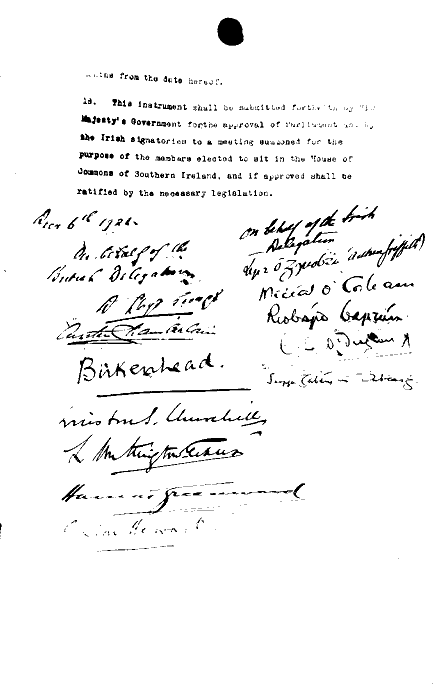
The treaty created the Irish Free State but kept it in the Empire and partitioned the island.
Chapter IV

Story 17 of 25 · Independent Ireland
War and conflict
Pro- and anti-treaty sides fought a war that bitterly divided the country for generations.

Story 18 of 25 · Independent Ireland
States and rulers
The new constitution made the state "Ireland" in practice.

Story 19 of 25 · Independent Ireland
States and rulers
Ireland formally left the Commonwealth and became a republic.

Story 20 of 25 · Independent Ireland
States and rulers
After years of British vetoes, the Community grew from six to nine members when three northern countries joined it.

Story 21 of 25 · Independent Ireland
Science, trade and industry
Irish economic growth, driven by foreign investment, made it one of the richest countries in Europe.

Story 22 of 25 · Independent Ireland
States and rulers
Ireland, Britain and parties in Northern Ireland agreed on a peace and power-sharing settlement.

Story 23 of 25 · Independent Ireland
States and rulers
Ireland was the first country to legalise same-sex marriage by popular vote.

Story 24 of 25 · Independent Ireland
States and rulers
Two thirds of voters repealed the constitutional ban on abortion.

Story 25 of 25 · Independent Ireland
States and rulers
The independent left-wing candidate won the election with about 64 per cent of the vote and was inaugurated as the tenth President of Ireland.
Journey complete
25 stories, c. 3200 BC to 2025. More events are being researched and added.
Culture and faith
Neolithic farmers built a passage tomb aligned to the winter sun, a thousand years before the pyramids.

Culture and faith
From as early as 2800 BC, people across Europe, from Iberia to the British Isles and beyond, made inverted-bell drinking cups, used at the start of the European Bronze Age.

Culture and faith
Atlantic Bronze Age is a loose label for the period from about 1300 to 700 BC along the Atlantic coast of Britain, France, Ireland, Portugal and Spain. The term has never been formally defined.

Culture and faith
A Romano-British former slave returned to Ireland as a missionary. He is the patron saint of Ireland.

War and conflict
Vikings raided Rathlin Island and monasteries, and later founded Dublin.

Culture and faith
Monks decorated the four Gospels with intricate designs, in a manuscript now at Trinity College Dublin.

War and conflict
Brian Boru defeated the Vikings and their Irish allies, but died in the battle.

War and conflict
Anglo-Norman knights landed to help an exiled king of Leinster and stayed to rule.

War and conflict
Cromwell's army took Drogheda and Wexford and confiscated much of the land.

War and conflict
William of Orange beat the Catholic James II in Ireland.
War and conflict
The United Irishmen rose against British rule inspired by revolutionary France.

States and rulers
After the 1798 Irish rebellion Britain merged the two kingdoms. Irish MPs began sitting at Westminster.
Ireland stayed in the union until 1922.

Disasters and epidemics
The potato blight caused a famine that killed about a million people and made a million more leave.

States and rulers
Irish republicans seized buildings in Dublin and were crushed. The executions of the leaders swung opinion.

War and conflict
The IRA fought a guerrilla war against British forces.
States and rulers
The treaty created the Irish Free State but kept it in the Empire and partitioned the island.

War and conflict
Pro- and anti-treaty sides fought a war that bitterly divided the country for generations.
States and rulers
The new constitution made the state "Ireland" in practice.

States and rulers
Ireland formally left the Commonwealth and became a republic.

States and rulers
After years of British vetoes, the Community grew from six to nine members when three northern countries joined it.

Science, trade and industry
Irish economic growth, driven by foreign investment, made it one of the richest countries in Europe.

States and rulers
Ireland, Britain and parties in Northern Ireland agreed on a peace and power-sharing settlement.

States and rulers
Ireland was the first country to legalise same-sex marriage by popular vote.

States and rulers
Two thirds of voters repealed the constitutional ban on abortion.

States and rulers
The independent left-wing candidate won the election with about 64 per cent of the vote and was inaugurated as the tenth President of Ireland.