Jerusalem, city wall (west)

All countries

Israel

The land between the Mediterranean and the Jordan: early humans, Canaanites, Israelites, empires and crusaders, Ottoman and British rule, and the state founded in 1948.

Declared independence on 14 May 1948

Stories
56
Distance
1,502,025 years
Route
c. 1,500,000 BC to 2026
  1. Early peoples3 stories
  2. Canaan, Israel and Judah7 stories
  3. Empires and revolts8 stories
  4. Caliphs, crusaders and sultans11 stories
  5. British Mandate6 stories
  6. State of Israel21 stories
Begin the journey

Suleiman's walls, 1535. Image: איתן פרמן 13:56, 4 December 2006 (UTC) · Public domain, via Wikimedia Commons

  1. Chapter I

    Early peoples

    3 stories in this chapter

  2. Early humans at 'Ubeidiya

    Story 1 of 56 · Early peoples

    People and rights

    Early humans at 'Ubeidiya

    Early humans who had walked out of Africa camped by a lake in the Jordan Valley, leaving hand axes among the bones of hippos and other animals.

    Next storyc. 4400 BC · The Ghassulian culture
  3. About 1,495,600 years later

    c. 1,500,000 BC to c. 4400 BC

  4. The Ghassulian culture

    Story 2 of 56 · Early peoples

    Culture and faith

    The Ghassulian culture

    The Ghassulian culture of the Chalcolithic Levant is named after Teleilat Ghassul in the Jordan Valley. Its farming villages smelted copper, and some of their houses were covered in many-coloured wall paintings, such as the Ghassulian Star.

    Next storyc. 3500 BC · Canaan
  5. About 900 years later

    c. 4400 BC to c. 3500 BC

  6. Zoom into this map at maps.bpl.org

    Story 3 of 56 · Early peoples

    States and rulers

    Canaan

    Canaan was the name of the land between the Jordan and the Mediterranean in the Bronze Age, with walled city-states, trade and its own alphabet-writing culture, before and during the time of Egypt's empire.

    Next storyc. 3000 BC · Beth Yerah
  7. About 500 years later

    c. 3500 BC to c. 3000 BC

  8. Chapter II

    Canaan, Israel and Judah

    7 stories in this chapter

  9. Beth Yerah

    Story 4 of 56 · Canaan, Israel and Judah

    Culture and faith

    Beth Yerah

    On the south shore of the Sea of Galilee, the great mound of Khirbet Kerak, or Beth Yerah, covers more than 50 acres. Its Early Bronze Age town gave its name to Khirbet Kerak ware, a Levantine form of the Kura–Araxes pottery of the Caucasus.

    Next storyc. 1750 BC · Hazor
  10. About 1,300 years later

    c. 3000 BC to c. 1750 BC

  11. Hazor

    Story 5 of 56 · Canaan, Israel and Judah

    States and rulers

    Hazor

    For roughly nine centuries, from about 1750 BC until the 9th century BC, no walled city in the region was bigger than Hazor, north of the Sea of Galilee, and it ranked among the great cities of the Fertile Crescent.

    Next storyc. 1457 BC · The Battle of Megiddo
  12. About 290 years later

    c. 1750 BC to c. 1457 BC

  13. Aerial view of Tel Megiddo , northern Israel

    Story 6 of 56 · Canaan, Israel and Judah

    War and conflict

    The Battle of Megiddo

    The pharaoh Thutmose III defeated a coalition of Canaanite kings at Megiddo and besieged the city for seven months.

    Next storyc. 1350 BC · The Amarna letters
  14. The Amarna letters

    Story 7 of 56 · Canaan, Israel and Judah

    States and rulers

    The Amarna letters

    A cache of clay tablets in Akhetaten, Egypt's capital, holds letters from the rulers of Canaanite city-states and other kings to the pharaoh. They show a land of small rival cities under Egyptian control.

    Next storyc. 1175 BC · The Philistines
  15. About 180 years later

    c. 1350 BC to c. 1175 BC

  16. Procession of Philistine Captives At Medinet-habu

    Story 8 of 56 · Canaan, Israel and Judah

    States and rulers

    The Philistines

    After the collapse of the Late Bronze Age, the Philistines settled the southern coast of Canaan, in cities such as Gaza, Ashkelon and Ashdod, and became rivals of the Israelites.

    Next storyc. 950 BC · The First Temple
  17. About 230 years later

    c. 1175 BC to c. 950 BC

  18. Sixteenth century gravure of a reconstruction of the temple of Solomon (detail)

    Story 9 of 56 · Canaan, Israel and Judah

    Culture and faith

    The First Temple

    According to the Hebrew Bible, King Solomon built a temple in Jerusalem to house the Ark of the Covenant. Little archaeological evidence of it survives.

    Next storyc. 722 BC · Assyria ends the northern kingdom
  19. About 230 years later

    c. 950 BC to c. 722 BC

  20. The Kingdoms of Judah and Israel

    Story 10 of 56 · Canaan, Israel and Judah

    States and rulers

    Assyria ends the northern kingdom

    The Assyrian army took Samaria, capital of the kingdom of Israel, and deported many of its people. The southern kingdom of Judah survived.

    Next story587 BC · Babylon destroys Jerusalem
  21. Chapter III

    Empires and revolts

    8 stories in this chapter

  22. Babylon destroys Jerusalem

    Story 11 of 56 · Empires and revolts

    War and conflict

    Babylon destroys Jerusalem

    Nebuchadnezzar II's Babylonian army captured Jerusalem, destroyed the Temple and deported much of Judah's population to Babylon.

    Next story539 BC · Persia conquers Babylon
  23. The Cyrus Cylinder, a clay cylinder inscribed in Babylonian cuneiform that records Cyrus's conquest of Babylon

    Story 12 of 56 · Empires and revolts

    States and rulers

    Persia conquers Babylon

    Cyrus the Great took Babylon. Exiles from Judah were allowed to go home to Jerusalem and rebuild their temple under Persian rule.

    Next story140 BC · The Hasmoneans rule Judea
  24. About 400 years later

    539 BC to 140 BC

  25. Obverse of a Roman silver denarius from 120 BCE (Bachius Judaeus) pertaining to Judaea in the Hashmonean era

    Story 13 of 56 · Empires and revolts

    States and rulers

    The Hasmoneans rule Judea

    After the Maccabean revolt, Simon Maccabeus was confirmed as high priest and ruler. The state he founded was independent until Rome arrived.

    Next story63 BC · Rome takes Jerusalem
  26. Pompey enters the Jerusalem Temple

    Story 14 of 56 · Empires and revolts

    States and rulers

    Rome takes Jerusalem

    Pompey stormed the Temple Mount after a siege of three months. Judea became a Roman dependency and later a province.

    Next storyc. 30 · Jesus is crucified
  27. La obra representa a Jesucristo crucificado , y es una de las obras religiosas más conocidas del pintor sevillano Diego Velázquez

    Story 15 of 56 · Empires and revolts

    Culture and faith

    Jesus is crucified

    Jesus of Nazareth, a Jewish preacher from Galilee, was crucified by the Roman governor Pontius Pilate in Jerusalem. His followers proclaimed that he had risen from the dead.

    Next story70 · Rome destroys the Temple
  28. Map of the siege of Jerusalem with movements of Roman army

    Story 16 of 56 · Empires and revolts

    War and conflict

    Rome destroys the Temple

    Roman legions under Titus crushed a Jewish revolt, captured Jerusalem and destroyed the Second Temple.

    Next story73 · The siege of Masada
  29. A surprising Roman terrace at the siege of Masada, continued and extended to the foot of the fortress wall

    Story 17 of 56 · Empires and revolts

    War and conflict

    The siege of Masada

    Jewish rebels held out on Herod's mountaintop fortress by the Dead Sea until the Romans built a huge ramp. According to Josephus, nearly all took their own lives rather than surrender.

    Next story132 · The Bar Kokhba revolt
  30. Map of the State of Israel under the rule of Shimon bar Kokhba as Prince/ President of Israel

    Story 18 of 56 · Empires and revolts

    War and conflict

    The Bar Kokhba revolt

    Simon bar Kokhba led a last great Jewish revolt against Rome. Hadrian crushed it, banned Jews from Jerusalem and renamed the province Syria Palaestina.

    Next story637 · The Arab conquest of Jerusalem
  31. About 510 years later

    132 to 637

  32. Chapter IV

    Caliphs, crusaders and sultans

    11 stories in this chapter

  33. Al Jamea Al Qebli i Jerusalem

    Story 19 of 56 · Caliphs, crusaders and sultans

    War and conflict

    The Arab conquest of Jerusalem

    After a siege, Jerusalem's patriarch Sophronius surrendered the city to the Caliph Umar, who guaranteed the safety of its Christians.

    Next story691 · The Dome of the Rock
  34. The golden Dome of the Rock on the Temple Mount, Jerusalem

    Story 20 of 56 · Caliphs, crusaders and sultans

    Culture and faith

    The Dome of the Rock

    The Umayyad caliph Abd al-Malik built a golden-domed shrine over the rock on the Temple Mount, where Muslims believe Muhammad ascended to heaven.

    Next story1099 · The crusaders take Jerusalem
  35. About 410 years later

    691 to 1099

  36. Capture of Jerusalem during the First Crusade, 1099

    Story 21 of 56 · Caliphs, crusaders and sultans

    War and conflict

    The crusaders take Jerusalem

    Knights of the First Crusade stormed Jerusalem and massacred many of its Muslim and Jewish inhabitants.

    Next story1099 · The crusaders found the Kingdom of Jerusalem
  37. Medieval manuscript painting of Godfrey of Bouillon in his siege tower during the crusaders' assault on Jerusalem in 1099

    Story 22 of 56 · Caliphs, crusaders and sultans

    States and rulers

    The crusaders found the Kingdom of Jerusalem

    After taking the city, the crusaders chose Godfrey of Bouillon as ruler. His brother Baldwin took the title of king the next year.

    Next story1187 · The Battle of Hattin
  38. Battle of Hattin

    Story 23 of 56 · Caliphs, crusaders and sultans

    War and conflict

    The Battle of Hattin

    Saladin trapped and destroyed the crusader army on the dry hills above the Sea of Galilee, then took Jerusalem in October.

    Next story1260 · The Mamluks defeat the Mongols
  39. A map of the campaign leading to the Battle of Ain Jalut — in 1260 CE

    Story 24 of 56 · Caliphs, crusaders and sultans

    States and rulers

    The Mamluks defeat the Mongols

    In Galilee the Mamluks of Egypt stopped the Mongol advance. They then ruled Palestine and Syria for more than 250 years.

    Next story1291 · The fall of Acre
  40. The Hospitalier Master Mathieu de Clermont defending the walls in 1291

    Story 25 of 56 · Caliphs, crusaders and sultans

    War and conflict

    The fall of Acre

    The Mamluks captured Acre, the last major crusader stronghold in the Holy Land.

    Next story1516 · The Ottomans take Palestine
  41. About 230 years later

    1291 to 1516

  42. An engraved map and coloured by hand

    Story 26 of 56 · Caliphs, crusaders and sultans

    States and rulers

    The Ottomans take Palestine

    Sultan Selim I defeated the Mamluks at Marj Dabiq and took Syria and Palestine. Ottoman rule lasted 400 years.

    Next story1535 · Suleiman's walls
  43. Jerusalem, city wall (west)

    Story 27 of 56 · Caliphs, crusaders and sultans

    Culture and faith

    Suleiman's walls

    The Ottoman sultan Suleiman the Magnificent rebuilt the walls and gates around Jerusalem's Old City.

    Next story1882 · The First Aliyah
  44. About 350 years later

    1535 to 1882

  45. Rishon LeZion in the 1890s

    Story 28 of 56 · Caliphs, crusaders and sultans

    People and rights

    The First Aliyah

    Jews fleeing pogroms in the Russian Empire, and others from Yemen, settled in Ottoman Palestine and founded farming villages such as Rishon LeZion.

    Next story1909 · Tel Aviv is founded
  46. Families gathered in the sand dunes for the lottery of plots that founded Tel Aviv, 1909

    Story 29 of 56 · Caliphs, crusaders and sultans

    Science, trade and industry

    Tel Aviv is founded

    Sixty-six Jewish families drew lots for plots in the sand dunes north of Jaffa and founded a new neighbourhood, soon named Tel Aviv.

    Next story1917 · The Balfour Declaration
  47. Chapter V

    British Mandate

    6 stories in this chapter

  48. The Balfour Declaration

    Story 30 of 56 · British Mandate

    States and rulers

    The Balfour Declaration

    Britain's foreign secretary promised support for 'a national home for the Jewish people' in Palestine, as long as the rights of other communities were respected.

    Next story1917 · Britain takes Jerusalem
  49. Britain takes Jerusalem

    Story 31 of 56 · British Mandate

    War and conflict

    Britain takes Jerusalem

    British forces under General Allenby captured Jerusalem from the Ottomans, weeks after Britain's Balfour Declaration promised support for a Jewish national home in Palestine.

    Next story1922 · Britain is given the Mandate
  50. The front page of the Mandate for Palestine and Transjordan memorandum, 1922

    Story 32 of 56 · British Mandate

    States and rulers

    Britain is given the Mandate

    The League of Nations confirmed British rule over Palestine, with the Balfour pledge written into its terms.

    Next story1936 · The Arab revolt
  51. Palestinian rebels from the Haifa area and hills around Jenin posing with their commander, Abd al-Qadir Yusuf Abd al-Hadi

    Story 33 of 56 · British Mandate

    War and conflict

    The Arab revolt

    Palestinian Arabs rose against British rule and Jewish immigration with a general strike and armed revolt. Britain crushed it, killing thousands.

    Next story1947 · The Nakba
  52. Palestinians from Tantura are expelled to Jordan, June 1948

    Story 34 of 56 · British Mandate

    People and rights

    The Nakba

    About 700,000 Palestinian Arabs, more than half the Arab population of Palestine, fled or were expelled from their homes during the war of 1947 to 1949. Hundreds of villages were destroyed and they were not allowed to return.

    Next story1947 · The UN votes to partition Palestine
  53. This map has been uploaded by Electionworld from he.wikipedia.org to enable the Wikimedia Atlas of the World

    Story 35 of 56 · British Mandate

    States and rulers

    The UN votes to partition Palestine

    The General Assembly voted 33 to 13 to divide the land into a Jewish state and an Arab state, with Jerusalem under international rule. Jewish leaders accepted. Arab leaders rejected it, and fighting began the next day.

    Next story1948 · Israel declares independence
  54. Chapter VI

    State of Israel

    21 stories in this chapter

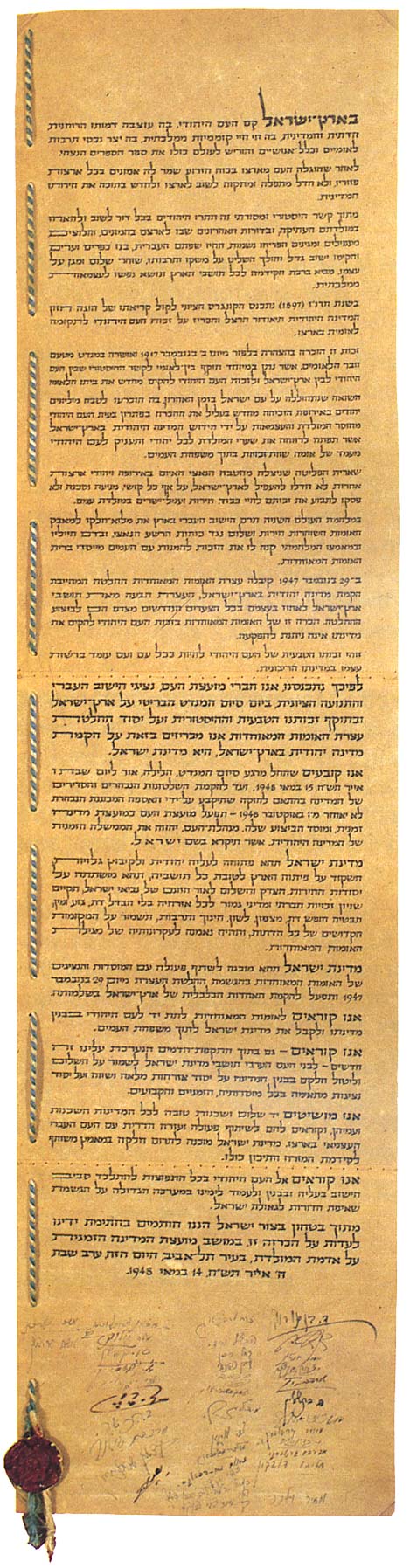
  55. Israeli Declaration of Independence

    Story 36 of 56 · State of Israel

    States and rulers

    Israel declares independence

    As the British Mandate ended, David Ben-Gurion read a declaration founding the State of Israel. Neighbouring Arab states invaded the next day.

    Next story1948 · The 1948 war
  56. Map depicting military operations from 15th May 1948 to 10th June 1948 during Israeli War of Independence

    Story 37 of 56 · State of Israel

    War and conflict

    The 1948 war

    Israel fought the armies of Egypt, Jordan, Syria and Iraq. When it ended, Israel held more land than the UN partition plan had proposed; Jordan held the West Bank and East Jerusalem, and Egypt the Gaza Strip.

    Next story1949 · Israel's first election
  57. Israel elections posters

    Story 38 of 56 · State of Israel

    States and rulers

    Israel's first election

    Voters chose the first Knesset. David Ben-Gurion's Mapai party led the first elected government.

    Next story1961 · The Eichmann trial
  58. Defendant Adolf Eichmann (inside glass booth) is sentenced to death by the court at the conclusion of the Eichmann Trial

    Story 39 of 56 · State of Israel

    People and rights

    The Eichmann trial

    Adolf Eichmann, a chief organiser of the Holocaust, was kidnapped from Argentina and tried in Jerusalem. Survivors testified for the world to hear. He was hanged in 1962.

    Next story1967 · The Six-Day War
  59. Esquèma generau de la Guèrra dei Sièis Jorns (1967)

    Story 40 of 56 · State of Israel

    War and conflict

    The Six-Day War

    Israel struck Egypt's air force and in six days took Sinai and Gaza from Egypt, the West Bank and East Jerusalem from Jordan, and the Golan Heights from Syria.

    Next story1977 · The right wins for the first time
  60. Menachem Begin surrounded by aides and microphones soon after it was announced that his party had won the 1977 election

    Story 41 of 56 · State of Israel

    States and rulers

    The right wins for the first time

    Menachem Begin's Likud ended 29 years of Labour-led governments.

    Next story1982 · The 1982 Israeli invasion
  61. A column of Israeli tanks on a Lebanese road in West Beirut during the June 1982 invasion

    Story 42 of 56 · State of Israel

    War and conflict

    The 1982 Israeli invasion

    Israel invaded Lebanon to expel the PLO and reached Beirut.

    Next story1987 · The First Intifada
  62. Demonstration in the Israeli-occupied Gaza Strip during the First Intifada, 21 December 1987

    Story 43 of 56 · State of Israel

    War and conflict

    The First Intifada

    Palestinians in the occupied territories rose up against Israeli rule with strikes, boycotts and stone-throwing, met by Israeli force. Hamas was founded at the start of it.

    Next story1992 · Rabin returns
  63. Close-up photograph of Yitzhak Rabin in a grey jacket and blue shirt, taken in 1986

    Story 44 of 56 · State of Israel

    States and rulers

    Rabin returns

    Labour under Yitzhak Rabin won on a promise to pursue peace. The Oslo Accords followed the next year.

    Next story1994 · The peace treaty with Israel
  64. The peace treaty with Israel

    Story 45 of 56 · State of Israel

    States and rulers

    The peace treaty with Israel

    Jordan became the second Arab state to make peace with Israel.

    Next story1995 · Rabin is assassinated
  65. Channel2 - Yitzhak Rabin

    Story 46 of 56 · State of Israel

    States and rulers

    Rabin is assassinated

    An Israeli extremist opposed to the Oslo peace process shot Prime Minister Yitzhak Rabin at the end of a peace rally.

    Next story2000 · The Second Intifada
  66. Clashes between Palestinians and Israeli soldiers near Ramallah, in the occupied West Bank, during the second intifada, 20 Oct 2000

    Story 47 of 56 · State of Israel

    War and conflict

    The Second Intifada

    After peace talks failed, a second uprising brought suicide bombings in Israeli cities and Israeli military incursions into the West Bank and Gaza. About 3,000 Palestinians and 1,000 Israelis were killed.

    Next story2006 · The 2006 war
  67. Dust rises after the impact of two 500lb (230kg) laser guided bombs dropped during an IAF airstrike on Tyre, Lebanon

    Story 48 of 56 · State of Israel

    War and conflict

    The 2006 war

    Israel and Hezbollah fought for 34 days after Hezbollah seized soldiers.

    Next story2020 · The Abraham Accords
  68. President Donald J

    Story 49 of 56 · State of Israel

    States and rulers

    The Abraham Accords

    Bahrain and the UAE agreed to normalise relations with Israel.

    Next story2021 · Netanyahu is replaced
  69. Thirty-sixth government of Israel at Beit HaNassi to photograph the traditional picture headed by the President of Israel , Reuven Rivlin

    Story 50 of 56 · State of Israel

    States and rulers

    Netanyahu is replaced

    An eight-party coalition under Naftali Bennett, with Yair Lapid, ended Benjamin Netanyahu's twelve years in office. It was the first to include an independent Arab party.

    Next story2022 · Netanyahu returns
  70. Ballot slips at a polling station in the 2022 Israeli election

    Story 51 of 56 · State of Israel

    States and rulers

    Netanyahu returns

    After five elections in under four years, Netanyahu formed a government with religious and far-right parties.

    Next story2023 · The 7 October attack
  71. The 7 October attack

    Story 52 of 56 · State of Israel

    War and conflict

    The 7 October attack

    Hamas-led militants broke through the Gaza border fence and attacked Israeli communities, army posts and a music festival, killing about 1,200 people and taking about 250 hostages.

    Next story2024 · The 2024 war
  72. Israeli Air Force 69th Squadron - Operation New Order: F-15I jets eliminating Hezbollah and Hassan Nasrallah

    Story 53 of 56 · State of Israel

    War and conflict

    The 2024 war

    Israel launched a campaign against Hezbollah, with air strikes and a ground invasion. A ceasefire ended it in November.

    Next story2025 · The Twelve-Day War
  73. The Israeli Air Force attacked parts of Tehran at dawn on Friday, June 13, 2025

    Story 54 of 56 · State of Israel

    War and conflict

    The Twelve-Day War

    Israel attacked Iran's nuclear sites and senior commanders, Iran fired missiles at Israel, and the United States bombed the Fordow enrichment plant before a ceasefire was agreed.

    Next story2025 · The Gaza ceasefire of October 2025
  74. Map of Trump's plan for Gaza

    Story 55 of 56 · State of Israel

    War and conflict

    The Gaza ceasefire of October 2025

    A US-backed ceasefire took effect, and Hamas freed the last 20 living hostages. Israeli strikes and the displacement of Gazans went on, and the later stages of the plan stalled.

    Next story2026 · The US–Israeli war on Iran
  75. Simplified map of the 2026 Iran war as of 14 March 2026

    Story 56 of 56 · State of Israel

    War and conflict

    The US–Israeli war on Iran

    The United States and Israel attacked Iran and killed Supreme Leader Ali Khamenei, and Iran fired at Israel and at Gulf states that host US bases. His son Mojtaba Khamenei was chosen as successor. A shaky ceasefire and talks followed from April.

    NextJourney's end

Journey complete

You travelled 1,502,025 years

56 stories, c. 1,500,000 BC to 2026. More events are being researched and added.

Choose another countryBack to the start