

Culture and faith
The villages of Dhar Tichitt
Farmers built hundreds of stone-walled villages on the cliffs of the Tichitt escarpment and grew millet.
- Where
- Tichitt

Neolithic farmers of Tichitt, the Almoravid movement, caravan towns of the Sahara, French rule, and a republic of coups and a long struggle against slavery.
Independent from France since 28 November 1960
Chinguetti, c. 1250. Image: Mohamed Natti · CC BY-SA 4.0, via Wikimedia Commons
Chapter I

Story 1 of 16 · Early peoples and empires
Culture and faith
Farmers built hundreds of stone-walled villages on the cliffs of the Tichitt escarpment and grew millet.
About 3,000 years later
c. 2000 BC to 1040

Story 2 of 16 · Early peoples and empires
States and rulers
A reform movement of Sanhaja Berbers began in the desert, conquered Morocco and Spain, and founded Marrakesh.
About 200 years later
1040 to 1235

Story 3 of 16 · Early peoples and empires
States and rulers
Sundiata Keita defeated the king of Sosso and founded an empire that grew rich on gold and held much of West Africa.

Story 4 of 16 · Early peoples and empires
Culture and faith
A caravan town became a centre of Islamic learning, with libraries of manuscripts that survive in family collections.
About 390 years later
c. 1250 to 1644

Story 5 of 16 · Early peoples and empires
War and conflict
A Berber religious leader and the Arab Hassaniya fought. The Arabs won, and Hassaniya Arabic became the language of the land.
About 250 years later
1644 to 1895

Story 6 of 16 · Early peoples and empires
States and rulers
France joined eight colonies under a governor-general at Dakar.
Chapter II

Story 7 of 16 · French rule
States and rulers
France ruled the Moorish emirates through the French Sudan. It took until the 1930s to subdue the desert.
Chapter III

Story 8 of 16 · Independent Mauritania
States and rulers
Mokhtar Ould Daddah led the new republic, with a new capital at Nouakchott.

Story 9 of 16 · Independent Mauritania
Disasters and epidemics
Rains failed across the Sahel for years. Herds died, millions went hungry and many people left their villages.

Story 10 of 16 · Independent Mauritania
States and rulers
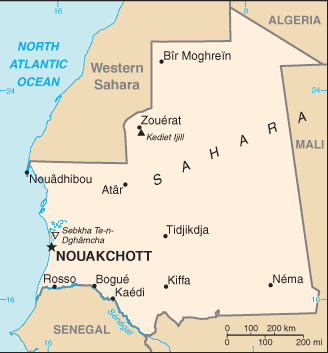
Spain handed Western Sahara to Morocco and Mauritania. Mauritania fought the Polisario Front until 1979, then withdrew.
Story 11 of 16 · Independent Mauritania
States and rulers
Officers overthrew Ould Daddah after the costly war. Mauritania has had many coups since.

Story 12 of 16 · Independent Mauritania
People and rights
Mauritania was the last country in the world to formally abolish slavery. It became a crime only in 2007.

Story 13 of 16 · Independent Mauritania
States and rulers
Colonel Taya took power in a coup and ruled for 21 years.
Story 14 of 16 · Independent Mauritania
States and rulers
The army ousted Taya while he was abroad and promised a quick return to elections.

Story 15 of 16 · Independent Mauritania
States and rulers
General Mohamed Ould Abdel Aziz took power from the elected president, and later won elections.

Story 16 of 16 · Independent Mauritania
States and rulers
Ould Ghazouani took over from Ould Abdel Aziz, the first time an elected Mauritanian president handed power to another.
Journey complete
16 stories, c. 2000 BC to 2019. More events are being researched and added.
Culture and faith
Farmers built hundreds of stone-walled villages on the cliffs of the Tichitt escarpment and grew millet.

States and rulers
A reform movement of Sanhaja Berbers began in the desert, conquered Morocco and Spain, and founded Marrakesh.

States and rulers
Sundiata Keita defeated the king of Sosso and founded an empire that grew rich on gold and held much of West Africa.

Culture and faith
A caravan town became a centre of Islamic learning, with libraries of manuscripts that survive in family collections.

War and conflict
A Berber religious leader and the Arab Hassaniya fought. The Arabs won, and Hassaniya Arabic became the language of the land.

States and rulers
France joined eight colonies under a governor-general at Dakar.
States and rulers
France ruled the Moorish emirates through the French Sudan. It took until the 1930s to subdue the desert.

States and rulers
Mokhtar Ould Daddah led the new republic, with a new capital at Nouakchott.

Disasters and epidemics
Rains failed across the Sahel for years. Herds died, millions went hungry and many people left their villages.
States and rulers
Spain handed Western Sahara to Morocco and Mauritania. Mauritania fought the Polisario Front until 1979, then withdrew.
States and rulers
Officers overthrew Ould Daddah after the costly war. Mauritania has had many coups since.

People and rights
Mauritania was the last country in the world to formally abolish slavery. It became a crime only in 2007.
Slavery persists in practice.
States and rulers
Colonel Taya took power in a coup and ruled for 21 years.
States and rulers
The army ousted Taya while he was abroad and promised a quick return to elections.

States and rulers
General Mohamed Ould Abdel Aziz took power from the elected president, and later won elections.
States and rulers
Ould Ghazouani took over from Ould Abdel Aziz, the first time an elected Mauritanian president handed power to another.