Archäologische Bauten in der Ruinenstadt Teotihuacán

All countries

Mexico

The first farmers of maize, the Olmecs, Maya and Aztecs, three centuries of New Spain, and the revolutions that made modern Mexico.

Independent from Spain since 1821

Stories
41
Distance
9,023 years
Route
c. 7000 BC to 2024
  1. First peoples and the Olmecs8 stories
  2. Classic and Postclassic Mesoamerica4 stories
  3. New Spain6 stories
  4. Independent Mexico8 stories
  5. Revolution and modern Mexico15 stories
Begin the journey

Teotihuacan's Pyramid of the Sun, c. 200. Image: Burkhard Mücke · CC BY-SA 4.0, via Wikimedia Commons

  1. Chapter I

    First peoples and the Olmecs

    8 stories in this chapter

  2. Corn farm ready to produce maize

    Story 1 of 41 · First peoples and the Olmecs

    Science, trade and industry

    Maize is domesticated

    Farmers in south-western Mexico began to breed teosinte, a wild grass with a few small hard seeds, into maize.

    Next storyc. 5000 BC · Early crops at Coxcatlan Cave
  3. About 2,000 years later

    c. 7000 BC to c. 5000 BC

  4. Story 2 of 41 · First peoples and the Olmecs

    Science, trade and industry

    Early crops at Coxcatlan Cave

    In the Tehuacán Valley of Puebla, foragers sheltered in Coxcatlan Cave over some 10,000 years. Layers of about 5000 to 3400 BC hold small maize cobs, squash, chile, avocado, beans and bottle gourd, among the early crops of Mexico.

    Next storyc. 2400 BC · The first pottery of Mesoamerica
  5. About 2,600 years later

    c. 5000 BC to c. 2400 BC

  6. Bahía de Puerto Marqués desde la carretera Escenica en Acapulco , Guerrero , México

    Story 3 of 41 · First peoples and the Olmecs

    Culture and faith

    The first pottery of Mesoamerica

    At Puerto Marqués, a bay south of Acapulco, archaeologists found "Pox" pottery dated to as early as 2400 BC, the oldest known pottery in Mesoamerica.

    Next storyc. 1900 BC · The Mokaya
  7. About 500 years later

    c. 2400 BC to c. 1900 BC

  8. The Mokaya

    Story 4 of 41 · First peoples and the Olmecs

    Culture and faith

    The Mokaya

    The Mokaya were pre-Olmec peoples of the Soconusco coast on the Pacific, in southern Mexico and Guatemala. They built some of Mesoamerica's earliest known settled villages.

    Next storyc. 1400 BC · The oldest ballcourt
  9. About 500 years later

    c. 1900 BC to c. 1400 BC

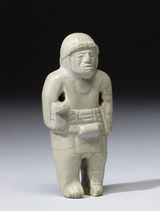
  10. The identification of this figure as a ballplayer rests on the characteristically wide belt, or "yoke," around his waist

    Story 5 of 41 · First peoples and the Olmecs

    Culture and faith

    The oldest ballcourt

    At Paso de la Amada in Chiapas, archaeologists found the oldest known Mesoamerican ballcourt, about 80 metres long and dated to about 1400 BC. The ball game went on to be played across Mesoamerica.

    Next storyc. 1200 BC · Olmec San Lorenzo
  11. About 200 years later

    c. 1400 BC to c. 1200 BC

  12. Olmec San Lorenzo

    Story 6 of 41 · First peoples and the Olmecs

    Culture and faith

    Olmec San Lorenzo

    The Olmecs built the first great centre of Mesoamerica on the Gulf Coast, carving colossal stone heads of their rulers.

    Next storyc. 500 BC · Monte Albán
  13. About 700 years later

    c. 1200 BC to c. 500 BC

  14. Monte Albán

    Story 7 of 41 · First peoples and the Olmecs

    States and rulers

    Monte Albán

    The Zapotecs levelled a mountaintop above the valley of Oaxaca and built a capital of plazas, temples and ball courts.

    Next storyc. 200 · Teotihuacan's Pyramid of the Sun
  15. About 700 years later

    c. 500 BC to c. 200

  16. Archäologische Bauten in der Ruinenstadt Teotihuacán

    Story 8 of 41 · First peoples and the Olmecs

    Culture and faith

    Teotihuacan's Pyramid of the Sun

    Teotihuacan, the largest city of the Americas at its height, raised a pyramid about 65 metres high over a cave.

    Next storyc. 600 · Chichen Itza
  17. About 400 years later

    c. 200 to c. 600

  18. Chapter II

    Classic and Postclassic Mesoamerica

    4 stories in this chapter

  19. El Castillo (pyramid of Kukulcán) in Chichén Itzá

    Story 9 of 41 · Classic and Postclassic Mesoamerica

    Culture and faith

    Chichen Itza

    The Maya city of Chichen Itza dominated northern Yucatán. At the equinoxes, light on the steps of El Castillo makes a serpent seem to slither down the pyramid.

    Next storyc. 900 · The Classic Maya collapse
  20. About 300 years later

    c. 600 to c. 900

  21. Tulum , lithograph published by Frederick Catherwood in 1844

    Story 10 of 41 · Classic and Postclassic Mesoamerica

    Culture and faith

    The Classic Maya collapse

    The southern lowland cities were abandoned over a century or two, probably because of drought, war and unrest.

    Next story1325 · Tenochtitlan is founded
  22. About 430 years later

    c. 900 to 1325

  23. Full view of Tenochtitlán

    Story 11 of 41 · Classic and Postclassic Mesoamerica

    States and rulers

    Tenochtitlan is founded

    According to tradition, the Mexica founded their city on an island in Lake Texcoco where they saw an eagle on a cactus. It grew into the capital of the Aztec Empire.

    Next story1428 · The Triple Alliance
  24. Aztec Empire with Aztec dominance between Teozapotlan and Xoconochco

    Story 12 of 41 · Classic and Postclassic Mesoamerica

    States and rulers

    The Triple Alliance

    Tenochtitlan, Texcoco and Tlacopan joined to defeat Azcapotzalco, and together came to dominate central Mexico.

    Next story1521 · The fall of Tenochtitlan
  25. Chapter III

    New Spain

    6 stories in this chapter

  26. From the Conquest of México series

    Story 13 of 41 · New Spain

    War and conflict

    The fall of Tenochtitlan

    After a siege of nearly three months, Hernán Cortés's Spaniards and tens of thousands of Indigenous allies captured the Aztec capital, weakened by smallpox.

    Next story1531 · Our Lady of Guadalupe
  27. Our Lady of Guadalupe

    Story 14 of 41 · New Spain

    Culture and faith

    Our Lady of Guadalupe

    According to Catholic tradition, the Virgin Mary appeared to Juan Diego, an Indigenous man, on the hill of Tepeyac.

    Next story1535 · The viceroyalty of New Spain
  28. Mapa polític del Virregnat de la Nova Espanya (1794)

    Story 15 of 41 · New Spain

    States and rulers

    The viceroyalty of New Spain

    Spain set up a viceroy in Mexico City to rule its lands in North America, the Caribbean and the Philippines.

    Next story1545 · The cocoliztli epidemic
  29. The cocoliztli epidemic

    Story 16 of 41 · New Spain

    Disasters and epidemics

    The cocoliztli epidemic

    A deadly fever the Nahua called cocoliztli killed perhaps 5 to 15 million people, most of the Indigenous population of central Mexico.

    Next story1810 · The Cry of Dolores
  30. About 270 years later

    1545 to 1810

  31. Photo taken March 2004 by Paige Morrison

    Story 17 of 41 · New Spain

    States and rulers

    The Cry of Dolores

    The priest Miguel Hidalgo rang his church bell and called on his parishioners to rise against Spanish rule.

    Next story1810 · The War of Independence
  32. A collage of the different stages in the Mexican War of Independence

    Story 18 of 41 · New Spain

    War and conflict

    The War of Independence

    After a decade of fighting in which Hidalgo and later José María Morelos were executed, the former royalist officer Agustín de Iturbide joined the rebels and Mexico became independent.

    Next story1822 · Iturbide becomes emperor
  33. Chapter IV

    Independent Mexico

    8 stories in this chapter

  34. Colour print of Agustín de Iturbide in a decorated uniform and sash as emperor of Mexico

    Story 19 of 41 · Independent Mexico

    States and rulers

    Iturbide becomes emperor

    After independence, the army officer Agustín de Iturbide had himself proclaimed emperor. Generals forced him to abdicate within a year.

    Next story1824 · Mexico becomes a federal republic
  35. Oval engraved portrait of Guadalupe Victoria, the first president of Mexico, in a general's uniform

    Story 20 of 41 · Independent Mexico

    States and rulers

    Mexico becomes a federal republic

    A constitution created a republic of states modelled partly on the United States, with Guadalupe Victoria as its first president.

    Next story1846 · The war with the United States
  36. Battle of Molino del Rey during the Mexican-American War, painting by Carl Nebel

    Story 21 of 41 · Independent Mexico

    War and conflict

    The war with the United States

    US armies invaded Mexico and occupied Mexico City. In the peace treaty Mexico gave up about half its territory, including California and New Mexico.

    Next story1855 · Santa Anna is overthrown
  37. Juan Nepomuceno Álvarez Hurtado de Luna, President of Mexico

    Story 22 of 41 · Independent Mexico

    States and rulers

    Santa Anna is overthrown

    A revolt that began in Guerrero drove Antonio López de Santa Anna from power for the last time.

    Next story1857 · The Liberal constitution of 1857
  38. Original cover of the Federal Constitution of the United Mexican States of 1857

    Story 23 of 41 · Independent Mexico

    States and rulers

    The Liberal constitution of 1857

    It guaranteed individual rights and weakened the church and the army. Conservatives took up arms against it in the Reform War.

    Next story1862 · The Battle of Puebla
  39. The Battle of Puebla

    Story 24 of 41 · Independent Mexico

    War and conflict

    The Battle of Puebla

    A Mexican army under Ignacio Zaragoza defeated an invading French army. France later returned and installed Maximilian as emperor until 1867.

    Next story1864 · Maximilian becomes emperor
  40. Full-length portrait of Maximilian I in an ermine-trimmed robe, with a crown on a table beside him

    Story 25 of 41 · Independent Mexico

    States and rulers

    Maximilian becomes emperor

    With French backing, the Austrian archduke Maximilian accepted a crown from Mexican conservatives. Juárez's republicans resisted, and Maximilian was shot in 1867.

    Next story1876 · The Porfiriato
  41. Porfirio Díaz in 1910

    Story 26 of 41 · Independent Mexico

    States and rulers

    The Porfiriato

    General Porfirio Díaz ruled for more than three decades, bringing railways and foreign investment while peasants lost their land.

    Next story1910 · The Mexican Revolution
  42. Chapter V

    Revolution and modern Mexico

    15 stories in this chapter

  43. Constitucionalistas, villistas y zapatistas en diciembre de 1915

    Story 27 of 41 · Revolution and modern Mexico

    War and conflict

    The Mexican Revolution

    Francisco Madero's call to rise against Díaz unleashed a decade of civil war among leaders including Emiliano Zapata and Pancho Villa. Perhaps a million or more people died.

    Next story1911 · Madero becomes president
  44. Portrait of Francisco I. Madero

    Story 28 of 41 · Revolution and modern Mexico

    States and rulers

    Madero becomes president

    Francisco Madero, whose call to arms had toppled Porfirio Díaz, took office after an election. His government lasted fifteen months.

    Next story1913 · The Ten Tragic Days
  45. A photograph of the fighting in Mexico City during the Ten Tragic Days of 1913

    Story 29 of 41 · Revolution and modern Mexico

    States and rulers

    The Ten Tragic Days

    A military revolt in Mexico City ended with General Victoriano Huerta arresting Madero. Madero was killed soon afterwards.

    Next story1917 · The 1917 Constitution
  46. Original Cover of the Political Constitution of the United Mexican States

    Story 30 of 41 · Revolution and modern Mexico

    States and rulers

    The 1917 Constitution

    A new constitution promised land reform, workers' rights, free public education and national ownership of minerals and oil.

    Next story1929 · A party to rule them all
  47. Black-and-white portrait of Plutarco Elías Calles in a suit and tie, the general who founded the party that became the PRI

    Story 31 of 41 · Revolution and modern Mexico

    States and rulers

    A party to rule them all

    Plutarco Elías Calles founded the party that became the PRI. It held the presidency for the next 71 years.

    Next story1938 · Oil is nationalised
  48. Portrait of President Lázaro Cárdenas in 1937

    Story 32 of 41 · Revolution and modern Mexico

    Science, trade and industry

    Oil is nationalised

    President Lázaro Cárdenas took over the foreign oil companies and created Pemex.

    Next story1968 · The Tlatelolco massacre
  49. The Plaza de las Tres Culturas in Tlatelolco, Mexico City

    Story 33 of 41 · Revolution and modern Mexico

    People and rights

    The Tlatelolco massacre

    Ten days before the Olympic Games, soldiers and police opened fire on student protesters in the Plaza de las Tres Culturas, killing many; the true number is still unknown.

    Next story1985 · The 1985 earthquake
  50. Mexico city - Collapsed General Hospital

    Story 34 of 41 · Revolution and modern Mexico

    Disasters and epidemics

    The 1985 earthquake

    A magnitude 8 earthquake killed at least 5,000 people, and possibly many more, in Mexico City. Citizens organised the rescue when the government was slow to act.

    Next story1988 · A disputed election
  51. Resultados electorales de la elección presidencial de México de 1988 por entidad federativa

    Story 35 of 41 · Revolution and modern Mexico

    States and rulers

    A disputed election

    The computers counting votes failed as Cuauhtémoc Cárdenas appeared to be ahead. Carlos Salinas was declared the winner, and many Mexicans doubted the result.

    Next story1994 · The Zapatista uprising
  52. El Subcomandante Marcos en Salamanca, el 12 de marzo de 2006

    Story 36 of 41 · Revolution and modern Mexico

    People and rights

    The Zapatista uprising

    On the day the North American Free Trade Agreement took effect, an Indigenous rebel army took towns in Chiapas, demanding land and rights.

    Next story2000 · The end of one-party rule
  53. Official portrait of Vicente Fox in 2000

    Story 37 of 41 · Revolution and modern Mexico

    States and rulers

    The end of one-party rule

    Vicente Fox of the National Action Party won the presidency, ending 71 years of rule by the Institutional Revolutionary Party.

    Next story2012 · The PRI returns
  54. Resultados electorales de la elección presidencial de México de 2012 por entidad federativa

    Story 38 of 41 · Revolution and modern Mexico

    States and rulers

    The PRI returns

    Enrique Peña Nieto won the presidency for the PRI, twelve years after it lost power.

    Next story2018 · López Obrador wins in a landslide
  55. Resultados electorales de la elección presidencial de México de 2018

    Story 39 of 41 · Revolution and modern Mexico

    States and rulers

    López Obrador wins in a landslide

    Andrés Manuel López Obrador won more than half the vote, the first left-wing president in decades.

    Next story2018 · The migrant caravans
  56. Migrants riding outside a freight train in Mexico

    Story 40 of 41 · Revolution and modern Mexico

    War and conflict

    The migrant caravans

    Thousands of Hondurans left on foot together towards the United States.

    Next story2024 · Mexico elects its first woman president
  57. A scene from the 2024 Mexican federal elections

    Story 41 of 41 · Revolution and modern Mexico

    States and rulers

    Mexico elects its first woman president

    Claudia Sheinbaum, López Obrador's chosen successor, won by a wide margin.

    NextJourney's end

Journey complete

You travelled 9,023 years

41 stories, c. 7000 BC to 2024. More events are being researched and added.

Choose another countryBack to the start