Basilius-Kathedrale in Moskau (Roter Platz)

All countries

Russia

Denisovans and Ice Age hunters, the Rus' and the Mongols, the tsars, revolution and the Soviet Union, and the Russian Federation.

The Russian Federation since 1991

Stories
58
Distance
202,025 years
Route
c. 200,000 BC to present
  1. Early peoples12 stories
  2. Rus' and Muscovy9 stories
  3. The tsars15 stories
  4. Soviet Russia11 stories
  5. Russian Federation11 stories
Begin the journey

St Basil's Cathedral, 1555. Image: W. Bulach · CC BY-SA 4.0, via Wikimedia Commons

  1. Chapter I

    Early peoples

    12 stories in this chapter

  2. Denisova Cave

    Story 1 of 58 · Early peoples

    People and rights

    Denisova Cave

    A cave in Siberia was home to Neanderthals and to Denisovans, a human group known mainly from a finger bone and teeth. One girl had a Neanderthal mother and a Denisovan father.

    Next storyc. 32,000 BC · The Sungir burials
  3. About 168,000 years later

    c. 200,000 BC to c. 32,000 BC

  4. Man in an Upper Paleolithic burial in Sunghir, Russia

    Story 2 of 58 · Early peoples

    Culture and faith

    The Sungir burials

    Hunters buried a man and two children in clothes sewn with thousands of ivory beads, with ivory spears.

    Next storyc. 3750 BC · The Yamnaya culture
  5. About 28,300 years later

    c. 32,000 BC to c. 3750 BC

  6. Map of the Yamnaya culture , based on map printed at page 651 in Encyclopedia of Indo-European Culture , which was edited by J

    Story 3 of 58 · Early peoples

    Culture and faith

    The Yamnaya culture

    The core of the Yamnaya, or Pit Grave, culture formed in the lower Dnieper and Don steppe between about 3750 and 3350 BC. It was a late Copper Age to early Bronze Age culture of the lands between the Southern Bug, Dniester and Ural rivers.

    Next storyc. 2900 BC · The Corded Ware culture
  7. About 850 years later

    c. 3750 BC to c. 2900 BC

  8. Map of the Corded Ware culture

    Story 4 of 58 · Early peoples

    Culture and faith

    The Corded Ware culture

    A broad horizon of pottery decorated with cord impressions spread across Europe from about 2900 to 2300 BC. Some DNA studies suggest it came from steppe herders who moved north and mixed with local farmers.

    Next storyc. 2200 BC · The Sintashta culture
  9. About 700 years later

    c. 2900 BC to c. 2200 BC

  10. Map of the Sintashta culture , based on map printed at page 379 in The Horse, the Wheel, and Language , which was edited by David W

    Story 5 of 58 · Early peoples

    Culture and faith

    The Sintashta culture

    In the southern Urals, the Sintashta culture of the Middle Bronze Age flourished from about 2200 to 1900 BC. It is the first phase of a larger complex that lasted to about 1750 BC, and is named after the Sintashta site.

    Next storyc. 2000 BC · The Andronovo culture
  11. About 200 years later

    c. 2200 BC to c. 2000 BC

  12. Map of the Andronovo culture , based on map printed at page 21 in Encyclopedia of Indo-European Culture , which was edited by J

    Story 6 of 58 · Early peoples

    Culture and faith

    The Andronovo culture

    From about 2000 to 1150 BC a group of related Late Bronze Age cultures spread from the southern Urals to the upper Yenisei in central Siberia and, in the south-east, to western Xinjiang.

    Next storyc. 1500 BC · The Karasuk culture
  13. About 500 years later

    c. 2000 BC to c. 1500 BC

  14. The Karasuk culture

    Story 7 of 58 · Early peoples

    Culture and faith

    The Karasuk culture

    Between about 1500 and 800 BC, Bronze Age communities known as the Karasuk culture spread across a huge area, reaching from the Aral Sea to the Yenisei River in the east and to the Altai and Tian Shan ranges in the south.

    Next storyc. 700 BC · The Scythians
  15. About 800 years later

    c. 1500 BC to c. 700 BC

  16. Scythian warriors, drawn after figures on an electrum cup from the Kul'Oba kurgan burial near Kerch

    Story 8 of 58 · Early peoples

    States and rulers

    The Scythians

    Mounted nomads from the steppe ruled a large territory north of the Black Sea and buried their kings with gold.

    Next story6th century BC · The Pazyryk culture
  17. The world's oldest known pile carpet was found in the largest of the Pazyryk burial mounds, Altay mountains

    Story 9 of 58 · Early peoples

    Culture and faith

    The Pazyryk culture

    The Pazyryk culture, a Saka Iron Age culture of the 6th to 3rd centuries BC, is known from objects and mummified bodies found in the Siberian permafrost of the Altai.

    Next story5th century BC · The Sarmatians
  18. Sarmatian heavy cavalry fleeing from Roman riders

    Story 10 of 58 · Early peoples

    Culture and faith

    The Sarmatians

    A confederation of Iranian horse-nomad peoples, the Sarmatians dominated the Pontic steppe from about the 5th century BC to the 4th century AD.

    Next story4th century · The Huns
  19. About 800 years later

    5th century BC to 4th century

  20. Huns in battle with the Alans, 1870s engraving after a drawing by Johann Nepomuk Geiger (1805-1880)

    Story 11 of 58 · Early peoples

    War and conflict

    The Huns

    Nomads of the steppe, the Huns moved between Central Asia, the Caucasus and eastern Europe from the 300s to the 500s. European sources first place them east of the Volga, in country that had been Scythian.

    Next storyc. 580 · The Khazar empire
  21. About 280 years later

    4th century to c. 580

  22. The Khazar empire

    Story 12 of 58 · Early peoples

    States and rulers

    The Khazar empire

    A semi-nomadic Turkic people, the Khazars, built a large trading state in the late 500s. It covered lands that are now southern European Russia, southern Ukraine and western Kazakhstan.

    Next story862 · Rurik in Novgorod
  23. About 280 years later

    c. 580 to 862

  24. Chapter II

    Rus' and Muscovy

    9 stories in this chapter

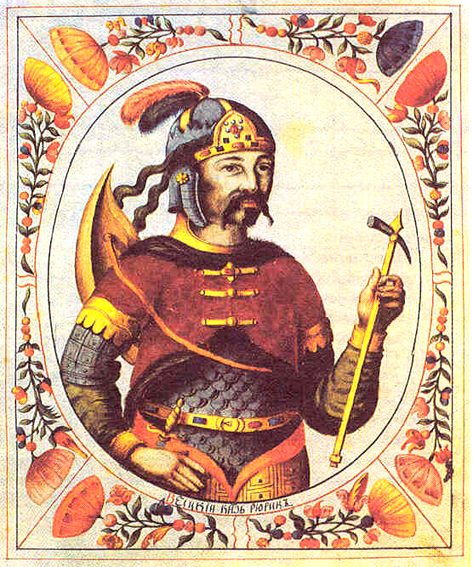
  25. Rurik (from the Russian "Tsarsky Titularnik")

    Story 13 of 58 · Rus' and Muscovy

    States and rulers

    Rurik in Novgorod

    According to the Primary Chronicle, the people of Novgorod invited the Varangian Rurik to rule them.

    Next story882 · Oleg takes Kyiv
  26. Oleg takes Kyiv

    Story 14 of 58 · Rus' and Muscovy

    States and rulers

    Oleg takes Kyiv

    Oleg of Novgorod took Kyiv and made it the capital of a Rus state that grew into Kyivan Rus.

    Next story988 · Volodymyr's baptism
  27. Volodymyr's baptism

    Story 15 of 58 · Rus' and Muscovy

    States and rulers

    Volodymyr's baptism

    Prince Volodymyr the Great took Orthodox Christianity from Byzantium and had Kyiv baptised.

    Next story1237 · The Mongol invasion
  28. About 250 years later

    988 to 1237

  29. 1236-1242 Mongol invasions of Europe

    Story 16 of 58 · Rus' and Muscovy

    War and conflict

    The Mongol invasion

    Batu Khan's armies destroyed Ryazan, Vladimir and other Russian cities.

    Next story1240 · The Mongols take Kyiv
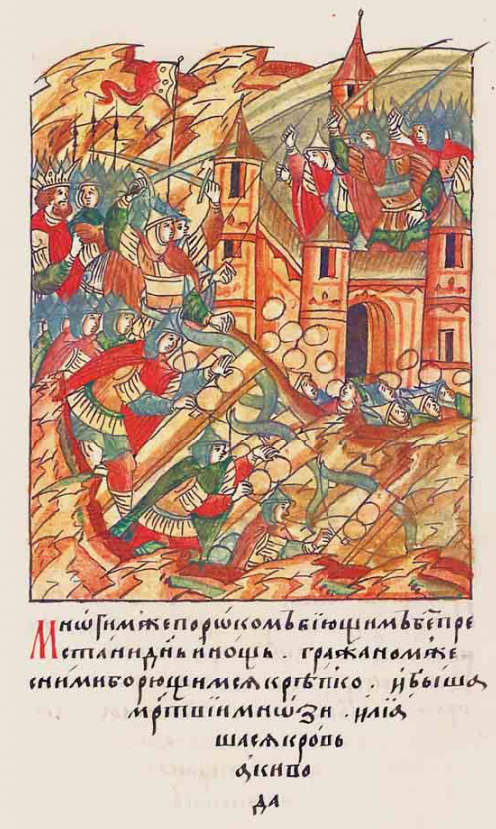
  30. Siege of Kiev by Batu in 1240 (miniature from the Russian Facial chronicle of the 16th century)

    Story 17 of 58 · Rus' and Muscovy

    War and conflict

    The Mongols take Kyiv

    The Mongols destroyed Kyiv and ended the Rus state.

    Next story1242 · The Battle on the Ice
  31. Alexander Nevskiy ice battle

    Story 18 of 58 · Rus' and Muscovy

    War and conflict

    The Battle on the Ice

    Prince Alexander Nevsky of Novgorod defeated the Livonian Knights on frozen Lake Peipus.

    Next story1243 · Russian princes bow to the Horde
  32. Golden Horde in the Catalan Atlas (1375)

    Story 19 of 58 · Rus' and Muscovy

    States and rulers

    Russian princes bow to the Horde

    After the Mongol invasion Russian princes had to travel to the khan's court to be confirmed in power and pay tribute for over two centuries.

    Next story1380 · The Battle of Kulikovo
  33. The Battle of Kulikovo

    Story 20 of 58 · Rus' and Muscovy

    War and conflict

    The Battle of Kulikovo

    Grand Prince Dmitry of Moscow defeated a Golden Horde army.

    Next story1480 · Moscow ends Mongol overlordship
  34. Standing on the Ugra river

    Story 21 of 58 · Rus' and Muscovy

    States and rulers

    Moscow ends Mongol overlordship

    Ivan III faced the Great Horde's army across the Ugra for weeks. The Mongols withdrew without a battle and tribute ended.

    Next story1547 · Ivan IV becomes tsar
  35. Chapter III

    The tsars

    15 stories in this chapter

  36. Ivan IV becomes tsar

    Story 22 of 58 · The tsars

    States and rulers

    Ivan IV becomes tsar

    Ivan IV was crowned the first tsar of all Russia. He conquered Kazan and Astrakhan, then turned on his own people with a reign of terror.

    Next story1555 · St Basil's Cathedral
  37. Basilius-Kathedrale in Moskau (Roter Platz)

    Story 23 of 58 · The tsars

    Culture and faith

    St Basil's Cathedral

    Ivan IV built a church with brightly coloured onion domes to celebrate the capture of Kazan.

    Next story1598 · The Time of Troubles
  38. The Time of Troubles

    Story 24 of 58 · The tsars

    States and rulers

    The Time of Troubles

    After the old dynasty died out, famine, impostors and a Polish occupation of Moscow tore Russia apart, until Mikhail Romanov was elected tsar.

    Next story1613 · The Romanovs take the throne
  39. Engraved portrait of Mikhail Fedorovich

    Story 25 of 58 · The tsars

    States and rulers

    The Romanovs take the throne

    To end the Time of Troubles an assembly chose 16-year-old Michael Romanov as tsar. His family ruled until 1917.

    Next story1703 · St Petersburg is founded
  40. Peter & Paul fortress in Saint Petersburg

    Story 26 of 58 · The tsars

    States and rulers

    St Petersburg is founded

    Peter the Great founded a city in the marshes of the Neva on land taken from Sweden. Thousands of forced labourers died building it.

    Next story1721 · Peter becomes emperor
  41. Original Description: Haying, near rest time

    Story 27 of 58 · The tsars

    States and rulers

    Peter becomes emperor

    After victory over Sweden the Senate gave Peter the Great the title Emperor of All Russia.

    Next story1762 · Catherine seizes the throne
  42. Person depicted: Empress Catherine II of Russia, daughter of C.A

    Story 28 of 58 · The tsars

    States and rulers

    Catherine seizes the throne

    With the Guards' support she deposed her husband Peter III, who was killed within days. She ruled for 34 years.

    Next story1773 · Pugachev's Rebellion
  43. Pugachev's Rebellion

    Story 29 of 58 · The tsars

    War and conflict

    Pugachev's Rebellion

    The Cossack Yemelyan Pugachev, claiming to be the dead Tsar Peter III, led serfs and Cossacks in the largest peasant revolt in Russian history.

    Next story1783 · Russia annexes Crimea
  44. Russia annexes Crimea

    Story 30 of 58 · The tsars

    States and rulers

    Russia annexes Crimea

    Catherine the Great annexed the Crimean Khanate.

    Next story1812 · The Battle of Borodino
  45. The Battle of Borodino

    Story 31 of 58 · The tsars

    War and conflict

    The Battle of Borodino

    Napoleon's army fought the Russians at Borodino, with some 70,000 casualties in a single day. Napoleon took Moscow, but it burned, and his army perished in the retreat.

    Next story1825 · The Decembrist revolt
  46. Peterburg, Senate Square, 1825, dec

    Story 32 of 58 · The tsars

    States and rulers

    The Decembrist revolt

    Army officers who wanted a constitution refused to swear loyalty to the new tsar, Nicholas I. Cannon fire broke them up.

    Next story1861 · The serfs are freed
  47. The serfs are freed

    Story 33 of 58 · The tsars

    People and rights

    The serfs are freed

    Tsar Alexander II freed about 23 million privately owned serfs, though they had to pay for land over decades.

    Next story1891 · The Trans-Siberian Railway
  48. Distance monument at Vladivostok railway station

    Story 34 of 58 · The tsars

    Science, trade and industry

    The Trans-Siberian Railway

    Russia built a railway more than 9,000 kilometres long from Moscow to Vladivostok.

    Next story1905 · Bloody Sunday
  49. Bloody Sunday

    Story 35 of 58 · The tsars

    People and rights

    Bloody Sunday

    Troops fired on a peaceful march of workers bringing a petition to the tsar, killing hundreds.

    Next story1906 · Russia gets a parliament
  50. Tsar Nicholas II's opening speech before the two chambers of the State Duma in the Winter Palace

    Story 36 of 58 · The tsars

    States and rulers

    Russia gets a parliament

    After the 1905 revolution Nicholas II allowed an elected Duma, but kept the right to dissolve it and rule by decree.

    Next story1917 · The tsar abdicates
  51. Chapter IV

    Soviet Russia

    11 stories in this chapter

  52. The arrest of tsarist generals during the February Revolution

    Story 37 of 58 · Soviet Russia

    States and rulers

    The tsar abdicates

    Strikes and mutinies in Petrograd ended three centuries of Romanov rule. A Provisional Government took over, sharing power with councils of workers and soldiers.

    Next story1917 · The Russian Civil War
  53. The Russian Civil War

    Story 38 of 58 · Soviet Russia

    War and conflict

    The Russian Civil War

    The Red Army fought the Whites and foreign interventions. Fighting, terror, famine and disease killed millions. The tsar and his family were shot in 1918.

    Next story1917 · The October Revolution
  54. After the capture of the Winter Palace

    Story 39 of 58 · Soviet Russia

    States and rulers

    The October Revolution

    Lenin's Bolsheviks seized power in Petrograd, overthrowing the Provisional Government that had replaced the tsar in February.

    Next story1918 · The imperial family is shot
  55. The basement of the Ipatiev house where the Romanov family was killed

    Story 40 of 58 · Soviet Russia

    States and rulers

    The imperial family is shot

    Bolsheviks killed Nicholas II, his wife and their five children in a cellar at Yekaterinburg.

    Next story1922 · The Soviet Union is founded
  56. The cover of the Declaration on the Creation of the Soviet Union, 1922

    Story 41 of 58 · Soviet Russia

    States and rulers

    The Soviet Union is founded

    Russia, Ukraine, Belarus and the Transcaucasian republics signed a treaty creating one state ruled from Moscow.

    Next story1936 · The Great Terror
  57. Resolution of Central Committee of the Communist Party of the Soviet Union

    Story 42 of 58 · Soviet Russia

    People and rights

    The Great Terror

    Stalin's secret police arrested more than a million people. About 680,000 were shot, including most of the Bolshevik old guard and much of the army's command.

    Next story1941 · The siege of Leningrad
  58. Map showing the situation on the Eastern Fronts northern part from May 1942 till January 1943

    Story 43 of 58 · Soviet Russia

    War and conflict

    The siege of Leningrad

    German and Finnish forces besieged Leningrad for 872 days. Up to a million or more civilians died, most of them from starvation.

    Next story1942 · The Battle of Stalingrad
  59. The Battle of Stalingrad

    Story 44 of 58 · Soviet Russia

    War and conflict

    The Battle of Stalingrad

    The Red Army encircled and destroyed a German army in the ruins of Stalingrad, after months of street fighting.

    Next story1953 · Stalin dies
  60. Funeral of Joseph Stalin, caught on camera by US assistant army attaché Major Martin Manhoff from the embassy balcony

    Story 45 of 58 · Soviet Russia

    States and rulers

    Stalin dies

    After 29 years in charge, Stalin died. A collective leadership took over and Nikita Khrushchev won the struggle for power.

    Next story1964 · Khrushchev is ousted
  61. Official portrait of Soviet leader Nikita Khrushchev

    Story 46 of 58 · Soviet Russia

    States and rulers

    Khrushchev is ousted

    While he was on holiday the Presidium voted him out. Leonid Brezhnev replaced him as party leader and ruled for 18 years.

    Next story1985 · Gorbachev takes over
  62. Portrait of Mikhail Gorbachev

    Story 47 of 58 · Soviet Russia

    States and rulers

    Gorbachev takes over

    At 54 the youngest Soviet leader in years began a programme of openness and restructuring.

    Next story1991 · Hardliners try to seize power
  63. Chapter V

    Russian Federation

    11 stories in this chapter

  64. T-80 UD tanks in the red square during the 1991 coup d'etat attempt

    Story 48 of 58 · Russian Federation

    States and rulers

    Hardliners try to seize power

    Eight officials put Gorbachev under house arrest. Crowds led by Boris Yeltsin defied them and the coup failed in three days.

    Next story1991 · The Belovezha Accords
  65. “Signing the Agreement to eliminate the USSR and establish the Commonwealth of Independent States”

    Story 49 of 58 · Russian Federation

    States and rulers

    The Belovezha Accords

    The leaders of Russia, Ukraine and Belarus met in a forest and declared that the Soviet Union had ceased to exist.

    Next story1991 · The Soviet Union ends
  66. “Signing of Protocol on Establishing Commonwealth of Independent States”

    Story 50 of 58 · Russian Federation

    States and rulers

    The Soviet Union ends

    After a failed hard-line coup in August, the Soviet republics declared independence, Gorbachev resigned and the red flag came down over the Kremlin.

    Next story1993 · Yeltsin fires on parliament
  67. The White House, the Russian parliament building in Moscow

    Story 51 of 58 · Russian Federation

    States and rulers

    Yeltsin fires on parliament

    After a standoff between the president and parliament, tanks fired on the White House. A new constitution that December gave the president wide powers.

    Next story1999 · Yeltsin resigns and Putin takes over
  68. Vladimir Putin at a meeting of the State Council Presidium on the development of public transport in the Russian Federation

    Story 52 of 58 · Russian Federation

    States and rulers

    Yeltsin resigns and Putin takes over

    Boris Yeltsin resigned on New Year's Eve and made his prime minister Vladimir Putin acting president.

    Next story2004 · The Beslan school siege
  69. Photos of the victims at Beslan school number 1

    Story 53 of 58 · Russian Federation

    War and conflict

    The Beslan school siege

    Chechen separatist militants took more than 1,100 people hostage at a school on the first day of term. 334 hostages died, 186 of them children.

    Next story2008 · Medvedev and Putin swap posts
  70. Russian voter invitation card, Russian presidential elections, March 2, 2008

    Story 54 of 58 · Russian Federation

    States and rulers

    Medvedev and Putin swap posts

    Barred from a third term in a row, Putin backed Dmitry Medvedev for president and became prime minister. He returned as president in 2012.

    Next story2014 · Russia annexes Crimea
  71. On The Scene: VOA's Elizabeth Arrott in Simferopol, Crimea (E Arrott/VOA)

    Story 55 of 58 · Russian Federation

    War and conflict

    Russia annexes Crimea

    Russia seized and annexed Crimea.

    Next story2020 · Term limits are reset
  72. Voting bulletin on the approval of amendments to the Constitution of Russia

    Story 56 of 58 · Russian Federation

    States and rulers

    Term limits are reset

    Voters approved amendments that reset Putin's term count, allowing him to stand again, potentially until 2036.

    Next story2022 · The full-scale invasion
  73. The consequences of a missile strike on Kyiv (6)

    Story 57 of 58 · Russian Federation

    War and conflict

    The full-scale invasion

    Russia launched a full-scale invasion of Ukraine.

    Next story2024 · Navalny dies in prison
  74. Spontaneous memorial to Alexei Navalny at the monument to victims of political repression in St

    Story 58 of 58 · Russian Federation

    People and rights

    Navalny dies in prison

    The opposition leader Alexei Navalny, jailed after surviving a nerve-agent poisoning, died in an Arctic penal colony.

    NextJourney's end

Journey complete

You travelled 202,025 years

58 stories, c. 200,000 BC to present. More events are being researched and added.

Choose another countryBack to the start