Sarmatian heavy cavalry fleeing from Roman riders

All countries

Ukraine

Trypillia farmers and Scythians, Kyivan Rus, Cossacks and the Hetmanate, partition between empires, the Holodomor, Chernobyl, independence in 1991 and the war since 2014.

Independent from the Soviet Union since 24 August 1991

Stories
38
Distance
7,525 years
Route
c. 5500 BC to present
  1. Early peoples8 stories
  2. Kyivan Rus5 stories
  3. Lithuanian, Polish and Cossack Ukraine7 stories
  4. Empires and the USSR9 stories
  5. Independent Ukraine8 stories
Begin the journey

The Sarmatians, 5th century BC. Image: Attributed to Apollodorus of Damascus / Conrad Cichorius · Public domain, via Wikimedia Commons

  1. The Linear Pottery farmers

    Story 1 of 38

    Culture and faith

    The Linear Pottery farmers

    From about 5500 to 4500 BC early farmers of the Linear Pottery culture spread over 1,500 km along European rivers in about 360 years, from the middle Danube to the Rhine and the Elbe, keeping cattle and pigs.

    Next storyc. 4800 BC · The Cucuteni–Trypillia culture
  2. About 700 years later

    c. 5500 BC to c. 4800 BC

  3. Chapter I

    Early peoples

    8 stories in this chapter

  4. The Cucuteni–Trypillia culture

    Story 2 of 38 · Early peoples

    Culture and faith

    The Cucuteni–Trypillia culture

    Farmers built some of the biggest settlements in the world of their time and painted pottery with spirals.

    Next storyc. 3750 BC · The Yamnaya culture
  5. About 1,100 years later

    c. 4800 BC to c. 3750 BC

  6. Map of the Yamnaya culture , based on map printed at page 651 in Encyclopedia of Indo-European Culture , which was edited by J

    Story 3 of 38 · Early peoples

    Culture and faith

    The Yamnaya culture

    The core of the Yamnaya, or Pit Grave, culture formed in the lower Dnieper and Don steppe between about 3750 and 3350 BC. It was a late Copper Age to early Bronze Age culture of the lands between the Southern Bug, Dniester and Ural rivers.

    Next storyc. 2900 BC · The Corded Ware culture
  7. About 850 years later

    c. 3750 BC to c. 2900 BC

  8. Map of the Corded Ware culture

    Story 4 of 38 · Early peoples

    Culture and faith

    The Corded Ware culture

    A broad horizon of pottery decorated with cord impressions spread across Europe from about 2900 to 2300 BC. Some DNA studies suggest it came from steppe herders who moved north and mixed with local farmers.

    Next storyc. 700 BC · The Scythians
  9. About 2,200 years later

    c. 2900 BC to c. 700 BC

  10. Scythian warriors, drawn after figures on an electrum cup from the Kul'Oba kurgan burial near Kerch

    Story 5 of 38 · Early peoples

    States and rulers

    The Scythians

    Mounted nomads from the steppe ruled a large territory north of the Black Sea and buried their kings with gold.

    Next story5th century BC · The Sarmatians
  11. About 200 years later

    c. 700 BC to 5th century BC

  12. Sarmatian heavy cavalry fleeing from Roman riders

    Story 6 of 38 · Early peoples

    Culture and faith

    The Sarmatians

    A confederation of Iranian horse-nomad peoples, the Sarmatians dominated the Pontic steppe from about the 5th century BC to the 4th century AD.

    Next storyc. 200 · The Chernyakhov culture
  13. About 700 years later

    5th century BC to c. 200

  14. The green area is the traditional extent of Götaland and the pink area is the island of Gotland

    Story 7 of 38 · Early peoples

    Culture and faith

    The Chernyakhov culture

    The Chernyakhov culture, of the 2nd to 5th centuries AD, spread over today's Ukraine, Moldova and Romania. Archaeologists often link it with the Goths and other peoples of the steppe edge.

    Next story4th century · The Huns
  15. Huns in battle with the Alans, 1870s engraving after a drawing by Johann Nepomuk Geiger (1805-1880)

    Story 8 of 38 · Early peoples

    War and conflict

    The Huns

    Nomads of the steppe, the Huns moved between Central Asia, the Caucasus and eastern Europe from the 300s to the 500s. European sources first place them east of the Volga, in country that had been Scythian.

    Next storyc. 580 · The Khazar empire
  16. About 280 years later

    4th century to c. 580

  17. The Khazar empire

    Story 9 of 38 · Early peoples

    States and rulers

    The Khazar empire

    A semi-nomadic Turkic people, the Khazars, built a large trading state in the late 500s. It covered lands that are now southern European Russia, southern Ukraine and western Kazakhstan.

    Next story882 · Oleg takes Kyiv
  18. About 300 years later

    c. 580 to 882

  19. Chapter II

    Kyivan Rus

    5 stories in this chapter

  20. Oleg takes Kyiv

    Story 10 of 38 · Kyivan Rus

    States and rulers

    Oleg takes Kyiv

    Oleg of Novgorod took Kyiv and made it the capital of a Rus state that grew into Kyivan Rus.

    Next story988 · Volodymyr's baptism
  21. Volodymyr's baptism

    Story 11 of 38 · Kyivan Rus

    States and rulers

    Volodymyr's baptism

    Prince Volodymyr the Great took Orthodox Christianity from Byzantium and had Kyiv baptised.

    Next story1037 · Saint Sophia Cathedral
  22. Saint Sophia Cathedral , Kyiv , Ukraine

    Story 12 of 38 · Kyivan Rus

    Culture and faith

    Saint Sophia Cathedral

    Yaroslav the Wise built a great cathedral in Kyiv, decorated with mosaics.

    Next story1236 · The Grand Duchy of Lithuania
  23. About 200 years later

    1037 to 1236

  24. Martynas Mažvydas' book CATECHISMVSA PRAsty Szadei (in Lithuanian language ), published in Königsberg, 1547

    Story 13 of 38 · Kyivan Rus

    States and rulers

    The Grand Duchy of Lithuania

    Belarusian lands made up most of the Grand Duchy, where Ruthenian was the official language.

    Next story1237 · The Mongol invasion
  25. 1236-1242 Mongol invasions of Europe

    Story 14 of 38 · Kyivan Rus

    War and conflict

    The Mongol invasion

    Batu Khan's armies destroyed Ryazan, Vladimir and other Russian cities.

    Next story1240 · The Mongols take Kyiv
  26. Chapter III

    Lithuanian, Polish and Cossack Ukraine

    7 stories in this chapter

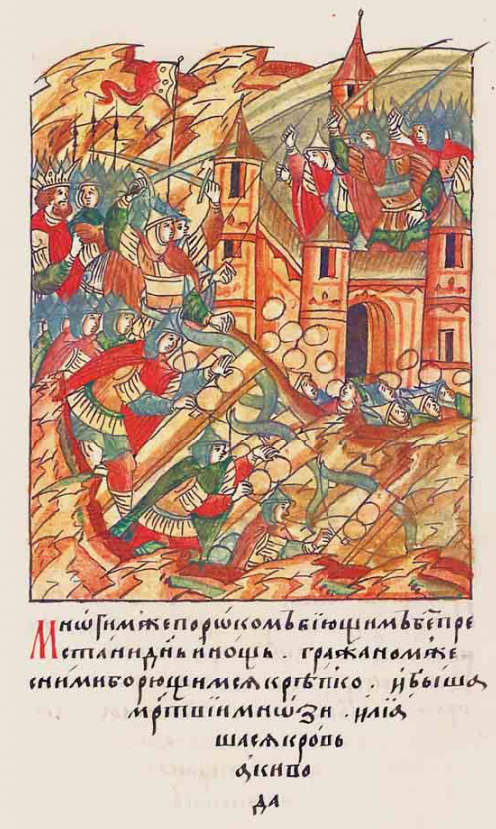
  27. Siege of Kiev by Batu in 1240 (miniature from the Russian Facial chronicle of the 16th century)

    Story 15 of 38 · Lithuanian, Polish and Cossack Ukraine

    War and conflict

    The Mongols take Kyiv

    The Mongols destroyed Kyiv and ended the Rus state.

    Next story1569 · The Union of Lublin
  28. About 330 years later

    1240 to 1569

  29. The Union of Lublin

    Story 16 of 38 · Lithuanian, Polish and Cossack Ukraine

    States and rulers

    The Union of Lublin

    Poland and Lithuania merged in a Commonwealth. Belarus lost its political independence.

    Next story1648 · The Khmelnytsky Uprising
  30. The Khmelnytsky Uprising

    Story 17 of 38 · Lithuanian, Polish and Cossack Ukraine

    War and conflict

    The Khmelnytsky Uprising

    Bohdan Khmelnytsky led the Cossacks against Polish rule and founded the Hetmanate.

    Next story1654 · The Treaty of Pereyaslav
  31. The Treaty of Pereyaslav

    Story 18 of 38 · Lithuanian, Polish and Cossack Ukraine

    States and rulers

    The Treaty of Pereyaslav

    The Cossacks swore allegiance to the Russian tsar.

    Next story1709 · The battle of Poltava
  32. The battle of Poltava

    Story 19 of 38 · Lithuanian, Polish and Cossack Ukraine

    War and conflict

    The battle of Poltava

    Peter the Great defeated Charles XII of Sweden and the Cossack hetman Mazepa.

    Next story1772 · The partitions
  33. The partitions

    Story 20 of 38 · Lithuanian, Polish and Cossack Ukraine

    States and rulers

    The partitions

    Russia, Prussia and Austria divided Poland-Lithuania in three partitions. The last gave Russia most of the Lithuanian lands.

    Next story1783 · Russia annexes Crimea
  34. Russia annexes Crimea

    Story 21 of 38 · Lithuanian, Polish and Cossack Ukraine

    States and rulers

    Russia annexes Crimea

    Catherine the Great annexed the Crimean Khanate.

    Next story1840 · The Kobzar
  35. Chapter IV

    Empires and the USSR

    9 stories in this chapter

  36. The Kobzar (picture from the Wikipedia article)

    Story 22 of 38 · Empires and the USSR

    Culture and faith

    The Kobzar

    Taras Shevchenko published poems in Ukrainian that made him the national poet.

    Next story1917 · The Ukrainian People's Republic
  37. The Ukrainian People's Republic

    Story 23 of 38 · Empires and the USSR

    States and rulers

    The Ukrainian People's Republic

    After the Russian Revolution the Central Rada proclaimed autonomy and later independence.

    Next story1917 · The Russian Civil War
  38. The Russian Civil War

    Story 24 of 38 · Empires and the USSR

    War and conflict

    The Russian Civil War

    The Red Army fought the Whites and foreign interventions. Fighting, terror, famine and disease killed millions. The tsar and his family were shot in 1918.

    Next story1917 · The Ukrainian–Soviet War
  39. Soldiers of the UNR Army in front of Saint Michael's Golden-Domed Monastery in Kyiv

    Story 25 of 38 · Empires and the USSR

    War and conflict

    The Ukrainian–Soviet War

    Ukraine fought Bolshevik Russia and lost.

    Next story1921 · The Peace of Riga
  40. Document of Riga Peace Treaty, ending Polish-Soviet war (1919-1920)

    Story 26 of 38 · Empires and the USSR

    States and rulers

    The Peace of Riga

    Poland and Soviet Russia divided Belarus and Ukraine along a border that cut through them.

    Next story1922 · The Soviet Union is founded
  41. The cover of the Declaration on the Creation of the Soviet Union, 1922

    Story 27 of 38 · Empires and the USSR

    States and rulers

    The Soviet Union is founded

    Russia, Ukraine, Belarus and the Transcaucasian republics signed a treaty creating one state ruled from Moscow.

    Next story1932 · The Holodomor
  42. Starved peasants on a street in Kharkiv, 1933, victims of Holodomor , photographed by Alexander Wienerberger

    Story 28 of 38 · Empires and the USSR

    Disasters and epidemics

    The Holodomor

    Soviet policies caused a famine that killed millions of Ukrainians.

    Next story1941 · The Babi Yar massacre
  43. The Babi Yar massacre

    Story 29 of 38 · Empires and the USSR

    War and conflict

    The Babi Yar massacre

    The Nazis shot more than 33,000 Jews in two days in a ravine near Kyiv.

    Next story1986 · The Chernobyl disaster
  44. Historical collections of the Chernobyl accident from the Ukrainian Society for Friendship and Cultural Relations with Foreign Countries (USFCRFC)

    Story 30 of 38 · Empires and the USSR

    Disasters and epidemics

    The Chernobyl disaster

    A reactor exploded at the Chernobyl plant, spreading radioactivity across Europe.

    Next story1991 · Independence
  45. Chapter V

    Independent Ukraine

    8 stories in this chapter

  46. The Act of Declaration of Independence of Ukraine, 1991

    Story 31 of 38 · Independent Ukraine

    States and rulers

    Independence

    Ukraine's parliament declared independence, and voters confirmed it by referendum on 1 December.

    Next story1991 · The Belovezha Accords
  47. “Signing the Agreement to eliminate the USSR and establish the Commonwealth of Independent States”

    Story 32 of 38 · Independent Ukraine

    States and rulers

    The Belovezha Accords

    The leaders of Russia, Ukraine and Belarus met in a forest and declared that the Soviet Union had ceased to exist.

    Next story1991 · The Soviet Union ends
  48. “Signing of Protocol on Establishing Commonwealth of Independent States”

    Story 33 of 38 · Independent Ukraine

    States and rulers

    The Soviet Union ends

    After a failed hard-line coup in August, the Soviet republics declared independence, Gorbachev resigned and the red flag came down over the Kremlin.

    Next story2004 · The Orange Revolution
  49. Morning first day of Orange Revolution

    Story 34 of 38 · Independent Ukraine

    States and rulers

    The Orange Revolution

    Mass protests overturned a rigged election and brought Viktor Yushchenko to power.

    Next story2014 · The Revolution of Dignity
  50. Euromaidan in Kyiv on 1 December 2013 by Nwssa Gnatoush

    Story 35 of 38 · Independent Ukraine

    War and conflict

    The Revolution of Dignity

    Protesters in Kyiv drove out President Yanukovych after the government killed dozens.

    Next story2014 · Russia annexes Crimea
  51. On The Scene: VOA's Elizabeth Arrott in Simferopol, Crimea (E Arrott/VOA)

    Story 36 of 38 · Independent Ukraine

    War and conflict

    Russia annexes Crimea

    Russia seized and annexed Crimea.

    Next story2014 · The war in Donbas
  52. Protests in Donetsk

    Story 37 of 38 · Independent Ukraine

    War and conflict

    The war in Donbas

    Russia-backed separatists took parts of Donetsk and Luhansk.

    Next story2022 · The full-scale invasion
  53. The consequences of a missile strike on Kyiv (6)

    Story 38 of 38 · Independent Ukraine

    War and conflict

    The full-scale invasion

    Russia launched a full-scale invasion of Ukraine.

    NextJourney's end

Journey complete

You travelled 7,525 years

38 stories, c. 5500 BC to present. More events are being researched and added.

Choose another countryBack to the start