"Hundreds of thousands descended on Washington, D.C.'s, Lincoln Memorial Aug

All countries

United States

Thousands of years of Native American history, then colonies, revolution, civil war and the rise of a superpower.

Declared independence from Britain on 4 July 1776

Stories
56
Distance
23,024 years
Route
c. 21,000 BC to 2024
  1. First peoples14 stories
  2. Colonial America5 stories
  3. A new republic13 stories
  4. Industry and world power10 stories
  5. Superpower14 stories
Begin the journey

The March on Washington, 1963. Image: Rowland Scherman · Public domain, via Wikimedia Commons

  1. Chapter I

    First peoples

    14 stories in this chapter

  2. White sands fossil footprints - clockwise from top left

    Story 1 of 56 · First peoples

    People and rights

    Footprints at White Sands

    Adults and children left footprints in the mud of an Ice Age lakeshore in New Mexico. Seeds in the layers date them to about 21,000 to 23,000 years ago.

    Next storyc. 11,000 BC · The Clovis hunters
  3. About 10,000 years later

    c. 21,000 BC to c. 11,000 BC

  4. Clovis spear point

    Story 2 of 56 · First peoples

    People and rights

    The Clovis hunters

    Hunters across North America made finely fluted stone spearpoints, first found near Clovis, New Mexico, and hunted mammoths and bison.

    Next storyc. 10,800 BC · The Folsom hunters
  5. About 200 years later

    c. 11,000 BC to c. 10,800 BC

  6. A Folsom Point — from the Paleo-indian Lithic stage Folsom tradition

    Story 3 of 56 · First peoples

    Culture and faith

    The Folsom hunters

    From about 10,800 to 10,200 BC, Paleo-Indians of the Folsom tradition hunted the extinct Bison antiquus across central North America. Their spear points, found with bison bones near Folsom, New Mexico, proved people had lived in the Americas for far longer than once believed.

    Next storyc. 9500 BC · The Spirit Cave mummy
  7. About 1,300 years later

    c. 10,800 BC to c. 9500 BC

  8. Remains of the Spirit Cave mummy still in the wrapping and cloth it was buried in

    Story 4 of 56 · First peoples

    People and rights

    The Spirit Cave mummy

    A man buried in Spirit Cave in Nevada about 11,500 years ago is the oldest human mummy found in North America. In 2016 his remains were returned to the Fallon Paiute-Shoshone Tribe.

    Next storyc. 6500 BC · The Ancient One of Kennewick
  9. About 3,000 years later

    c. 9500 BC to c. 6500 BC

  10. Fossil - Took the picture at Natural History Museum, Karlsruhe

    Story 5 of 56 · First peoples

    People and rights

    The Ancient One of Kennewick

    A skeleton eroded out of a Columbia River bank near Kennewick, Washington, in 1996. Radiocarbon dating puts the man at 8,400 to 8,700 years ago, and a lengthy legal dispute followed over who should study and keep the remains.

    Next storyc. 6000 BC · The Windover bog burials
  11. About 500 years later

    c. 6500 BC to c. 6000 BC

  12. THIS IS A PEAT BOG ACCIDENTALLY DISCOVERED IN 1982 WHICH PRESERVED THE BURIALS OF NATIVE AMERICANS 7,000 TO 8,000 YEARS AGO

    Story 6 of 56 · First peoples

    Culture and faith

    The Windover bog burials

    At Windover in Florida, people buried their dead in the peat of a shallow pond between about 8,000 and 7,000 years ago. The peat kept bones, even brain tissue, and cloth woven from plant fibres, one of the largest finds of early textiles in the Americas.

    Next storyc. 3500 BC · Watson Brake
  13. About 2,500 years later

    c. 6000 BC to c. 3500 BC

  14. Artists conception of Watson Brake, an archaeological site in Ouachita Parish, Louisiana that dates from the Archaic period

    Story 7 of 56 · First peoples

    Culture and faith

    Watson Brake

    At Watson Brake in Louisiana, Archaic hunter-gatherers raised earth mounds about 5,400 years ago. It is considered the oldest earthwork mound complex in North America.

    Next storyc. 1700 BC · Poverty Point
  15. About 1,800 years later

    c. 3500 BC to c. 1700 BC

  16. Mound A at the Poverty Point site, Louisiana, USA

    Story 8 of 56 · First peoples

    Culture and faith

    Poverty Point

    In north-eastern Louisiana, people of the Poverty Point culture built earthen ridges and mounds between 1700 and 1100 BC, in the Late Archaic period. The site is now a state historic site and a national monument.

    Next storyc. 1150 BC · The Ancestral Puebloans
  17. About 550 years later

    c. 1700 BC to c. 1150 BC

  18. The Ancestral Puebloans

    Story 9 of 56 · First peoples

    Culture and faith

    The Ancestral Puebloans

    The Ancestral Puebloans lived across the Four Corners region of the south-west, and their culture emerged around the 12th century BC. They built pit houses, large pueblos and cliff dwellings, and linked hundreds of communities across the Colorado Plateau.

    Next story500 BC · The Adena culture
  19. About 650 years later

    c. 1150 BC to 500 BC

  20. Pipe in the shape of a human being, on display at the Cleveland Museum of Art in Cleveland, Ohio

    Story 10 of 56 · First peoples

    Culture and faith

    The Adena culture

    The Adena culture, centred on today's Ohio, lasted from about 500 BC to 100 AD, in the Early Woodland period. Its related societies shared a burial complex and a ceremonial system.

    Next story100 BC · The Hopewell exchange network
  21. 400 years later

    500 BC to 100 BC

  22. A photo of the Mound City Hopewell site in en:Chillicothe, Ohio

    Story 11 of 56 · First peoples

    Culture and faith

    The Hopewell exchange network

    From about 100 BC to 500 AD, trade routes tied together many peoples of the eastern woodlands, from Lake Ontario south to Florida. The Hopewell tradition was not one society but a network of linked ones.

    Next storyc. 300 · The Hohokam
  23. About 400 years later

    100 BC to c. 300

  24. Casa Grande National Monument

    Story 12 of 56 · First peoples

    Culture and faith

    The Hohokam

    The Hohokam culture of south-central Arizona and Sonora existed from about 300 to 1500 AD, with cultural roots possibly as early as 300 BC.

    Next story900 · Chaco Canyon
  25. About 600 years later

    c. 300 to 900

  26. An image of the ruins of Chetro Ketl in Chaco Canyon (New Mexico, United States); shown is the complex's great kiva

    Story 13 of 56 · First peoples

    States and rulers

    Chaco Canyon

    Between 900 and 1150, Chaco Canyon in New Mexico was a major centre of the Ancestral Puebloans. They built fifteen great complexes, the largest buildings in North America until the 19th century.

    Next storyc. 1050 · Cahokia
  27. About 150 years later

    900 to c. 1050

  28. Cahokia

    Story 14 of 56 · First peoples

    States and rulers

    Cahokia

    On the Mississippi floodplain, the largest city north of Mexico grew around Monks Mound, an earthen pyramid 30 metres high, with perhaps 10,000 to 20,000 people at its peak.

    Next story1565 · The Spanish found St. Augustine
  29. About 520 years later

    c. 1050 to 1565

  30. Chapter II

    Colonial America

    5 stories in this chapter

  31. Collection of photos I took around St

    Story 15 of 56 · Colonial America

    States and rulers

    The Spanish found St. Augustine

    Pedro Menéndez de Avilés founded a fort and town on the Florida coast, then destroyed a nearby French Protestant colony.

    Next story1607 · Jamestown
  32. Jamestown

    Story 16 of 56 · Colonial America

    States and rulers

    Jamestown

    English colonists sent by the Virginia Company built a fort on land of the Powhatan Confederacy. Most died in the first years, but tobacco soon made the colony profitable.

    Next story1619 · Enslaved Africans reach Virginia
  33. Map of the 13 colonies; numbers = numbers of slaves (1770), colors = percentage of population enslaved

    Story 17 of 56 · Colonial America

    People and rights

    Enslaved Africans reach Virginia

    English privateers brought some 20 Africans, taken from a Portuguese slave ship, to Virginia and traded them for food.

    Next story1620 · The Pilgrims at Plymouth
  34. The recreated 17th-century village at the Plimoth Patuxet museum

    Story 18 of 56 · Colonial America

    People and rights

    The Pilgrims at Plymouth

    Religious separatists who had crossed on the Mayflower settled on the site of a Wampanoag village emptied by disease, and survived with the help of Wampanoag neighbours.

    Next story1680 · The Pueblo Revolt
  35. Loren Mozley Pueblo Revolt 1680 installed 1936 ABQ NM

    Story 19 of 56 · Colonial America

    War and conflict

    The Pueblo Revolt

    The Pueblo peoples, led by Popé, rose together against Spanish rule and drove the colonists out of New Mexico for twelve years.

    Next story1776 · The Declaration of Independence
  36. Chapter III

    A new republic

    13 stories in this chapter

  37. This is a high-resolution image of the United States Declaration of Independence ( article - text )

    Story 20 of 56 · A new republic

    States and rulers

    The Declaration of Independence

    During the war with Britain, the Continental Congress adopted Thomas Jefferson's declaration that the thirteen colonies were free and independent states, and that all men are created equal.

    Next story1781 · The first national government
  38. The Articles of Confederation, ratified in 1781

    Story 21 of 56 · A new republic

    States and rulers

    The first national government

    The thirteen states' first constitution took effect in 1781. It left Congress without the power to tax or to enforce its own laws.

    Next story1787 · The Constitution
  39. The Constitution

    Story 22 of 56 · A new republic

    States and rulers

    The Constitution

    Delegates meeting in Philadelphia agreed a new framework of government, with a president, a Congress and a Supreme Court checking one another.

    Next story1789 · Washington becomes the first president
  40. "Inauguration of George Washington", 1898 painting by Ramon Elorriaga

    Story 23 of 56 · A new republic

    States and rulers

    Washington becomes the first president

    Under the new Constitution George Washington took the oath in New York. The first Congress set up the executive departments and the federal courts.

    Next story1801 · Power changes hands without a fight
  41. 1800 Electoral College

    Story 24 of 56 · A new republic

    States and rulers

    Power changes hands without a fight

    After a deadlocked election, Federalist John Adams gave way to Thomas Jefferson. It was the first peaceful transfer of power between rival parties.

    Next story1803 · The Louisiana Purchase
  42. handover ceremony of Louisiana from France to the US, painting, Louisiana State Museum, New Orleans, LA

    Story 25 of 56 · A new republic

    States and rulers

    The Louisiana Purchase

    The United States bought France's claim to a vast territory west of the Mississippi for $15 million, doubling its size. The land itself belonged to Native nations.

    Next story1829 · Jackson's election
  43. Electoral college map for the 1828 United States presidential election

    Story 26 of 56 · A new republic

    States and rulers

    Jackson's election

    Andrew Jackson beat John Quincy Adams after most states had widened the vote to nearly all white men. Mass political parties took shape around him.

    Next story1830 · The Trail of Tears
  44. Map of the routes of the forced removals

    Story 27 of 56 · A new republic

    People and rights

    The Trail of Tears

    Under the Indian Removal Act, the government forced about 60,000 Cherokee, Muscogee, Seminole, Chickasaw and Choctaw people from their homelands. Thousands died on the way.

    Next story1836 · The Republic of Texas
  45. Engraved 1841 map of the Republic of Texas and the territories around it, with a compass rose

    Story 28 of 56 · A new republic

    States and rulers

    The Republic of Texas

    Settlers and Tejanos broke away from Mexico and ran their own republic for nearly ten years, until Texas joined the United States.

    Next story1848 · The California Gold Rush
  46. An 1849 handbill from the California Gold Rush

    Story 29 of 56 · A new republic

    Science, trade and industry

    The California Gold Rush

    Gold found at Sutter's Mill drew some 300,000 people to California from around the world. The Native population of California was devastated by violence and disease.

    Next story1860 · Lincoln wins without a Southern state
  47. 1860 Electoral College

    Story 30 of 56 · A new republic

    States and rulers

    Lincoln wins without a Southern state

    Abraham Lincoln won the presidency without carrying a single slave state. Seven Southern states left the Union before he took office.

    Next story1861 · The Confederacy
  48. Photograph of the crowd gathered before the domed Alabama State Capitol in Montgomery for Jefferson Davis's inauguration in 1861

    Story 31 of 56 · A new republic

    States and rulers

    The Confederacy

    Eleven Southern states formed a rival government with Jefferson Davis as president. It collapsed in 1865 when its armies surrendered and Davis was captured.

    Next story1861 · The Civil War
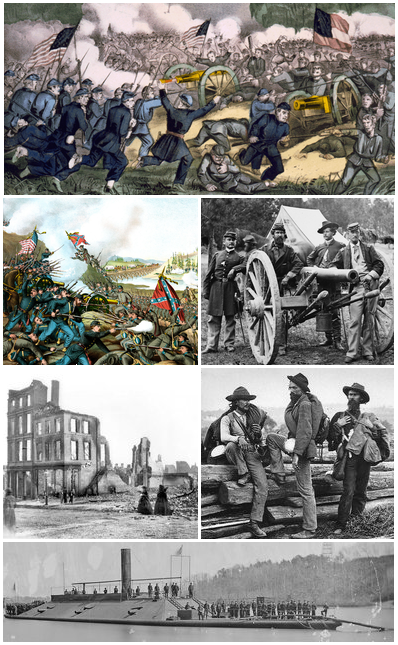
  49. A collection of American Civil War related pictures and photographs

    Story 32 of 56 · A new republic

    War and conflict

    The Civil War

    Eleven southern slave states left the Union and fought to keep slavery. After four years and about 620,000 or more deaths, the Union won.

    Next story1869 · The transcontinental railroad
  50. Chapter IV

    Industry and world power

    10 stories in this chapter

  51. Celebration of completion of the First Transcontinental Railroad at what is now Golden Spike National Historic Site , Promontory Summit, Utah

    Story 33 of 56 · Industry and world power

    Science, trade and industry

    The transcontinental railroad

    A golden spike joined the Union Pacific and Central Pacific railways, built largely by Irish and Chinese workers.

    Next story1877 · Reconstruction ends
  52. A cartoon on the compromise that settled the disputed 1876 election

    Story 34 of 56 · Industry and world power

    States and rulers

    Reconstruction ends

    After a disputed election Rutherford Hayes took the presidency and federal troops left the South. Southern white governments took back control of state politics.

    Next story1890 · The Wounded Knee Massacre
  53. The monument at the mass grave of those killed at Wounded Knee

    Story 35 of 56 · Industry and world power

    War and conflict

    The Wounded Knee Massacre

    The US Army killed about 250 or more Lakota men, women and children at Wounded Knee Creek.

    Next story1893 · The Hawaiian monarchy is overthrown
  54. Bluejackets of the U.S.S

    Story 36 of 56 · Industry and world power

    States and rulers

    The Hawaiian monarchy is overthrown

    A committee of American and European businessmen, backed by US Marines, removed Queen Liliʻuokalani. The islands were annexed by the United States in 1898.

    Next story1903 · The first powered flight
  55. First successful flight of the Wright Flyer , by the Wright brothers

    Story 37 of 56 · Industry and world power

    Science, trade and industry

    The first powered flight

    Orville and Wilbur Wright flew a powered, controlled aeroplane for 12 seconds over the sand dunes of North Carolina.

    Next story1906 · The San Francisco earthquake
  56. San Francisco Earthquake of 1906: Ruins in vicinity of Post and Grant Avenue

    Story 38 of 56 · Industry and world power

    Disasters and epidemics

    The San Francisco earthquake

    A huge earthquake on the San Andreas Fault, and the fires that followed, destroyed most of San Francisco and killed about 3,000 people.

    Next story1920 · Women win the vote
  57. Alice Paul unfurling the suffrage ratification banner from a balcony, August 1920

    Story 39 of 56 · Industry and world power

    People and rights

    Women win the vote

    After seven decades of campaigning, an amendment barred states from denying the vote on account of sex.

    Next story1929 · The Wall Street Crash
  58. A solemn crowd gathers outside the Stock Exchange after the crash

    Story 40 of 56 · Industry and world power

    Science, trade and industry

    The Wall Street Crash

    Share prices collapsed on the New York Stock Exchange, wiping out fortunes and savings.

    Next story1932 · Roosevelt wins the Depression election
  59. 1932 Electoral College

    Story 41 of 56 · Industry and world power

    States and rulers

    Roosevelt wins the Depression election

    Franklin Roosevelt beat President Hoover by a wide margin. Democrats then held the White House for twenty years.

    Next story1941 · Pearl Harbor
  60. A navy photographer snapped this photograph of the Japanese attack on Pearl Harbor in Hawaii on December 7, 1941, just as the USS Shaw exploded

    Story 42 of 56 · Industry and world power

    War and conflict

    Pearl Harbor

    Japanese aircraft attacked the US Pacific Fleet in Hawaii, killing more than 2,400 Americans.

    Next story1945 · The first atomic bomb
  61. Chapter V

    Superpower

    14 stories in this chapter

  62. PA-98-0520 — Trinity Site explosion , 0.016 second after explosion, July 16, 1945

    Story 43 of 56 · Superpower

    Science, trade and industry

    The first atomic bomb

    Scientists of the Manhattan Project exploded the first nuclear weapon in the New Mexico desert.

    Next story1954 · Brown v. Board of Education
  63. Soldiers escort the Little Rock Nine to Central High School in 1957, enforcing the Brown ruling

    Story 44 of 56 · Superpower

    People and rights

    Brown v. Board of Education

    The Supreme Court ruled unanimously that separate schools for Black and white children were unconstitutional.

    Next story1963 · The March on Washington
  64. "Hundreds of thousands descended on Washington, D.C.'s, Lincoln Memorial Aug

    Story 45 of 56 · Superpower

    People and rights

    The March on Washington

    About 250,000 people marched for civil rights, and Martin Luther King Jr. gave his 'I Have a Dream' speech at the Lincoln Memorial.

    Next story1963 · President Kennedy is shot
  65. Picture of President Kennedy in the limousine in Dallas, Texas, on Main Street, minutes before the assassination

    Story 46 of 56 · Superpower

    States and rulers

    President Kennedy is shot

    President John F. Kennedy was shot dead while riding in an open car through Dallas.

    Next story1969 · Apollo 11 sets off for the Moon
  66. The Apollo 11 lunar landing mission crew, pictured from left to right, Neil A

    Story 47 of 56 · Superpower

    Science, trade and industry

    Apollo 11 sets off for the Moon

    A Saturn V rocket launched Neil Armstrong, Buzz Aldrin and Michael Collins. Four days later Armstrong and Aldrin walked on the Moon.

    Next story1974 · Nixon resigns
  67. Richard Nixon's presidential portrait

    Story 48 of 56 · Superpower

    States and rulers

    Nixon resigns

    Facing impeachment over the Watergate cover-up, Richard Nixon became the only president to resign. Gerald Ford took over.

    Next story1980 · Reagan wins in a landslide
  68. Map of the 1980 Electoral College result, with Reagan winning 44 states

    Story 49 of 56 · Superpower

    States and rulers

    Reagan wins in a landslide

    Ronald Reagan beat President Carter and carried 44 states. Republicans also took the Senate for the first time in 26 years.

    Next story2000 · Bush v. Gore
  69. (en) results of the U.S

    Story 50 of 56 · Superpower

    States and rulers

    Bush v. Gore

    The result hung on a few hundred votes in Florida. The Supreme Court stopped a recount and George W. Bush became president though Al Gore won more votes nationally.

    Next story2001 · The September 11 attacks
  70. The northeast face of Two World Trade Center (south tower) after being struck by plane in the south face

    Story 51 of 56 · Superpower

    War and conflict

    The September 11 attacks

    Al-Qaeda terrorists hijacked four airliners, destroying the World Trade Center towers and damaging the Pentagon. Nearly 3,000 people were killed.

    Next story2005 · Hurricane Katrina
  71. Hurricane Katrina on August 28, 2005

    Story 52 of 56 · Superpower

    Disasters and epidemics

    Hurricane Katrina

    The storm broke the levees protecting New Orleans and flooded most of the city. About 1,400 people died.

    Next story2008 · Barack Obama is elected
  72. Crowds in Grant Park, Chicago, on election night 2008

    Story 53 of 56 · Superpower

    States and rulers

    Barack Obama is elected

    Barack Obama won the presidency, becoming the first African American elected to the office.

    Next story2016 · Trump wins
  73. Electoral college map for the 2016 United States presidential election (note: Nebraska and Maine split their EVs by congressional district)

    Story 54 of 56 · Superpower

    States and rulers

    Trump wins

    Donald Trump won the Electoral College while Hillary Clinton led the national vote by almost three million.

    Next story2020 · Biden defeats Trump
  74. Joe Biden and Donald Trump

    Story 55 of 56 · Superpower

    States and rulers

    Biden defeats Trump

    Joe Biden won the presidency in an election held during the pandemic, with record turnout. Trump disputed the result, and his supporters stormed the Capitol on 6 January 2021.

    Next story2024 · Trump returns to office
  75. Map of the Electoral College for the 2024 United States presidential election

    Story 56 of 56 · Superpower

    States and rulers

    Trump returns to office

    Donald Trump beat Kamala Harris, who had replaced President Biden as the Democratic candidate that summer. He was the second president to win non-consecutive terms.

    NextJourney's end

Journey complete

You travelled 23,024 years

56 stories, c. 21,000 BC to 2024. More events are being researched and added.

Choose another countryBack to the start