Battle of Trenton, a painting

All major events

The American Revolution

Thirteen British colonies on the Atlantic coast fell out with Parliament over taxes and representation, then over the Crown itself. After eight years of war, and with help from France, they became the United States.

Ended with the Treaty of Paris in 1783, in which Britain recognised American independence.

Stories
18
Distance
18 years
Route
1765 to 1783
  1. The road to revolution5 stories
  2. The war for independence12 stories
  3. Peace1 story
Begin the journey

Washington crosses the Delaware, 1776. Image: Hugh Charles McBarron Jr., published by the US Government Printing Office · Public domain, via Wikimedia Commons

  1. Chapter I

    The road to revolution

    5 stories in this chapter

  2. Exhibit in the National Museum of American History, Washington, DC, USA

    Story 1 of 18 · The road to revolution

    Politics and diplomacy

    The Stamp Act

    Parliament taxed printed paper in the American colonies, from legal documents to newspapers and playing cards, to help pay for Britain's debts. Colonists protested, boycotted British goods and forced its repeal the next year.

    Next story1770 · The Boston Massacre
  3. The bloody massacre perpetrated in King Street Boston on March 5th 1770 by a party of the 29th Regt

    Story 2 of 18 · The road to revolution

    People and society

    The Boston Massacre

    British soldiers guarding the customs house fired into an angry crowd in Boston, killing five colonists. The soldiers were tried, and most were acquitted, defended by John Adams. Patriots made the event famous.

    Next story1773 · The Boston Tea Party
  4. A work of art by Nathayel Corrier entitled "Tea sabotage in Boston Port"

    Story 3 of 18 · The road to revolution

    Revolt and resistance

    The Boston Tea Party

    Protesters, some in Mohawk dress, boarded three ships and threw 342 chests of East India Company tea into Boston Harbor to defy the Tea Act. Britain answered by closing the port.

    Next story1774 · The First Continental Congress
  5. The First Continental Congress

    Story 4 of 18 · The road to revolution

    Politics and diplomacy

    The First Continental Congress

    Delegates from twelve colonies met in Philadelphia to answer Britain's punishing Coercive Acts, which colonists called the Intolerable Acts. They called for a boycott of British goods and prepared for resistance.

    Next story1775 · Lexington and Concord
  6. Battle of Lexington

    Story 5 of 18 · The road to revolution

    Battles and campaigns

    Lexington and Concord

    British troops marched from Boston to seize colonial military supplies at Concord. Militia met them at Lexington and Concord, and fought them all the way back. These were the first battles of the war.

    Next story1775 · Battle of Bunker Hill
  7. Chapter II

    The war for independence

    12 stories in this chapter

  8. Battle of Bunker Hill

    Story 6 of 18 · The war for independence

    Battles and campaigns

    Battle of Bunker Hill

    British troops took a hill overlooking Boston after three assaults on colonial earthworks, but over 1,000 of their men were killed or wounded, about two in five of those engaged. The Americans ran short of powder and withdrew.

    Next story1775 · Dunmore's Proclamation
  9. Portrait of Lord Dunmore, Virginia's royal governor, by Sir Joshua Reynolds

    Story 7 of 18 · The war for independence

    People and society

    Dunmore's Proclamation

    Lord Dunmore, Virginia's royal governor, offered freedom to enslaved people owned by rebels who would join the British. Within weeks hundreds of enslaved men, women and children left their owners and went to British lines.

    Next story1776 · Thomas Paine publishes Common Sense
  10. Scan of title page of Common Sense, the pamphlet

    Story 8 of 18 · The war for independence

    Ideas and culture

    Thomas Paine publishes Common Sense

    Thomas Paine, a recent immigrant, published a plain-spoken pamphlet attacking monarchy and arguing for independence. It sold in huge numbers and made independence a respectable idea.

    Next story1776 · The Declaration of Independence
  11. This is a high-resolution image of the United States Declaration of Independence ( article - text )

    Story 9 of 18 · The war for independence

    Politics and diplomacy

    The Declaration of Independence

    Congress approved Thomas Jefferson's statement explaining why the thirteen colonies were free of Britain. It said that all men are created equal and have rights governments exist to protect, while enslaving many of its own people.

    Next story1776 · Battle of Long Island
  12. Modern painting of Continental soldiers firing from a hillside during the battle of Long Island

    Story 10 of 18 · The war for independence

    Battles and campaigns Unverified

    Battle of Long Island

    Weeks after independence was declared, General Howe's army, landed from a huge fleet, outflanked Washington's troops in Brooklyn and routed them. Washington slipped the rest of his army across the East River at night, but New York was lost.

    Next story1776 · Washington crosses the Delaware
  13. Battle of Trenton, a painting

    Story 11 of 18 · The war for independence

    Battles and campaigns

    Washington crosses the Delaware

    After a string of defeats, Washington led his army across the ice-choked Delaware on Christmas night and surprised the Hessian garrison at Trenton at dawn, taking some 800 to 900 prisoners.

    Next story1777 · Battles of Saratoga
  14. Battles of Saratoga

    Story 12 of 18 · The war for independence

    Battles and campaigns

    Battles of Saratoga

    A British army marching south from Canada under Burgoyne was stopped twice, surrounded, and surrendered with nearly 6,000 men.

    Next story1777 · Winter at Valley Forge
  15. George Washington and Lafayette at Valley Forge

    Story 13 of 18 · The war for independence

    Battles and campaigns

    Winter at Valley Forge

    The Continental Army spent a bitter winter in huts near Philadelphia, short of food and clothing; roughly 1,700 to 2,000 men died, mostly of disease. The Prussian officer Baron von Steuben drilled the survivors into a better army.

    Next story1778 · France joins the war
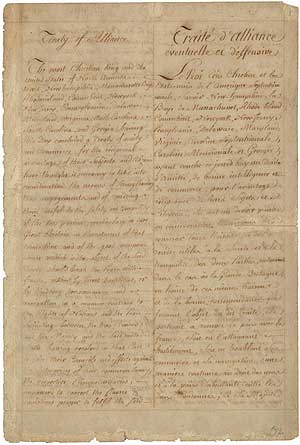
  16. Franco American treaty of alliance 6 feb 1778

    Story 14 of 18 · The war for independence

    Politics and diplomacy

    France joins the war

    After Saratoga, France recognised the United States and signed an alliance with it. French money, ships and soldiers followed, and Spain and the Dutch Republic later joined the war against Britain.

    Next story1780 · The fall of Charleston
  17. Painting of British warships and troops before the forts of Charleston harbour

    Story 15 of 18 · The war for independence

    Battles and campaigns

    The fall of Charleston

    Having failed in the north, Britain turned south. A British army and fleet besieged Charleston for six weeks until General Benjamin Lincoln surrendered the town and his whole garrison.

    Next story1781 · Battle of the Chesapeake
  18. Painting of French ships of the line firing broadsides at the battle off the Virginia Capes

    Story 16 of 18 · The war for independence

    Battles and campaigns

    Battle of the Chesapeake

    A French fleet under the Comte de Grasse met a British fleet under Admiral Graves off the mouth of Chesapeake Bay. The fight itself was indecisive, but the British sailed back to New York, leaving the French in control of the bay.

    Next story1781 · The siege of Yorktown
  19. The siege of Yorktown

    Story 17 of 18 · The war for independence

    Battles and campaigns

    The siege of Yorktown

    Washington's army and a French army under Rochambeau trapped Lord Cornwallis in Virginia while a French fleet blocked his escape by sea. He surrendered about 8,000 men.

    Next story1783 · The Treaty of Paris
  20. Chapter III

    Peace

    1 story in this chapter

  21. The last page of the 1783 Treaty of Paris

    Story 18 of 18 · Peace

    Politics and diplomacy

    The Treaty of Paris

    Britain recognised the United States and gave it land west to the Mississippi River. Nothing in it protected the Native nations whose lands this was, or most of the enslaved people the war had freed.

    NextJourney's end

Journey complete

You travelled 18 years

18 stories, 1765 to 1783. More turning points are being researched and added.

Choose another eventBack to the start