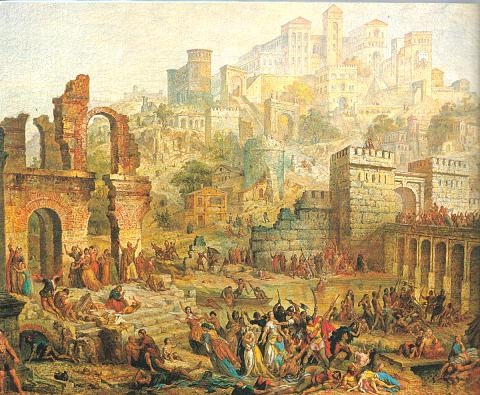
Capture of Jerusalem during the First Crusade, 1099

All major events

The Crusades

From 1095, Christian armies from western Europe marched to the eastern Mediterranean to take Jerusalem and the Holy Land. It set off two centuries of war, trade and exchange between Latin Christians, Muslim states and the Byzantine Empire.

Ended in 1291, when the last major Crusader stronghold on the mainland fell.

Stories
21
Distance
195 years
Route
1095 to 1291
  1. The First Crusade5 stories
  2. The Crusader states2 stories
  3. Saladin and Richard6 stories
  4. The later crusades8 stories
Begin the journey

The crusaders take Jerusalem, 1099. Image: Unknown author · Public domain, via Wikimedia Commons

  1. Chapter I

    The First Crusade

    5 stories in this chapter

  2. Miniature: Pope Urban II preaching at the Council of Clermont

    Story 1 of 21 · The First Crusade

    Politics and diplomacy

    Pope Urban II calls for a crusade

    At the close of a church council in central France, Urban II urged the knights of Europe to help the Byzantine emperor against the Seljuk Turks and to free Jerusalem, promising spiritual reward. The response was far bigger than he had expected.

    Next story1096 · The Rhineland massacres
  3. Massacre of Jewish people in Metz (Holy Roman Empire) during the First Crusade

    Story 2 of 21 · The First Crusade

    People and society

    The Rhineland massacres

    Crusader bands and local townspeople attacked Jewish communities in Speyer, Worms, Mainz and Cologne on the way east. Some bishops tried to shelter Jews; many Jews chose death over forced baptism.

    Next story1097 · Battle of Dorylaeum
  4. Medieval manuscript painting of crusader knights charging Turkish horsemen

    Story 3 of 21 · The First Crusade

    Battles and campaigns

    Battle of Dorylaeum

    Marching across Anatolia after taking Nicaea, the crusaders had split into two columns. The Seljuk sultan Kilij Arslan fell on Bohemond's column and nearly destroyed it, until the second column arrived and turned the battle into a Seljuk rout.

    Next story1097 · Siege of Antioch
  5. Detail of a medieval miniature of the Siege of Antioch from Sébastien Mamerot's Les Passages d'Outremer

    Story 4 of 21 · The First Crusade

    Battles and campaigns

    Siege of Antioch

    The crusaders besieged the great walled city for eight months and took it by betrayal from within, only to find themselves besieged in turn by a Muslim relief army. They broke out and defeated it outside the walls.

    Next story1099 · The crusaders take Jerusalem
  6. Capture of Jerusalem during the First Crusade, 1099

    Story 5 of 21 · The First Crusade

    Battles and campaigns

    The crusaders take Jerusalem

    After a five-week siege the crusaders stormed Jerusalem. Estimates of the Muslim and Jewish dead in the sack run from hundreds to many thousands. The massacre is remembered with horror in the Muslim world and among Jews.

    Next story1144 · Edessa falls
  7. Chapter II

    The Crusader states

    2 stories in this chapter

  8. Map of the Crusader states in 1135

    Story 6 of 21 · The Crusader states

    Battles and campaigns

    Edessa falls

    Zengi, the Muslim ruler of Mosul and Aleppo, took Edessa, capital of the first and most exposed Crusader state, after a month's siege. News of the loss shocked Europe.

    Next story1147 · The Second Crusade
  9. Asia Minor and the States of the Crusaders in Syria, about 1140

    Story 7 of 21 · The Crusader states

    Battles and campaigns

    The Second Crusade

    Armies led by Louis VII of France and Conrad III of Germany marched east and were mauled crossing Anatolia. In 1148 they besieged Damascus, a Muslim city that had been friendly to the Crusaders. The siege failed within a week.

    Next story1187 · Battle of Hattin
  10. Chapter III

    Saladin and Richard

    6 stories in this chapter

  11. Battle of Hattin

    Story 8 of 21 · Saladin and Richard

    Battles and campaigns

    Battle of Hattin

    Saladin trapped the army of the Kingdom of Jerusalem on a waterless plateau in July heat and destroyed it. King Guy was captured, and within months most of the Crusader cities had surrendered.

    Next story1187 · Saladin retakes Jerusalem
  12. Balian of Ibelin surrendering the city of Jerusalem to Saladin

    Story 9 of 21 · Saladin and Richard

    Battles and campaigns

    Saladin retakes Jerusalem

    After a short siege Saladin accepted Jerusalem's surrender on terms. Christians who could pay a ransom were allowed to leave, those who could not were enslaved. He did not massacre the population as the crusaders had in 1099.

    Next story1189 · The Third Crusade
  13. Philippe Auguste assiège Acre durant la troisième croisade

    Story 10 of 21 · Saladin and Richard

    Battles and campaigns

    The Third Crusade

    Jerusalem's fall brought a force of kings: Richard I of England, Philip II of France and the Emperor Frederick Barbarossa, who drowned on the way. Richard and Saladin fought to a standstill.

    Next story1189 · Siege of Acre
  14. Philippe Auguste et Richard Cœur de Lion reçoivent les clés d'Acre (1191)

    Story 11 of 21 · Saladin and Richard

    Battles and campaigns

    Siege of Acre

    The Crusaders besieged Acre for almost two years while Saladin's army besieged them in turn. Richard's arrival in 1191 tipped the balance. Afterwards, on his orders, about 2,500 Muslim prisoners (some accounts say 2,700 or 3,000) were killed.

    Next story1191 · Battle of Arsuf
  15. Battle of Arsuf

    Story 12 of 21 · Saladin and Richard

    Battles and campaigns

    Battle of Arsuf

    Marching south along the coast, Richard kept his army together under heavy attack from Saladin's archers until he judged the moment to charge. The victory showed that Saladin could be beaten in the open.

    Next story1192 · The Treaty of Ramla
  16. Richard I of England at the Battle of Jaffa

    Story 13 of 21 · Saladin and Richard

    Politics and diplomacy

    The Treaty of Ramla

    Richard and Saladin agreed a three-year truce. The Crusaders kept the coast from Tyre to Jaffa, Jerusalem stayed in Muslim hands, and unarmed Christian pilgrims could visit the city.

    Next story1204 · The sack of Constantinople
  17. Chapter IV

    The later crusades

    8 stories in this chapter

  18. The Taking of Constantinople

    Story 14 of 21 · The later crusades

    Battles and campaigns

    The sack of Constantinople

    A crusade meant for Egypt was diverted by debts to Venice and by a Byzantine succession quarrel. The crusaders stormed and plundered Constantinople, the greatest Christian city, for three days and set up a Latin Empire.

    Next story1209 · The Albigensian Crusade
  19. The Albigensian Crusade

    Story 15 of 21 · The later crusades

    Battles and campaigns

    The Albigensian Crusade

    The pope called a crusade against the Cathars, a Christian movement he judged heretical, in southern France. It brought northern barons into the south and ended with the region under the French crown.

    Next story1212 · The Children's Crusade
  20. The Childrens Crusade

    Story 16 of 21 · The later crusades

    People and society

    The Children's Crusade

    Stories tell of thousands of young people who set out from France and Germany to take Jerusalem by faith alone. Accounts are thin and later embellished, but they show how widespread crusading fervour had become.

    Next story1217 · The Fifth Crusade
  21. The Conquest of Damiate

    Story 17 of 21 · The later crusades

    Battles and campaigns

    The Fifth Crusade

    The Crusaders took the Egyptian port of Damietta after a long siege, then lost their army marching on Cairo as the Nile flooded around them. They gave Damietta back in return for their lives.

    Next story1229 · Frederick II takes Jerusalem by treaty
  22. Frederick II (left) meets al-Kamil (right)

    Story 18 of 21 · The later crusades

    Politics and diplomacy

    Frederick II takes Jerusalem by treaty

    The Holy Roman Emperor Frederick II, excommunicated by the pope, recovered Jerusalem, Bethlehem and Nazareth by agreement with Sultan al-Kamil, without a major battle. Hardliners on both sides disapproved.

    Next story1244 · Jerusalem is lost again
  23. 18th-century engraving of siege towers and bridges set against the walls of Jerusalem

    Story 19 of 21 · The later crusades

    Battles and campaigns Unverified

    Jerusalem is lost again

    Fifteen years after Frederick II won Jerusalem back by treaty, a Khwarazmian cavalry army, displaced westwards by the Mongols, stormed the poorly defended city and sacked it. Weeks later the Crusaders and their Syrian allies were crushed at La Forbie.

    Next story1248 · The Seventh Crusade
  24. Louis IX on a ship departing from Aigues-Mortes, for the Seventh Crusade

    Story 20 of 21 · The later crusades

    Battles and campaigns

    The Seventh Crusade

    Louis IX of France invaded Egypt and took Damietta, but his army was beaten at Mansurah and he was captured. He paid a vast ransom and stayed for years in the Holy Land.

    Next story1291 · Acre falls
  25. The Hospitalier Master Mathieu de Clermont defending the walls in 1291

    Story 21 of 21 · The later crusades

    Battles and campaigns

    Acre falls

    The Mamluk sultan al-Ashraf Khalil besieged and stormed Acre, the last major Crusader city in the Holy Land. Within three months the remaining coastal strongholds were given up.

    NextJourney's end

Journey complete

You travelled 195 years

21 stories, 1095 to 1291. More turning points are being researched and added.

Choose another eventBack to the start