Prise de la Bastille by Jean-Pierre-Louis-Laurent Houel

All major events

The French Revolution

In 1789 a financial crisis turned into a revolution that overthrew the French monarchy, declared the rights of man, executed a king, and unleashed terror and war. It changed how people thought about citizens, nations and power.

Ended in 1799, when Napoleon took power.

Stories
22
Distance
11 years
Route
1789 to 1799
  1. A new order10 stories
  2. War and the republic7 stories
  3. The Terror2 stories
  4. Thermidor to Napoleon3 stories
Begin the journey

The storming of the Bastille, 1789. Image: Jean-Pierre Houël · Public domain, via Wikimedia Commons

  1. Chapter I

    A new order

    10 stories in this chapter

  2. Oil painting "Opening of the Estates General at Versailles on 5th May 1789"; painted in 1839 by Louis Charles Auguste Couder

    Story 1 of 22 · A new order

    Politics and diplomacy

    The Estates-General meets

    Louis XVI called the Estates-General for the first time in 175 years to deal with the state's debts. A quarrel over how to vote, with the clergy and nobles outvoting the common people, set the Third Estate against the king.

    Next story1789 · The Tennis Court Oath
  3. The Tennis Court Oath

    Story 2 of 22 · A new order

    Politics and diplomacy

    The Tennis Court Oath

    Locked out of their meeting hall, delegates of the Third Estate gathered in a nearby indoor tennis court and swore not to separate until France had a constitution. They had already declared themselves a National Assembly.

    Next story1789 · The storming of the Bastille
  4. Prise de la Bastille by Jean-Pierre-Louis-Laurent Houel

    Story 3 of 22 · A new order

    Revolt and resistance

    The storming of the Bastille

    A Paris crowd, hunting for gunpowder, stormed the royal fortress-prison. Only seven prisoners were inside, and around a hundred attackers died. The governor was killed and his head paraded on a pike.

    Next story1789 · Feudal privileges are abolished
  5. Print of the National Assembly's night session of 4 August 1789, when feudal privileges were abolished

    Story 4 of 22 · A new order

    Politics and diplomacy

    Feudal privileges are abolished

    In one night, nobles and clergy in the National Assembly gave up their special rights, from hunting privileges to feudal dues and church tithes. The decrees were then written into law over the following days.

    Next story1789 · The Declaration of the Rights of Man
  6. La Déclaration des droits de l'homme et du citoyen de 1789, une des premières consécration juridiques de droits fondamentaux

    Story 5 of 22 · A new order

    Ideas and culture

    The Declaration of the Rights of Man

    The National Assembly proclaimed that men are born and remain free and equal in rights, and that sovereignty rests with the nation. It did not extend these rights to women or to enslaved people in the colonies.

    Next story1789 · The Women's March on Versailles
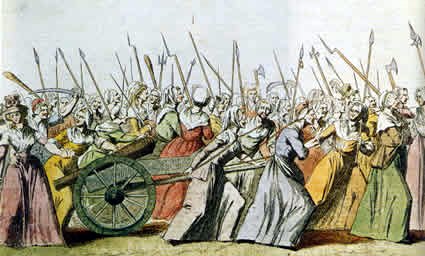
  7. Women’s March on Versailles , 5-6 october 1789

    Story 6 of 22 · A new order

    Revolt and resistance

    The Women's March on Versailles

    Thousands of Parisian women, angry at the price of bread, marched about twenty kilometres to Versailles in the rain. They made the king and royal family come back with them to Paris, where they lived as virtual prisoners.

    Next story1790 · The Civil Constitution of the Clergy
  8. ANC, Louis XVI - Proclamation du roi pour la Constitution civile du Clergé, 24 août 1790

    Story 7 of 22 · A new order

    Politics and diplomacy

    The Civil Constitution of the Clergy

    The Assembly reorganised the Catholic Church in France as a state institution, with priests and bishops elected and paid by the state. The pope condemned it, and many priests refused the oath.

    Next story1791 · The flight to Varennes
  9. Engraving of the royal family's coach being stopped by a crowd at Varennes

    Story 8 of 22 · A new order

    Politics and diplomacy

    The flight to Varennes

    Louis XVI and his family tried to slip away from Paris in disguise to reach royalist troops near the frontier. He was recognised and stopped at Varennes and returned to Paris under guard.

    Next story1791 · The Champ de Mars massacre
  10. Engraving of the National Guard proclaiming martial law on the Champ de Mars, 17 July 1791

    Story 9 of 22 · A new order

    Revolt and resistance

    The Champ de Mars massacre

    After the king's failed flight, a crowd gathered on the Champ de Mars in Paris to sign a petition for his removal. Martial law was declared, and the National Guard under Lafayette fired on the crowd; estimates of the dead run from a dozen to about fifty.

    Next story1792 · France goes to war
  11. France goes to war

    Story 10 of 22 · A new order

    Battles and campaigns

    France goes to war

    The Assembly declared war on Austria, hoping to spread the Revolution and unite the country. The French armies did badly at first, and the war became a European war that lasted, with short pauses, for 23 years.

    Next story1792 · The monarchy falls
  12. Chapter II

    War and the republic

    7 stories in this chapter

  13. Depiction of the storming of the Tuileries Palace on 10 august 1792

    Story 11 of 22 · War and the republic

    Revolt and resistance

    The monarchy falls

    Parisians and volunteers from the provinces stormed the Tuileries Palace, defended by the king's Swiss Guard, after the Prussians threatened to destroy Paris if the king were harmed. Louis was suspended and imprisoned.

    Next story1792 · The September Massacres
  14. Massacre à la Salpêtrière, 3 septembre 1792

    Story 12 of 22 · War and the republic

    People and society

    The September Massacres

    As Prussian armies advanced, Parisians who feared that prisoners would rise and join the invaders killed about 1,200 of them in the city's prisons over five days, among them priests and ordinary criminals.

    Next story1792 · Battle of Valmy
  15. The Battle of Valmy , September 20th, 1792

    Story 13 of 22 · War and the republic

    Battles and campaigns

    Battle of Valmy

    A French army of mixed volunteers and professionals held its ground against a Prussian advance at Valmy, mostly in an artillery duel. The Prussians retreated. The republic was proclaimed the next day.

    Next story1793 · Louis XVI is executed
  16. Execution of Louis XVI – copperplate engraving 1793

    Story 14 of 22 · War and the republic

    Politics and diplomacy

    Louis XVI is executed

    Found guilty of treason by the National Convention, the former king was guillotined in the Place de la Révolution, now the Place de la Concorde. Many European monarchies were horrified, and Britain and Spain joined the war against France.

    Next story1793 · The war in the Vendée
  17. The war in the Vendée

    Story 15 of 22 · War and the republic

    Revolt and resistance

    The war in the Vendée

    In western France, peasants and local nobles rose against conscription into the revolutionary army and against attacks on the Church. The Republic put the rising down with great ferocity; estimates of the dead run well over 100,000, with some at 170,000 or more.

    Next story1793 · The levée en masse
  18. Printed decree of the National Convention of 23 August 1793 ordering the levée en masse

    Story 16 of 22 · War and the republic

    People and society

    The levée en masse

    Facing invasion on every side, the Convention placed all French people at the service of the war and called up unmarried men aged 18 to 25. The army grew to well over a million on paper.

    Next story1793 · The Reign of Terror
  19. Marie Antoinette's execution in 1793 at the Place de la Révolution

    Story 17 of 22 · War and the republic

    People and society

    The Reign of Terror

    Under a Committee of Public Safety dominated by Robespierre, the Revolution used revolutionary courts and the guillotine against suspected enemies. About 17,000 were officially executed, and many more died in prison or without trial.

    Next story1794 · France abolishes slavery
  20. Chapter III

    The Terror

    2 stories in this chapter

  21. Décret d'abolition de l’esclavage par la Convention

    Story 18 of 22 · The Terror

    Politics and diplomacy

    France abolishes slavery

    Prompted by revolt in Saint-Domingue, the Convention freed all enslaved people in France's colonies and made them citizens. It was the first major European abolition. Napoleon restored slavery in 1802.

    Next story1794 · Robespierre falls
  22. Valery Jacobi (1834-1902) Ninth Thermidor

    Story 19 of 22 · The Terror

    Politics and diplomacy

    Robespierre falls

    Fearing they would be next, members of the Convention turned on Robespierre and had him arrested. He was guillotined the next day with his closest allies. The Terror was soon relaxed.

    Next story1795 · The Directory
  23. Chapter IV

    Thermidor to Napoleon

    3 stories in this chapter

  24. Members of the French Directory in their official robes

    Story 20 of 22 · Thermidor to Napoleon

    Politics and diplomacy

    The Directory

    A five-man Directory took charge under a new constitution. It was unstable, widely seen as corrupt, and relied on the army to stay in power, annulling elections it did not like.

    Next story1796 · Napoleon's Italian campaign
  25. Napoleon's Italian campaign

    Story 21 of 22 · Thermidor to Napoleon

    Battles and campaigns

    Napoleon's Italian campaign

    A young general, Napoleon Bonaparte, took command of a poor, ragged French army in northern Italy and beat the Austrians and their allies in rapid succession. He negotiated peace on his own authority.

    Next story1799 · Napoleon seizes power
  26. Napoleon seizes power

    Story 22 of 22 · Thermidor to Napoleon

    Politics and diplomacy

    Napoleon seizes power

    General Napoleon Bonaparte and fellow plotters overthrew France's Directory and made themselves consuls. Napoleon soon became the sole ruler as First Consul.

    NextJourney's end

Journey complete

You travelled 11 years

22 stories, 1789 to 1799. More turning points are being researched and added.

Choose another eventBack to the start