Léonidas aux Thermopyles (Jacques-Louis David)

All major events

The Greco-Persian Wars

Twice the vast Persian Empire sent armies and fleets against Greece, and twice a handful of quarrelling city-states beat them back, in a struggle that shaped the Greek world and, through it, much of what came after.

Ended around 449 BC, with the Persians out of the Aegean.

Stories
15
Distance
50 years
Route
499 BC to c. 449 BC
  1. The Ionian Revolt3 stories
  2. Darius sends armies3 stories
  3. Xerxes invades6 stories
  4. The Greeks take the offensive3 stories
Begin the journey

Battle of Thermopylae, 480 BC. Image: Jacques-Louis David · Public domain, via Wikimedia Commons

  1. Chapter I

    The Ionian Revolt

    3 stories in this chapter

  2. Regional map of Asia Minor in the 2nd Century BC

    Story 1 of 15 · The Ionian Revolt

    Revolt and resistance

    The Ionian Revolt

    Greek cities on the coast of Anatolia rose against Persian rule and the tyrants Persia backed. Athens and Eretria sent a few ships, and the rebels burned Sardis, but the revolt was ground down over six years.

    Next story498 BC · Sardis burns
  3. The burning of Sardis during the Ionian Revolt

    Story 2 of 15 · The Ionian Revolt

    Battles and campaigns

    Sardis burns

    An Ionian and Athenian force marched inland and took the Persian regional capital of Sardis. A fire started in the houses and spread through the city, destroying the temple of Cybele. The raiders were driven off on the way home.

    Next story494 BC · Battle of Lade
  4. Map of the Ionian coast, showing Mycale, Lade and Miletus

    Story 3 of 15 · The Ionian Revolt

    Battles and campaigns

    Battle of Lade

    The Ionian fleet was beaten off the island of Lade by a larger Persian fleet after several of its squadrons withdrew. Miletus, the heart of the revolt, was taken and sacked soon after.

    Next story492 BC · Mardonius's expedition
  5. Chapter II

    Darius sends armies

    3 stories in this chapter

  6. Mount Athos seen from Sarti, off which a Persian fleet was wrecked in 492 BC

    Story 4 of 15 · Darius sends armies

    Battles and campaigns

    Mardonius's expedition

    Darius's son-in-law Mardonius marched a Persian army along the Thracian coast, bringing Thrace and Macedon under Persian rule. A storm off Mount Athos wrecked, by Herodotus's account, about 300 ships, and the expedition turned back.

    Next story490 BC · Eretria destroyed
  7. Remains of the walls of ancient Eretria on the island of Euboea

    Story 5 of 15 · Darius sends armies

    Battles and campaigns

    Eretria destroyed

    A Persian fleet under Datis and Artaphernes crossed the Aegean and besieged Eretria, which had helped the Ionian rebels. After six days of attack, two leading citizens betrayed the city. It was burned and its people deported to Persia.

    Next story490 BC · Battle of Marathon
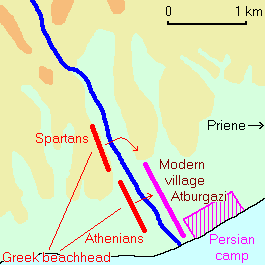
  8. Scene of the Battle of Marathon

    Story 6 of 15 · Darius sends armies

    Battles and campaigns

    Battle of Marathon

    About 10,000 Athenians and 1,000 Plataeans attacked a larger Persian army on the plain of Marathon and won, killing thousands for the loss of fewer than 200. The Persian fleet sailed away.

    Next story480 BC · Xerxes invades Greece
  9. Chapter III

    Xerxes invades

    6 stories in this chapter

  10. Map of the Battle of Thermopylae , 480 BC, 2nd Greco–Persian War , and the movements to Salamis and Plataea

    Story 7 of 15 · Xerxes invades

    Battles and campaigns

    Xerxes invades Greece

    Xerxes led an army and fleet across a bridge of boats over the Hellespont and south through Thrace and Macedon. Modern estimates put his army at roughly 70,000 to 300,000, far below the millions ancient writers claimed.

    Next story480 BC · Battle of Artemisium
  11. Campaign map for the Battles of Thermopylae & Artemisium (480 BC), based on the description of Herodotus

    Story 8 of 15 · Xerxes invades

    Battles and campaigns

    Battle of Artemisium

    A Greek fleet fought the Persian navy off the northern tip of Euboea while the army held Thermopylae. The fighting was inconclusive, but storms had already cost the Persians many ships. When the pass fell, the Greeks withdrew.

    Next story480 BC · Battle of Thermopylae
  12. Léonidas aux Thermopyles (Jacques-Louis David)

    Story 9 of 15 · Xerxes invades

    Battles and campaigns

    Battle of Thermopylae

    A small Greek force under the Spartan king Leonidas held a narrow coastal pass against the Persian army for three days. A local man showed the Persians a path around it, and Leonidas stayed behind with a rearguard that was wiped out.

    Next story480 BC · Battle of Salamis
  13. Battle of Thermopylae and movements to Salamis, 480 BC

    Story 10 of 15 · Xerxes invades

    Battles and campaigns

    Battle of Salamis

    The Greek fleet lured the Persian navy into the narrow strait between Salamis and the mainland, where its numbers were a burden. Xerxes watched from the shore as his ships were rammed and scattered.

    Next story479 BC · Battle of Mycale
  14. Map of the Battle of Mycale

    Story 11 of 15 · Xerxes invades

    Battles and campaigns

    Battle of Mycale

    Greek marines landed on the Ionian coast, stormed the camp where the Persian fleet had beached its ships and burned them. Tradition says it was fought on the same day as Plataea. Ionian cities rose against Persia again.

    Next story479 BC · Battle of Plataea
  15. Scene of the Battle of Plataea

    Story 12 of 15 · Xerxes invades

    Battles and campaigns

    Battle of Plataea

    A united Greek army under the Spartan regent Pausanias beat the Persian army left in Greece under Mardonius, who was killed. The Persians fled north, and the threat to mainland Greece was over.

    Next story478 BC · The Delian League is formed
  16. Chapter IV

    The Greeks take the offensive

    3 stories in this chapter

  17. Map of the Delian League ("Athenian Empire") in 431 B.C.E., just prior to the Peloponnesian War

    Story 13 of 15 · The Greeks take the offensive

    Politics and diplomacy

    The Delian League is formed

    Athens led the Greek cities of the Aegean into an alliance, with its treasury on the island of Delos, to keep up the war and share the gains. Within a generation it had become an Athenian empire.

    Next storyc. 466 BC · Battle of the Eurymedon
  18. The Eurymedon Bridge ( Köprüpazar Köprüsü ) near Aspendos, Pamphylia, Turkey

    Story 14 of 15 · The Greeks take the offensive

    Battles and campaigns

    Battle of the Eurymedon

    The Athenian general Cimon destroyed a Persian fleet at the mouth of the Eurymedon river in Anatolia and, by tradition, beat the army on land the same day. Its date is uncertain, between about 469 and 466 BC.

    Next storyc. 449 BC · The Peace of Callias
  19. Illustration of the Athenian general Cimon taking command of the Greek fleet

    Story 15 of 15 · The Greeks take the offensive

    Politics and diplomacy

    The Peace of Callias

    Ancient writers describe an agreement between Athens and Persia that ended the fighting: Persia would keep out of the Aegean and Athens would leave Persian lands alone. Some historians doubt a formal treaty was ever signed.

    NextJourney's end

Journey complete

You travelled 50 years

15 stories, 499 BC to c. 449 BC. More turning points are being researched and added.

Choose another eventBack to the start