San Martín crosses the Andes

All major events

Latin American independence

Within about fifteen years, most of Spain's American empire broke apart. Armies led by Simón Bolívar, José de San Martín and many others, with Indigenous, Black and mixed-race soldiers, won independence and created a dozen new republics.

By 1826 Spain had lost almost all its mainland colonies; Brazil became an independent empire in 1822.

Stories
20
Distance
35 years
Route
1791 to 1826
  1. Sparks3 stories
  2. The wars of independence11 stories
  3. Independence secured6 stories
Begin the journey

San Martín crosses the Andes, 1817. Image: Julio Vila y Prades · Public domain, via Wikimedia Commons

  1. Chapter I

    Sparks

    3 stories in this chapter

  2. Battle of San Domingo , also known as the Battle for Palm Tree Hill

    Story 1 of 20 · Sparks

    Revolt and resistance

    The Haitian Revolution

    Enslaved people in Saint-Domingue, France's richest colony, rose against their owners. Led by Toussaint Louverture and later Jean-Jacques Dessalines, they defeated French, Spanish and British armies and ended slavery in the colony.

    Next story1804 · Haiti declares independence
  3. A page of the Haitian Declaration of Independence of 1804

    Story 2 of 20 · Sparks

    Politics and diplomacy

    Haiti declares independence

    Dessalines declared the independence of Haiti from France, taking back the Taíno name for the island. It was the second independent state in the Americas and the first led by formerly enslaved people.

    Next story1808 · Napoleon takes Spain's crown
  4. Napoleon takes Spain's crown

    Story 3 of 20 · Sparks

    Politics and diplomacy

    Napoleon takes Spain's crown

    Napoleon lured the Spanish royal family to Bayonne in France and forced the king and his heir to give up the throne. He put his brother Joseph on it. Spaniards and their colonies had to decide whom to obey.

    Next story1810 · The May Revolution
  5. Chapter II

    The wars of independence

    11 stories in this chapter

  6. The May Revolution

    Story 4 of 20 · The wars of independence

    Politics and diplomacy

    The May Revolution

    The people of Buenos Aires removed the Spanish viceroy and set up their own governing junta, in the name of the captive king. It began the process that led to Argentine independence.

    Next story1810 · The Cry of Dolores
  7. Photo taken March 2004 by Paige Morrison

    Story 5 of 20 · The wars of independence

    Revolt and resistance

    The Cry of Dolores

    The priest Miguel Hidalgo rang the church bell at Dolores and called on his parishioners to rise against Spanish rule. His peasant army of tens of thousands marched on Mexico City. Hidalgo was captured and shot the next year.

    Next story1811 · Venezuela declares independence
  8. Painting of the congress that declared Venezuelan independence on 5 July 1811

    Story 6 of 20 · The wars of independence

    Politics and diplomacy

    Venezuela declares independence

    Venezuela's congress declared independence from Spain, the first Spanish American territory to do so. The first republic did not last, but the idea did.

    Next story1815 · Bolívar's Letter from Jamaica
  9. Bolívar's Letter from Jamaica

    Story 7 of 20 · The wars of independence

    Ideas and culture

    Bolívar's Letter from Jamaica

    In exile on Jamaica after a defeat, Simón Bolívar wrote a long letter laying out the case for independence and his hopes of a united Spanish America. He argued that Spanish America had the right to be free.

    Next story1817 · San Martín crosses the Andes
  10. San Martín crosses the Andes

    Story 8 of 20 · The wars of independence

    Battles and campaigns

    San Martín crosses the Andes

    José de San Martín led an army of several thousand men, with mules and artillery, over high Andean passes from Argentina into Chile, then defeated the Spanish at Chacabuco on 12 February. It was a feat of planning.

    Next story1818 · Battle of Maipú
  11. Painting by Rugendas of cavalry and infantry clashing on the plain at Maipú

    Story 9 of 20 · The wars of independence

    Battles and campaigns Unverified

    Battle of Maipú

    Near Santiago, San Martín's patriot army destroyed the royalist army of General Mariano Osorio, which had come back to retake Chile weeks after Chile declared independence.

    Next story1819 · Battle of Boyacá
  12. The Battle of Boyacá in the War of Independence of Colombia, Venezuela, Ecuador and Panama against Spain (Boyacá, Colombia, 1819)

    Story 10 of 20 · The wars of independence

    Battles and campaigns

    Battle of Boyacá

    Bolívar led his army over the Andes in the rainy season to attack the Spanish in New Granada. At Boyacá he won in about two hours. Three days later he entered Bogotá.

    Next story1819 · Gran Colombia is proclaimed
  13. The house in Angostura, now Ciudad Bolívar, where Bolívar's congress met in 1819

    Story 11 of 20 · The wars of independence

    Politics and diplomacy

    Gran Colombia is proclaimed

    Bolívar's congress at Angostura proclaimed the Republic of Colombia, uniting Venezuela and New Granada, with Ecuador added later. It was meant to be a great state to match the United States.

    Next story1821 · The Plan of Iguala
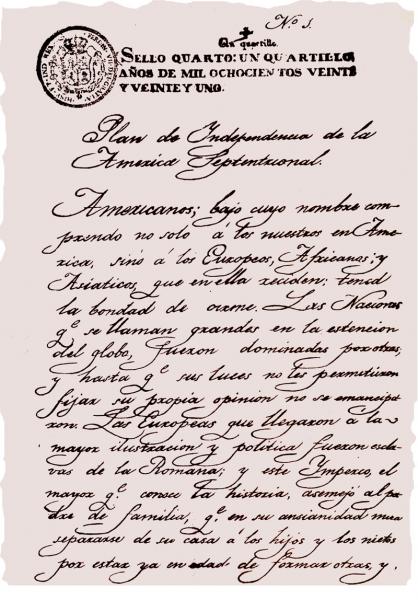
  14. First page of the Plan of Iguala of 1821

    Story 12 of 20 · The wars of independence

    Politics and diplomacy

    The Plan of Iguala

    Agustín de Iturbide and Vicente Guerrero, former enemies, joined forces behind a plan for an independent Mexico, with three guarantees: the Catholic religion, independence, and equality for Spaniards and Mexicans. Spanish rule collapsed within months.

    Next story1821 · Battle of Carabobo
  15. Battle of Carabobo

    Story 13 of 20 · The wars of independence

    Battles and campaigns

    Battle of Carabobo

    Bolívar's army, with local llaneros, British volunteers and Colombian troops, defeated a Spanish army in a short and decisive battle in central Venezuela.

    Next story1821 · Mexico declares independence
  16. The handwritten 1821 act of independence of the Mexican Empire, with signatures

    Story 14 of 20 · The wars of independence

    Politics and diplomacy Unverified

    Mexico declares independence

    The day after the Army of the Three Guarantees entered Mexico City, a governing board signed the act of independence of the Mexican Empire, ending three centuries of Spanish rule in New Spain.

    Next story1822 · Battle of Pichincha
  17. Chapter III

    Independence secured

    6 stories in this chapter

  18. Bronze statue of Antonio José de Sucre on a stone pedestal in Quito

    Story 15 of 20 · Independence secured

    Battles and campaigns Unverified

    Battle of Pichincha

    On the slopes of the Pichincha volcano, some 3,500 metres above sea level, Antonio José de Sucre's patriot army beat the royalists defending Quito.

    Next story1822 · Bolívar and San Martín meet
  19. The semicircular monument in Guayaquil marking the meeting of Bolívar and San Martín

    Story 16 of 20 · Independence secured

    Politics and diplomacy

    Bolívar and San Martín meet

    The two great liberators met privately at Guayaquil. No record exists of what was said. Soon afterwards San Martín resigned his command and left South America, leaving Bolívar to finish the war.

    Next story1822 · Brazil declares independence
  20. Pedro Américo's painting of Prince Pedro declaring Brazilian independence beside the Ipiranga river

    Story 17 of 20 · Independence secured

    Politics and diplomacy

    Brazil declares independence

    Prince Pedro, heir to the Portuguese throne, who had stayed in Brazil when his father returned to Lisbon, declared independence beside the Ipiranga river and became its first emperor. Brazil remained a monarchy and kept slavery until 1888.

    Next story1823 · The Monroe Doctrine
  21. US President Cleveland twists the tail of the lion (Britain); Puck cartoon 1880s

    Story 18 of 20 · Independence secured

    Politics and diplomacy

    The Monroe Doctrine

    President Monroe told European powers that the United States would regard any new colonisation in the Americas as hostile. It protected the new republics from Europe, and later gave the United States a pretext to intervene in them.

    Next story1824 · Battle of Ayacucho
  22. Battle of Ayacucho

    Story 19 of 20 · Independence secured

    Battles and campaigns

    Battle of Ayacucho

    General Antonio José de Sucre, Bolívar's lieutenant, defeated the last big Spanish army in South America in the high Andes of Peru in about an hour. The Spanish viceroy was captured.

    Next story1826 · The Congress of Panama
  23. Monument in Panama City to Bolívar and the Congress of Panama of 1826

    Story 20 of 20 · Independence secured

    Ideas and culture

    The Congress of Panama

    Bolívar called delegates of the new republics to Panama to form a league for mutual defence. Only four states took part, and only Gran Colombia ratified the treaties.

    NextJourney's end

Journey complete

You travelled 35 years

20 stories, 1791 to 1826. More turning points are being researched and added.

Choose another eventBack to the start