The scribe Ahmes copied an older maths manual. It splits fractions into parts, shares loaves among workers, finds the volume of granaries, and uses 256/81 for pi, which is within one percent of the true value.
Babylonian scribes wrote a two-tablet handbook naming 66 stars and constellations and giving when each rises and sets through the year. The second tablet sets out how to follow the sun, moon and planets and keep the calendar in step.
Priests in India wrote rules for laying out brick fire altars with ropes and pegs, some shaped like falcons. The texts contain the Pythagorean rule and right-angled triangles such as 15, 36 and 39.
Watchers in Babylon logged the Moon, planets, eclipses and weather night after night, along with river levels and the prices of barley, dates and wool. The records ran for about 700 years; the oldest dated diary that survives is from 652 BC.
In a right-angled triangle, the square on the longest side equals the sum of the squares on the other two sides. Greek tradition credits Pythagoras, but Babylonian scribes were using the rule more than a thousand years earlier.
In his History of Animals, Aristotle described hundreds of creatures, many from his own watching of sea life on Lesbos: the octopus changing colour, dogfish young growing inside the mother. He grouped animals by how they live and breed.
Aristarchus of Samos proposed that the Earth turns on its axis each day and circles the Sun each year. His own book is lost; we know the idea because Archimedes mentioned it in The Sand Reckoner.
Euclid gathered the geometry of his day into thirteen books, building each result step by step from a few plain definitions and assumptions. Copies served as a school textbook for more than two thousand years.
Archimedes showed that anything placed in a fluid is pushed upwards by a force equal to the weight of the fluid it pushes aside. He set the idea out in his treatise On Floating Bodies.
Eratosthenes heard that at noon on midsummer the Sun shone straight down a well at Syene, yet it cast a shadow in Alexandria. From the angle of that shadow and the distance between the cities, he calculated the size of the Earth.
The Chinese mathematician and astronomer Zu Chongzhi showed that pi lies between 3.1415926 and 3.1415927, and gave 355/113 as a close fraction for it. He built on Liu Hui's method of fitting polygons with thousands of sides inside a circle.
In a short verse book finished in 499, the Indian astronomer Aryabhata explained the daily turning of the sky as the Earth rotating on its axis. He also gave pi as 3.1416 and methods for eclipses and planetary positions.
In a book finished in 628, the Indian astronomer Brahmagupta set out rules for adding, subtracting and multiplying with zero, treating it as a number in its own right and not just an empty place in a written figure.
A paper scroll from the Mogao Caves at Dunhuang maps the whole sky visible from China in panels, with stars coloured by the three old Chinese schools of astronomy. It was taken to London in the early 20th century and is kept at the British Library.
Working in Baghdad, Muhammad ibn Musa al-Khwarizmi wrote a book on solving equations by moving terms and balancing both sides. Its title, al-jabr, gave algebra its name, and his own name gave us the word algorithm.
In his Secret of Secrets, the Persian physician al-Razi grouped minerals into classes such as spirits, metals, stones and salts, and listed the flasks, stills and furnaces used to treat them, written in plain, practical terms.
Working in Cairo between 1011 and 1021, Ibn al-Haytham showed by experiment that we see because light from objects enters the eye. His seven-volume book also studied reflection, refraction and the camera obscura.
In July 1054 court astronomers of the Song dynasty recorded a 'guest star' in Taurus bright enough to see by day; it stayed visible at night for almost two years. Japanese and Arabic writings mention it too. The Crab Nebula is what remains.
Around 1070 in Samarkand, the Persian poet and mathematician Omar Khayyam began a treatise on algebra that sorted cubic equations into types and solved each by intersecting curves such as circles and parabolas.
In his Dream Pool Essays, the Song official Shen Kuo described petrified bamboo found deep underground where no bamboo now grows, and reasoned that the climate there had once been different. He also described a magnetic needle that points not quite to true north.
Pages of the Dresden Codex, a bark-paper book of the Maya, track Venus through its cycle of 584 days as morning and evening star, with corrections that keep the table in step for centuries. Other pages predict eclipses.
The Persian astronomer Nasir al-Din al-Tusi showed that a small circle rolling inside one twice its size moves a point back and forth in a straight line. He used it to fix flaws in Ptolemy's planetary models.
Madhava of Sangamagrama, of the Kerala school in southern India, worked out endless sums for sine, cosine and arctangent and used them to calculate pi. Most of his own works are lost; his results survive in later Kerala writings.
At his great observatory in Samarkand, the Timurid ruler and astronomer Ulugh Beg remeasured the positions of 992 stars and published them, with tables of the planets, in the Zij-i Sultani. He also timed the year to within a minute.
Nicolaus Copernicus published On the Revolutions of the Heavenly Spheres, arguing that Earth and the other planets travel around the Sun. It challenged the Earth-centred picture that had stood since Ptolemy.
Johannes Kepler showed that planets move in ellipses with the Sun at one focus, sweeping out equal areas in equal times. His third law, published in 1619, ties each planet's year to its distance from the Sun.
With his new telescope, Galileo watched Venus change from a thin crescent to an almost full disc. Ptolemy's Earth-centred scheme could not produce a full set of phases, though Tycho Brahe's mixed system could.
Through his new telescope, Galileo Galilei saw four small points of light moving back and forth beside Jupiter, and realised they were moons orbiting it. He published the find in The Starry Messenger in March 1610.
John Napier, a Scottish landowner, published tables that turned long multiplications into simple additions. Astronomers and navigators took them up at once, and slide rules built on the same idea lasted until pocket calculators.
In Two New Sciences, Galileo argued that bodies fall at the same rate regardless of their mass, and that distance fallen grows with the square of time.
Christiaan Huygens worked out that the strange 'ears' Galileo had seen beside Saturn were a thin, flat ring circling the planet. He announced it in a coded anagram in 1656 and explained it fully in 1659.
In a darkened room, Isaac Newton passed sunlight through a glass prism and spread it into a rainbow, then showed that a second prism could blend the colours back to white. White light, he concluded, is a mixture.
Nicolas Steno argued that rock layers form horizontally with the oldest at the bottom, and that rock cut by faults or intrusions is younger than what it cuts.
Ole Rømer saw that eclipses of Jupiter's moon Io ran late when Earth was farther from Jupiter, and realised the delay was the time light takes to cross the extra distance. Light, he concluded, travels at a finite speed.
The Japanese mathematician Seki Takakazu introduced determinants in 1683 to eliminate unknowns from systems of equations. Leibniz used them in Europe about ten years later, and Seki also found the Bernoulli numbers.
Isaac Newton worked out methods for rates of change and areas in the 1660s, but Gottfried Leibniz was first to publish, in 1684, using the notation still taught today. Their followers fought a bitter dispute over who came first.
In his Principia, Isaac Newton showed that the same force pulls an apple to the ground and keeps the Moon in orbit. Every mass attracts every other, with a pull that weakens with the square of the distance.
Jacob Bernoulli's Ars Conjectandi, published after his death, proved that the average of many trials gets closer to the true chance as trials increase.
Carl Linnaeus published Systema Naturae, a scheme for sorting living things into nested groups, and later gave every species a short two-part Latin name. Biologists still follow his method.
In his Introductio of 1748, Leonhard Euler published the formula that ties the exponential function to sine and cosine. Setting the angle to pi gives e to the power i times pi equals minus one, linking e, i, pi, 1 and 0.
Joseph Black heated limestone and found that it lost weight by giving off a gas he called "fixed air". The gas put out flames and turned limewater cloudy. It was the first gas shown to be different from ordinary air.
Henry Cavendish collected a light, flammable gas given off when metals react with acids, and showed it was a distinct substance. Antoine Lavoisier later named it hydrogen, 'water-maker', after showing it burns to form water.
Joseph Priestley heated mercury oxide and collected a gas in which a candle burned fiercely. Carl Wilhelm Scheele had made it a few years earlier but published later; Antoine Lavoisier explained its role in burning.
Jan Ingenhousz found that the green parts of plants give off the oxygen Priestley had noticed, but only in sunlight. Later work showed that plants take in carbon dioxide and water and build sugars from them.
William Herschel spotted a faint disc through his home-built telescope and at first took it for a comet. It was the first planet found since ancient times, and doubled the known size of the Solar System.
Studying tilted rock layers at Siccar Point on the Scottish coast, James Hutton argued that Earth is shaped by slow processes still at work today, such as erosion and uplift. That meant the planet had to be unimaginably old.
By weighing everything before and after a reaction in sealed vessels, Antoine Lavoisier showed that the total mass stays the same, even when a substance burns or changes form. His 1789 textbook set out the principle.
Antoine Lavoisier's Elementary Treatise of Chemistry listed substances such as oxygen and hydrogen as elements, though some on his list were later shown to be compounds.
Edward Jenner showed that infecting people with mild cowpox protected them from deadly smallpox. He tested it on a boy in 1796 and published in 1798; the word vaccine comes from vacca, Latin for cow.
Humphry Davy passed a strong electric current through molten potash and soda and collected two new metals that burst into flame on touching water. He named them potassium and sodium.
John Dalton proposed that each element is made of its own kind of tiny, unbreakable atom, and that compounds form when atoms join in fixed whole-number ratios. The idea explained why elements combine in set proportions.
The eruption of Mount Tambora in Indonesia was the largest in recorded history, and it lowered global temperatures. 1816 became the year without a summer.
Sadi Carnot showed that no engine working between two temperatures can beat an ideal reversible engine. Its efficiency depends only on those temperatures.
William Buckland described a huge jaw and bones from near Oxford and named the animal Megalosaurus, "great lizard". It was the first dinosaur to get a scientific name, though the word "dinosaur" itself arrived in 1842.
Friedrich Wöhler heated an inorganic salt and unexpectedly made urea, a compound until then known only from living things. The result weakened the belief that making organic matter needs a special "vital force".
Nikolai Lobachevsky published a consistent geometry in which Euclid's rule about parallel lines fails, and János Bolyai reached the same result alone. Mathematicians had tried for about two thousand years to prove that rule from the others.
Michael Faraday found that a changing magnetic field makes an electric current flow in a nearby wire. Simply moving a magnet in and out of a coil was enough to produce electricity.
Studying boulders far from their source rock and scratched valley floors in the Alps, Louis Agassiz argued that vast sheets of ice once covered much of Europe. Geologists were at first sceptical, then convinced.
Friedrich Bessel watched the star 61 Cygni shift slightly against more distant stars as Earth moved around the Sun. The tiny angle gave its distance, about ten light-years.
Matthias Schleiden and Theodor Schwann proposed that all plants and animals are built from cells, the basic unit of life. Rudolf Virchow later added that every cell comes from another cell.
Heinrich Schwabe counted sunspots for 17 years and saw their numbers rise and fall in a cycle of about a decade. The Sun's activity follows a regular rhythm.
Johann Galle found Neptune within a degree of where Urbain Le Verrier had calculated it must be, from unexplained tugs on Uranus. It was the first planet located by mathematics before anyone saw it.
James Joule's careful experiments showed that heat and motion trade at a fixed rate. In 1847 Hermann von Helmholtz stated that energy is never created or destroyed, only changed from one form to another.
William Henry Perkin, aged 18, was trying to make quinine when he produced a purple dye from coal-tar aniline. It was the first commercial synthetic dye.
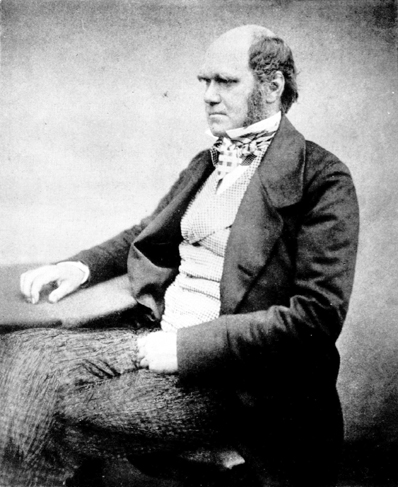
Charles Darwin and Alfred Russel Wallace proposed that living things best suited to their surroundings leave more offspring, so species change over time. Darwin set out the evidence in On the Origin of Species in 1859.
John Tyndall measured how carbon dioxide and water vapour absorb heat, showing in the laboratory that gases in the air can keep a planet warm. In 1896 Svante Arrhenius calculated what extra carbon dioxide would do to temperatures.
Robert Bunsen and Gustav Kirchhoff heated mineral samples in a flame and examined the light with a spectroscope. Each element gave its own bright lines.
Louis Pasteur showed that microbes cause fermentation and decay rather than arising on their own. Through the 1870s and 1880s, Robert Koch proved that particular germs cause particular diseases.
A feathered fossil from a German limestone quarry had teeth, a long bony tail and wings. It seemed to link birds with reptiles, and later with dinosaurs.
Cato Guldberg and Peter Waage showed that reaction rates depend on the concentrations of the substances involved, and that reactions settle at a balance.
August Kekulé proposed that the six carbon atoms of benzene form a ring with alternating single and double bonds. Chemists could now draw the structure of carbon compounds, which let them design new ones.
James Clerk Maxwell combined electricity and magnetism in a few equations that predicted waves travelling at the speed of light, and concluded that light is such a wave. Heinrich Hertz made radio waves in 1887 to prove it.
By crossing thousands of pea plants and counting the offspring, Gregor Mendel showed that traits are passed on as separate units, some dominant and some hidden. His work was ignored until it was rediscovered in 1900.
During a solar eclipse, Jules Janssen saw an unknown yellow line in the Sun's light, and Norman Lockyer concluded it came from a new element. Helium was not found on Earth until 1895.
Dmitri Mendeleev arranged the known elements by atomic weight in a table that grouped elements with similar properties. He left gaps for undiscovered elements and correctly predicted what they would be like.
Georg Cantor proved that the real numbers cannot be matched one for one with the counting numbers, so some infinities are bigger than others. Many mathematicians of his day found the idea deeply troubling.
Jacobus van 't Hoff and Joseph Le Bel proposed that carbon's four bonds point to the corners of a tetrahedron, giving molecules a three-dimensional shape.
Heinrich Hertz sent sparks across a gap and detected invisible waves across the room. He showed that electromagnetic waves travel at the speed of light.
Albert Michelson and Edward Morley used an interferometer to look for Earth's motion through the aether. They found no measurable difference in the speed of light.
Using a silver stain on thin slices of brain tissue, Santiago Ramón y Cajal showed that the nervous system is made of separate cells that meet at tiny gaps, rather than one continuous web.
On 17 April 1889 Ernst von Rebeur-Paschwitz's pendulums in Potsdam and Wilhelmshaven swung about an hour after a strong earthquake near Tokyo. The waves had crossed the Earth.
Georg Cantor gave a new, simpler proof that the real numbers cannot be listed, by building a number that differs from every entry on a list. The same trick showed that every set has more subsets than members.
Dmitri Ivanovsky showed that the sap of diseased tobacco plants stayed infectious after passing through a filter fine enough to hold back bacteria. Martinus Beijerinck confirmed it in 1898 and called the agent a "contagious living fluid".
Lord Rayleigh and William Ramsay found that nitrogen taken from air was slightly heavier than nitrogen made in the laboratory. The difference was a new gas that would not react with anything. They named it argon, "the idle one".
Wilhelm Röntgen noticed a screen glowing near a covered cathode-ray tube and found invisible rays that pass through flesh but not bone. Within weeks, X-ray pictures of hands were amazing people around the world.
Henri Becquerel found that uranium salts fogged photographic plates even in the dark, giving off rays of their own. Marie and Pierre Curie went on to discover the radioactive elements polonium and radium.
J. J. Thomson showed that cathode rays are streams of particles far lighter than any atom, each carrying a negative charge. The electron was the first subatomic particle ever found.
To explain the glow of hot objects, Max Planck had to assume that energy is handed out in small, fixed packets instead of a smooth flow. He called them quanta, and at first saw the step as a mathematical device.
Karl Landsteiner found that mixing some people's blood caused clumping, and identified the A, B and O blood groups. His colleagues found the rarer AB group in 1902.
Walter Sutton noticed that chromosomes separate in the same way as Mendel's inherited factors, and proposed that chromosomes carry heredity. Theodor Boveri reached the same idea independently.
Albert Einstein argued that light arrives in packets whose energy depends on frequency. This explained why light only knocks electrons loose above a set frequency.
Albert Einstein showed that light travels at the same speed for everyone, so time and distance depend on how fast you move. A follow-up paper that year gave the famous equation E = mc².
Thomas Hunt Morgan's lab bred fruit flies and found that linked genes are inherited together. The rate of crossing over let them build the first gene maps.
Hans Geiger and Ernest Marsden fired alpha particles at thin gold foil, and a few bounced straight back. Ernest Rutherford concluded that an atom's mass and positive charge sit in a tiny central nucleus.
Henrietta Leavitt found that brighter Cepheid variable stars pulse more slowly. Comparing a star's pulse with its apparent brightness gives its true luminosity and distance.
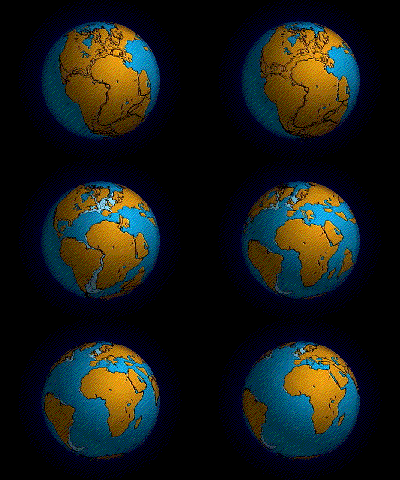
Alfred Wegener noticed that the coasts of South America and Africa fit together and that matching fossils and rocks lie on both sides of the Atlantic. He said the continents had once been joined, but could not say how they moved.
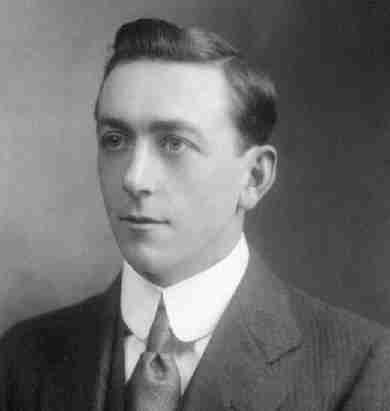
William Lawrence Bragg showed that X-rays reflected from crystal planes reinforce at certain angles, so crystal structure can be read from the pattern.
Henry Moseley measured the X-ray spectra of many elements and found their frequencies rise in a regular pattern with each element's position in the table.
Albert Einstein described gravity as the bending of space and time by mass and energy. In 1919, astronomers saw starlight bending around the Sun during an eclipse, just as he had predicted.
Gilbert Lewis proposed that atoms bond by sharing pairs of electrons until each has a full outer shell of eight. His dot diagrams are still drawn in school chemistry lessons.
Harlow Shapley used globular clusters to map the Milky Way and placed the Sun far out from its centre. The Galaxy turned out to be much bigger than thought.
Hermann Staudinger argued that rubber and similar materials are made of long chains of small units joined by covalent bonds, a view that was then disputed.
Otto Stern and Walther Gerlach sent silver atoms through a magnetic field and saw the beam split in two. The split revealed a quantum property later called spin.
Louis de Broglie suggested that electrons and other particles have wavelengths linked to their momentum. Electron diffraction confirmed it a few years later.
Edwin Hubble found Cepheid stars in the Andromeda nebula and used them to measure its distance. It lay far outside the Milky Way, so it is a separate galaxy.
Georges Lemaître in 1927 and Edwin Hubble in 1929 found that the farther away a galaxy is, the faster it is moving away from us. The universe itself is expanding.
In 1927 Georges Lemaître, a Belgian priest and physicist, derived an expanding universe from general relativity. In 1931 he suggested it had begun from a single compact 'primeval atom'.
Werner Heisenberg showed that position and momentum cannot both be known exactly at the same time. The limit comes from nature, not from poor instruments.
Alexander Fleming noticed that a mould growing on one of his bacteria plates had killed the colonies around it. Howard Florey and Ernst Chain turned it into a usable medicine in the early 1940s.
At Zhoukoudian, near Beijing, the Chinese anthropologist Pei Wenzhong found an almost complete Homo erectus skullcap. Davidson Black had set up the research there.
Clyde Tombaugh found Pluto by comparing photographs of the same patch of sky taken days apart and spotting a dot that moved. It was reclassified as a dwarf planet in 2006.
Kurt Gödel proved that any consistent system of arithmetic rules contains true statements that the system itself can never prove. It ended the hope of resting all of mathematics on one complete, self-proving set of axioms.
James Chadwick identified a particle in the atomic nucleus with no electric charge and about the mass of a proton. It explained why atoms weigh more than their protons alone.
Studying faint earthquake waves that should not have reached certain places, the Danish seismologist Inge Lehmann concluded that Earth's liquid core hides a smaller solid centre. Later instruments confirmed it.
Otto Hahn and Fritz Strassmann bombarded uranium with neutrons and found lighter barium among the products. Lise Meitner and Otto Frisch explained it as the nucleus splitting in two and releasing huge amounts of energy.
Oswald Avery, Colin MacLeod and Maclyn McCarty showed that DNA from one strain of bacteria could change the inherited traits of another. Most biologists had expected proteins, not DNA, to carry genes.
John Bardeen and Walter Brattain, in William Shockley's group at Bell Labs, built a transistor that could amplify an electrical signal, a small solid replacement for bulky vacuum tubes.
Ralph Alpher and George Gamow, with Hans Bethe added as a joke, proposed that hydrogen and helium formed in the hot early universe and calculated their amounts.
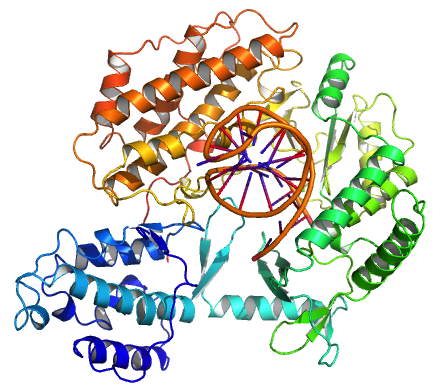
James Watson and Francis Crick proposed that DNA is a double helix of two strands linked by paired bases, using X-ray images made by Rosalind Franklin and Raymond Gosling. The pairing suggested how DNA copies itself.
Frederick Sanger read the order of amino acids in the two chains of cow insulin in 1951 and 1952, and by 1955 had placed the bonds that link them. It was the first protein sequence ever worked out.
Clair Patterson measured lead isotopes in a meteorite that fell in Arizona and in ocean sediments, and calculated that Earth is about 4.55 billion years old. The figure has barely changed since.
Maps of the ocean floor showed new crust spreading out from mid-ocean ridges, reviving Alfred Wegener's 1912 idea of drifting continents. By the late 1960s, geologists agreed that Earth's surface is broken into moving plates.
Marshall Nirenberg and Heinrich Matthaei made a synthetic RNA of one repeated letter and found that it built a protein of a single amino acid. That first match began the decoding of how DNA's letters stand for amino acids.
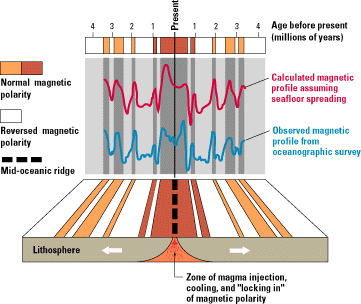
Fred Vine and Drummond Matthews, and separately Lawrence Morley, showed that stripes of magnetised rock on the seafloor mirror each other across ridges.
Maarten Schmidt measured the redshift of a radio source and found it was extremely distant and enormously bright. Others soon found many similar objects.
John Bell derived an inequality that any local hidden-variable theory must obey. Quantum mechanics predicts violations, and experiments confirmed them.
Arno Penzias and Robert Wilson picked up a faint microwave hiss coming equally from every direction in the sky. It turned out to be heat left over from the hot, dense early universe.
Jocelyn Bell Burnell, a graduate student, noticed a regular radio pulse from one spot in the sky. It came from a rapidly spinning neutron star, a pulsar.
The X-ray source Cygnus X-1 was found to orbit an invisible companion too heavy to be a neutron star. Most astronomers came to accept it as a black hole.
Donald Johanson and Tom Gray found about 40 percent of the skeleton of an Australopithecus afarensis in Ethiopia's Afar region. At 3.2 million years old, it showed that our ancestors walked upright long before they had large brains.
Luis and Walter Alvarez found a thin clay layer rich in iridium, rare on Earth but common in asteroids, in rocks laid down 66 million years ago. They argued that a giant impact wiped out the dinosaurs. The Chicxulub crater was identified later.
Luc Montagnier's team in Paris, including Françoise Barré-Sinoussi, isolated the virus now called HIV in 1983. In 1984 Robert Gallo's team in the United States showed that it causes AIDS.
Joseph Farman and his colleagues at the British Antarctic Survey reported that the ozone layer above Antarctica had thinned sharply each spring since the 1970s. Chlorine from man-made chemicals was soon blamed.
Rebecca Cann, Mark Stoneking and Allan Wilson used mitochondrial DNA from living people to show that all humans share a maternal ancestor who lived in Africa.
A star in the Large Magellanic Cloud exploded and was visible to the naked eye. Detectors on Earth caught a burst of neutrinos hours before the light arrived.
In 1637 Pierre de Fermat noted that no whole numbers satisfy xⁿ + yⁿ = zⁿ once n is above 2. Andrew Wiles proved it after seven years of secret work, repairing a gap in his first attempt with Richard Taylor in 1994.
Michel Mayor and Didier Queloz found 51 Pegasi b, a giant planet that circles a Sun-like star in just four days, by spotting the tiny wobble it causes in the star. Thousands more planets have been found since.
Scientists at the Roslin Institute near Edinburgh grew a lamb from a single cell taken from an adult sheep's udder. Dolly was born in 1996, and the news came out in February 1997.
Two teams measuring distant exploding stars found them dimmer than expected, meaning the universe's expansion is speeding up. Something later named dark energy seems to be pushing space apart.
Tiny zircon crystals from the Jack Hills in Western Australia were dated to 4.4 billion years old. Their chemistry suggested liquid water existed then.
Jennifer Doudna and Emmanuelle Charpentier showed that a bacterial defence system could be reprogrammed to cut DNA at any chosen spot. Scientists soon used it to edit genes in plants, animals and human cells.
Physicists at CERN's Large Hadron Collider announced a new particle matching the one predicted in 1964 by Peter Higgs and others. It confirmed how fundamental particles get their mass.
The twin LIGO detectors in the United States recorded ripples in space-time from two black holes merging about 1.3 billion light-years away. Einstein had predicted such waves a century earlier.
NASA released the first full-colour science image from the James Webb Space Telescope, a deep field of distant galaxies seen in infrared. More images followed the next day.
The scribe Ahmes copied an older maths manual. It splits fractions into parts, shares loaves among workers, finds the volume of granaries, and uses 256/81 for pi, which is within one percent of the true value.
Why it matters
It is the fullest record of how Egyptian scribes did sums, and it shows maths put to work on bread, grain and storage.
Credit is debated. The papyrus dates to about 1550 BC, but Ahmes says he copied it from a text of the reign of Amenemhat III, around 1800 BC.
Babylonian scribes wrote a two-tablet handbook naming 66 stars and constellations and giving when each rises and sets through the year. The second tablet sets out how to follow the sun, moon and planets and keep the calendar in step.
Why it matters
Scribes kept copying it for about 700 years, which shows how closely Mesopotamian astronomers tied the stars to the calendar.
Credit is debated. The oldest surviving copy is from 686 BC. Most scholars date the text to about 1000 BC, though estimates run from about 1370 BC to as early as 2300 BC.
Priests in India wrote rules for laying out brick fire altars with ropes and pegs, some shaped like falcons. The texts contain the Pythagorean rule and right-angled triangles such as 15, 36 and 39.
Why it matters
They show geometry developed for ritual in India in the first millennium BC, with ropes as the measuring tool.
Credit is debated. The oldest sutra is placed between about 800 and 500 BC, and scholars debate whether Babylonian mathematics influenced it.
Watchers in Babylon logged the Moon, planets, eclipses and weather night after night, along with river levels and the prices of barley, dates and wool. The records ran for about 700 years; the oldest dated diary that survives is from 652 BC.
Lasted
About 690 years
Why it matters
Their long run of observations let Babylonians predict eclipses and planetary motions with arithmetic, and Greek astronomers later drew on them.
In a right-angled triangle, the square on the longest side equals the sum of the squares on the other two sides. Greek tradition credits Pythagoras, but Babylonian scribes were using the rule more than a thousand years earlier.
Why it matters
It underlies how we measure distance, from surveying land to navigation, engineering and computer graphics.
Credit is debated. Named after Pythagoras, but the rule appears on Babylonian clay tablets such as Plimpton 322, from around 1800 BC.
In his History of Animals, Aristotle described hundreds of creatures, many from his own watching of sea life on Lesbos: the octopus changing colour, dogfish young growing inside the mother. He grouped animals by how they live and breed.
Why it matters
It is the oldest surviving detailed work of zoology, and it shaped the study of living things for some 2,000 years.
Credit is debated. It was written some time between the middle of the 4th century BC and Aristotle's death in 322 BC; some of his reports were wrong.
Aristarchus of Samos proposed that the Earth turns on its axis each day and circles the Sun each year. His own book is lost; we know the idea because Archimedes mentioned it in The Sand Reckoner.
Why it matters
It is the first known Sun-centred model, about 1,800 years before Copernicus, though most later astronomers rejected it.
Euclid gathered the geometry of his day into thirteen books, building each result step by step from a few plain definitions and assumptions. Copies served as a school textbook for more than two thousand years.
Why it matters
It taught the world to prove things from first principles, a model for science and logic ever since.
Archimedes showed that anything placed in a fluid is pushed upwards by a force equal to the weight of the fluid it pushes aside. He set the idea out in his treatise On Floating Bodies.
Why it matters
It explains why ships float and balloons rise, and is still used to measure density.
Eratosthenes heard that at noon on midsummer the Sun shone straight down a well at Syene, yet it cast a shadow in Alexandria. From the angle of that shadow and the distance between the cities, he calculated the size of the Earth.
Why it matters
It showed that a round Earth could be measured with geometry and a stick in the ground.
Credit is debated. The length of the stadion he used is uncertain, so how close he came to the modern figure is still debated.
The Nine Chapters on the Mathematical Art gave rules for adding and subtracting positive and negative numbers, shown with red and black counting rods.
Why it matters
Negative numbers became essential for algebra, debts and temperatures.
Credit is debated. The Nine Chapters was compiled over several centuries; its present form dates from about the 1st century AD, with Liu Hui's commentary of 263.
The Chinese mathematician and astronomer Zu Chongzhi showed that pi lies between 3.1415926 and 3.1415927, and gave 355/113 as a close fraction for it. He built on Liu Hui's method of fitting polygons with thousands of sides inside a circle.
Why it matters
No one anywhere computed pi more precisely for about 900 years.
Credit is debated. Zu lived from 429 to about 500; the book with his method, the Zhui Shu, is lost, so the year of the result is unknown.
In a short verse book finished in 499, the Indian astronomer Aryabhata explained the daily turning of the sky as the Earth rotating on its axis. He also gave pi as 3.1416 and methods for eclipses and planetary positions.
Why it matters
It shaped Indian astronomy for centuries and, through Arabic translations, reached the Islamic world.
In a book finished in 628, the Indian astronomer Brahmagupta set out rules for adding, subtracting and multiplying with zero, treating it as a number in its own right and not just an empty place in a written figure.
Why it matters
Modern arithmetic, algebra and computing all depend on zero.
Credit is debated. Babylonian and Maya scribes used a symbol for an empty place long before; Brahmagupta's step was to give zero rules as a number.
A paper scroll from the Mogao Caves at Dunhuang maps the whole sky visible from China in panels, with stars coloured by the three old Chinese schools of astronomy. It was taken to London in the early 20th century and is kept at the British Library.
Why it matters
It is the oldest known complete star atlas, and it shows how Tang astronomers recorded and compared their star lists.
Unverified. The article dates the chart only to the Tang dynasty (618–907); the year 700 is an estimate from general knowledge.
Working in Baghdad, Muhammad ibn Musa al-Khwarizmi wrote a book on solving equations by moving terms and balancing both sides. Its title, al-jabr, gave algebra its name, and his own name gave us the word algorithm.
Why it matters
It turned problems once solved by clever tricks into steps that anyone could follow.
In his Secret of Secrets, the Persian physician al-Razi grouped minerals into classes such as spirits, metals, stones and salts, and listed the flasks, stills and furnaces used to treat them, written in plain, practical terms.
Why it matters
It is one of the first systematic classifications of chemical substances and apparatus, a step from alchemy towards chemistry.
Credit is debated. The book is undated; al-Razi lived from 864 or 865 to 925 or 935.
Working in Cairo between 1011 and 1021, Ibn al-Haytham showed by experiment that we see because light from objects enters the eye. His seven-volume book also studied reflection, refraction and the camera obscura.
Why it matters
Latin translations made it the basic optics text of medieval Europe, and its habit of testing claims by experiment shaped later science.
In July 1054 court astronomers of the Song dynasty recorded a 'guest star' in Taurus bright enough to see by day; it stayed visible at night for almost two years. Japanese and Arabic writings mention it too. The Crab Nebula is what remains.
Why it matters
Matching the old records to the Crab Nebula showed that supernovae leave remnants, and its pulsar became a key object of modern astrophysics.
Around 1070 in Samarkand, the Persian poet and mathematician Omar Khayyam began a treatise on algebra that sorted cubic equations into types and solved each by intersecting curves such as circles and parabolas.
Why it matters
It was the first general theory of cubic equations, nearly 500 years before Cardano's formulas.
In his Dream Pool Essays, the Song official Shen Kuo described petrified bamboo found deep underground where no bamboo now grows, and reasoned that the climate there had once been different. He also described a magnetic needle that points not quite to true north.
Why it matters
It contains the first known description of magnetic declination and early reasoning from fossils about past climates.
Pages of the Dresden Codex, a bark-paper book of the Maya, track Venus through its cycle of 584 days as morning and evening star, with corrections that keep the table in step for centuries. Other pages predict eclipses.
Why it matters
It shows Maya astronomers reached long-range planetary prediction independently of the Old World.
Credit is debated. The codex is usually dated to the 11th or 12th century, and its tables may copy older ones.
Unverified. The 584-day cycle is from general knowledge; the cited article says only that the Venus tables follow the planet's movements.
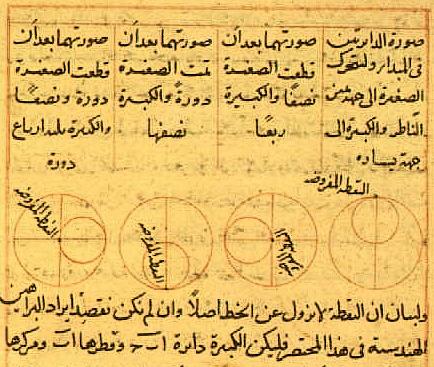
The Persian astronomer Nasir al-Din al-Tusi showed that a small circle rolling inside one twice its size moves a point back and forth in a straight line. He used it to fix flaws in Ptolemy's planetary models.
Why it matters
Copernicus used the same device in his own models, and historians think it reached him from Arabic texts.
Madhava of Sangamagrama, of the Kerala school in southern India, worked out endless sums for sine, cosine and arctangent and used them to calculate pi. Most of his own works are lost; his results survive in later Kerala writings.
Why it matters
Such series reached Europe only in the 17th century, with Gregory, Newton and Leibniz.
Credit is debated. Madhava's dates are uncertain (about 1340 to 1425); one of his works gives 1400 as an epoch.
At his great observatory in Samarkand, the Timurid ruler and astronomer Ulugh Beg remeasured the positions of 992 stars and published them, with tables of the planets, in the Zij-i Sultani. He also timed the year to within a minute.
Why it matters
It was one of the most original star catalogues of the Middle Ages, made by fresh observation rather than by updating Ptolemy's.
Nicolaus Copernicus published On the Revolutions of the Heavenly Spheres, arguing that Earth and the other planets travel around the Sun. It challenged the Earth-centred picture that had stood since Ptolemy.
Why it matters
It began the Scientific Revolution and changed how people saw their place in the universe.
Johannes Kepler showed that planets move in ellipses with the Sun at one focus, sweeping out equal areas in equal times. His third law, published in 1619, ties each planet's year to its distance from the Sun.
Why it matters
They turned Copernicus's idea into precise predictions, and gave Newton the pattern his theory of gravity had to explain.
With his new telescope, Galileo watched Venus change from a thin crescent to an almost full disc. Ptolemy's Earth-centred scheme could not produce a full set of phases, though Tycho Brahe's mixed system could.
Why it matters
It ruled out Ptolemy's arrangement of the planets and gave strong support to the idea that Venus circles the Sun.
Through his new telescope, Galileo Galilei saw four small points of light moving back and forth beside Jupiter, and realised they were moons orbiting it. He published the find in The Starry Messenger in March 1610.
Why it matters
It proved that not everything in the sky circles the Earth, strong support for Copernicus.
John Napier, a Scottish landowner, published tables that turned long multiplications into simple additions. Astronomers and navigators took them up at once, and slide rules built on the same idea lasted until pocket calculators.
Why it matters
They made heavy calculation quick enough for astronomy, navigation and engineering for more than 350 years.
In Two New Sciences, Galileo argued that bodies fall at the same rate regardless of their mass, and that distance fallen grows with the square of time.
Why it matters
It moved physics from Aristotle's descriptions to mathematical laws tested by experiment.
Christiaan Huygens worked out that the strange 'ears' Galileo had seen beside Saturn were a thin, flat ring circling the planet. He announced it in a coded anagram in 1656 and explained it fully in 1659.
Why it matters
It showed telescopes could reveal structures no one had imagined; every giant planet has since been found to have rings.
Robert Boyle trapped air in a J-shaped tube and added mercury. Doubling the pressure halved the volume of the trapped air.
Why it matters
It was one of the first quantitative laws of gases.
Credit is debated. Henry Power stated the relation in 1661, and Boyle credited it to Richard Towneley. In France it is named after Edme Mariotte, who published in 1676.
In a darkened room, Isaac Newton passed sunlight through a glass prism and spread it into a rainbow, then showed that a second prism could blend the colours back to white. White light, he concluded, is a mixture.
Why it matters
It founded the science of colour and spectra, which later let astronomers read what stars are made of.
Nicolas Steno argued that rock layers form horizontally with the oldest at the bottom, and that rock cut by faults or intrusions is younger than what it cuts.
Why it matters
These principles let geologists read the order of past events in rock.
Ole Rømer saw that eclipses of Jupiter's moon Io ran late when Earth was farther from Jupiter, and realised the delay was the time light takes to cross the extra distance. Light, he concluded, travels at a finite speed.
Why it matters
It ended the idea that light is instant; Christiaan Huygens soon turned Rømer's delay into a first estimate of its speed.
The Japanese mathematician Seki Takakazu introduced determinants in 1683 to eliminate unknowns from systems of equations. Leibniz used them in Europe about ten years later, and Seki also found the Bernoulli numbers.
Why it matters
It shows the Edo-period wasan tradition reached major results at the same time as Europe, independently.
Isaac Newton worked out methods for rates of change and areas in the 1660s, but Gottfried Leibniz was first to publish, in 1684, using the notation still taught today. Their followers fought a bitter dispute over who came first.
Why it matters
It gave science the mathematics of motion and change, from planetary orbits to the spread of disease.
Credit is debated. Newton developed his method in 1665 and 1666 but published it much later. Historians now credit both men with inventing it independently.
In his Principia, Isaac Newton showed that the same force pulls an apple to the ground and keeps the Moon in orbit. Every mass attracts every other, with a pull that weakens with the square of the distance.
Why it matters
It explained Kepler's laws, the tides and the paths of comets, and still guides spacecraft today.
Jacob Bernoulli's Ars Conjectandi, published after his death, proved that the average of many trials gets closer to the true chance as trials increase.
Why it matters
It is the reason statistics works and why large samples are trusted.
Carl Linnaeus published Systema Naturae, a scheme for sorting living things into nested groups, and later gave every species a short two-part Latin name. Biologists still follow his method.
Why it matters
It gave scientists a shared language for naming and comparing the living world.
In his Introductio of 1748, Leonhard Euler published the formula that ties the exponential function to sine and cosine. Setting the angle to pi gives e to the power i times pi equals minus one, linking e, i, pi, 1 and 0.
Why it matters
It is often called the most beautiful equation in mathematics.
Credit is debated. Euler's formula appears in the Introductio, but Euler never seems to have written the special case e^(iπ) + 1 = 0 down himself.
Benjamin Franklin flew a kite in a storm and drew sparks from a key tied to the string. He argued that lightning is an electric spark.
Why it matters
It turned lightning from a sign of the gods into a known physical effect.
Credit is debated. In May 1752 Thomas-François Dalibard in France carried out Franklin's proposed test with a tall iron rod, before Franklin's own kite flight that summer.
Joseph Black heated limestone and found that it lost weight by giving off a gas he called "fixed air". The gas put out flames and turned limewater cloudy. It was the first gas shown to be different from ordinary air.
Why it matters
It opened the way to isolating other gases and, much later, to understanding carbon in the atmosphere.
Credit is debated. Jan Baptist van Helmont noticed a "wild spirit" from burning charcoal in the 1600s; Black was the first to study the gas closely.
People: Jan Baptist van Helmont, Joseph Black, Joseph Priestley
Henry Cavendish collected a light, flammable gas given off when metals react with acids, and showed it was a distinct substance. Antoine Lavoisier later named it hydrogen, 'water-maker', after showing it burns to form water.
Why it matters
Hydrogen is the most common element in the universe, and the fuel that powers the stars.
Joseph Priestley heated mercury oxide and collected a gas in which a candle burned fiercely. Carl Wilhelm Scheele had made it a few years earlier but published later; Antoine Lavoisier explained its role in burning.
Why it matters
It overturned the old phlogiston theory and explained both burning and breathing.
Credit is debated. Scheele produced oxygen around 1771 to 1772; Priestley published first, in 1774.
Jan Ingenhousz found that the green parts of plants give off the oxygen Priestley had noticed, but only in sunlight. Later work showed that plants take in carbon dioxide and water and build sugars from them.
Why it matters
It revealed how nearly all food, and the air we breathe, trace back to sunlight.
William Herschel spotted a faint disc through his home-built telescope and at first took it for a comet. It was the first planet found since ancient times, and doubled the known size of the Solar System.
Why it matters
It showed the Solar System was bigger than anyone knew, and its odd motion later led to Neptune.
Studying tilted rock layers at Siccar Point on the Scottish coast, James Hutton argued that Earth is shaped by slow processes still at work today, such as erosion and uplift. That meant the planet had to be unimaginably old.
Why it matters
It gave geology, and later Darwin, the vast span of time that they needed.
By weighing everything before and after a reaction in sealed vessels, Antoine Lavoisier showed that the total mass stays the same, even when a substance burns or changes form. His 1789 textbook set out the principle.
Why it matters
It turned chemistry into a measuring science, built on careful balances.
Credit is debated. Mikhail Lomonosov stated a similar principle in the 1740s and 1750s, but his work was little known in Western Europe.
Lavoisier publishes the first modern list of elements
Antoine Lavoisier's Elementary Treatise of Chemistry listed substances such as oxygen and hydrogen as elements, though some on his list were later shown to be compounds.
Why it matters
It was the first list that separated elements from compounds by experiment.
Edward Jenner showed that infecting people with mild cowpox protected them from deadly smallpox. He tested it on a boy in 1796 and published in 1798; the word vaccine comes from vacca, Latin for cow.
Why it matters
It was the first vaccine, and led to smallpox becoming the first human disease to be wiped out, in 1980.
Humphry Davy passed a strong electric current through molten potash and soda and collected two new metals that burst into flame on touching water. He named them potassium and sodium.
Why it matters
It showed that electricity could split stubborn compounds, and it led to a run of newly found elements.
John Dalton proposed that each element is made of its own kind of tiny, unbreakable atom, and that compounds form when atoms join in fixed whole-number ratios. The idea explained why elements combine in set proportions.
Why it matters
It gave chemistry its basic picture of matter and a way to compare the weights of atoms.
The eruption of Mount Tambora in Indonesia was the largest in recorded history, and it lowered global temperatures. 1816 became the year without a summer.
Why it matters
A century later scientists tied it to the cold 'year without a summer', showing that one eruption can chill the whole world.
Sadi Carnot showed that no engine working between two temperatures can beat an ideal reversible engine. Its efficiency depends only on those temperatures.
Why it matters
It set the limits of energy conversion and laid the ground for the second law.
William Buckland described a huge jaw and bones from near Oxford and named the animal Megalosaurus, "great lizard". It was the first dinosaur to get a scientific name, though the word "dinosaur" itself arrived in 1842.
Why it matters
It uncovered a vanished world of giant reptiles and fed public wonder at the age of the Earth.
Friedrich Wöhler heated an inorganic salt and unexpectedly made urea, a compound until then known only from living things. The result weakened the belief that making organic matter needs a special "vital force".
Why it matters
It opened organic chemistry and the factory making of substances once supplied only by nature.
Credit is debated. The story that this one experiment ended belief in a vital force is an oversimplification; the idea faded over several decades.
Nikolai Lobachevsky published a consistent geometry in which Euclid's rule about parallel lines fails, and János Bolyai reached the same result alone. Mathematicians had tried for about two thousand years to prove that rule from the others.
Why it matters
It showed that space need not be flat, and later gave Einstein the geometry he needed for general relativity.
Credit is debated. Carl Friedrich Gauss had reached similar ideas privately but did not publish them. Bolyai's version appeared in 1832.
Michael Faraday found that a changing magnetic field makes an electric current flow in a nearby wire. Simply moving a magnet in and out of a coil was enough to produce electricity.
Why it matters
Every generator and transformer works this way, so it makes most of the electricity we use.
Studying boulders far from their source rock and scratched valley floors in the Alps, Louis Agassiz argued that vast sheets of ice once covered much of Europe. Geologists were at first sceptical, then convinced.
Why it matters
It revealed that Earth's climate has swung between extremes in the past.
Credit is debated. Jean de Charpentier and Ignaz Venetz had argued for past glaciers before Agassiz; his 1837 lecture made the idea famous.
Friedrich Bessel watched the star 61 Cygni shift slightly against more distant stars as Earth moved around the Sun. The tiny angle gave its distance, about ten light-years.
Why it matters
It gave direct proof that Earth orbits the Sun, and began the measuring of the universe.
Matthias Schleiden and Theodor Schwann proposed that all plants and animals are built from cells, the basic unit of life. Rudolf Virchow later added that every cell comes from another cell.
Why it matters
It is the foundation of modern biology and medicine.
People: Matthias Jacob Schleiden, Theodor Schwann, Rudolf Virchow
Heinrich Schwabe counted sunspots for 17 years and saw their numbers rise and fall in a cycle of about a decade. The Sun's activity follows a regular rhythm.
Why it matters
It showed the Sun changes on a predictable schedule, which matters for satellites and power grids.
Johann Galle found Neptune within a degree of where Urbain Le Verrier had calculated it must be, from unexplained tugs on Uranus. It was the first planet located by mathematics before anyone saw it.
Why it matters
It was a triumph for Newton's gravity, showing that calculation could reveal unseen worlds.
People: Heinrich Louis d'Arrest, Urbain Le Verrier, Johann Gottfried Galle, John Couch Adams
James Joule's careful experiments showed that heat and motion trade at a fixed rate. In 1847 Hermann von Helmholtz stated that energy is never created or destroyed, only changed from one form to another.
Why it matters
It is among the most basic laws in science, and it rules out perpetual motion machines.
Credit is debated. Julius Robert Mayer, Joule and Helmholtz all reached the idea in the 1840s, and each has been credited.
William Henry Perkin, aged 18, was trying to make quinine when he produced a purple dye from coal-tar aniline. It was the first commercial synthetic dye.
Why it matters
It started the synthetic dye industry and much of modern organic chemistry.
Charles Darwin and Alfred Russel Wallace proposed that living things best suited to their surroundings leave more offspring, so species change over time. Darwin set out the evidence in On the Origin of Species in 1859.
Why it matters
It explains the variety of life on Earth and is the organising idea of biology.
John Tyndall measured how carbon dioxide and water vapour absorb heat, showing in the laboratory that gases in the air can keep a planet warm. In 1896 Svante Arrhenius calculated what extra carbon dioxide would do to temperatures.
Why it matters
It is the physical basis of climate science.
Credit is debated. Eunice Newton Foote reported in 1856 that carbon dioxide and water vapour trap the Sun's heat, three years before Tyndall's more detailed measurements.
Bunsen and Kirchhoff discover caesium by spectroscopy
Robert Bunsen and Gustav Kirchhoff heated mineral samples in a flame and examined the light with a spectroscope. Each element gave its own bright lines.
Why it matters
Spectroscopy became a way to identify elements in the lab and in distant stars.
Louis Pasteur showed that microbes cause fermentation and decay rather than arising on their own. Through the 1870s and 1880s, Robert Koch proved that particular germs cause particular diseases.
Why it matters
It led to antiseptic surgery, clean water and new vaccines, saving countless lives.
People: Germ theory's key 19th century figures, Louis Pasteur
A feathered fossil from a German limestone quarry had teeth, a long bony tail and wings. It seemed to link birds with reptiles, and later with dinosaurs.
Why it matters
It is a key transitional fossil in the story of bird origins.
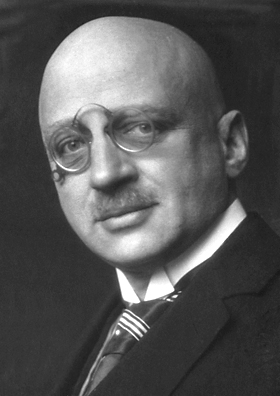
Image: Photogravure by H. Riffart, Berlin. Scanned, image processed and uploaded by Kuebi = Armin Kübelbeck · Public domain, via Wikimedia Commons
Chemistry
Law of mass action describes chemical equilibrium
Cato Guldberg and Peter Waage showed that reaction rates depend on the concentrations of the substances involved, and that reactions settle at a balance.
Why it matters
Equilibrium explains how reactions run both ways and where they stop.
August Kekulé proposed that the six carbon atoms of benzene form a ring with alternating single and double bonds. Chemists could now draw the structure of carbon compounds, which let them design new ones.
Why it matters
It explained the stability of benzene and underpins the chemistry of dyes, drugs and plastics.
James Clerk Maxwell combined electricity and magnetism in a few equations that predicted waves travelling at the speed of light, and concluded that light is such a wave. Heinrich Hertz made radio waves in 1887 to prove it.
Why it matters
It united electricity, magnetism and light, and led to radio, television and radar.
By crossing thousands of pea plants and counting the offspring, Gregor Mendel showed that traits are passed on as separate units, some dominant and some hidden. His work was ignored until it was rediscovered in 1900.
Why it matters
It founded genetics and explained how traits can skip a generation.
During a solar eclipse, Jules Janssen saw an unknown yellow line in the Sun's light, and Norman Lockyer concluded it came from a new element. Helium was not found on Earth until 1895.
Why it matters
It was the first element discovered in space, proving we can read the chemistry of stars from their light.
People: William Ramsay, Pierre Janssen, Norman Lockyer
Dmitri Mendeleev arranged the known elements by atomic weight in a table that grouped elements with similar properties. He left gaps for undiscovered elements and correctly predicted what they would be like.
Why it matters
It organises all of chemistry, and guided the search for new elements.
Georg Cantor proved that the real numbers cannot be matched one for one with the counting numbers, so some infinities are bigger than others. Many mathematicians of his day found the idea deeply troubling.
Why it matters
Set theory became the foundation on which nearly all of modern mathematics is built.
Jacobus van 't Hoff and Joseph Le Bel proposed that carbon's four bonds point to the corners of a tetrahedron, giving molecules a three-dimensional shape.
Why it matters
Shape decides how molecules fit into enzymes and receptors.
Heinrich Hertz sent sparks across a gap and detected invisible waves across the room. He showed that electromagnetic waves travel at the speed of light.
Why it matters
Radio, radar and wireless communication grew from his experiments.
Albert Michelson and Edward Morley used an interferometer to look for Earth's motion through the aether. They found no measurable difference in the speed of light.
Why it matters
Their null result pointed towards Einstein's special relativity.
Using a silver stain on thin slices of brain tissue, Santiago Ramón y Cajal showed that the nervous system is made of separate cells that meet at tiny gaps, rather than one continuous web.
Why it matters
It founded modern neuroscience and the idea that thought comes from signals passing between cells.
Credit is debated. Camillo Golgi, whose stain Cajal used, favoured a continuous network. They shared the 1906 Nobel Prize while disagreeing.
The first distant earthquake is recorded on a seismograph
On 17 April 1889 Ernst von Rebeur-Paschwitz's pendulums in Potsdam and Wilhelmshaven swung about an hour after a strong earthquake near Tokyo. The waves had crossed the Earth.
Why it matters
It showed that seismographs can record quakes thousands of kilometres away.
Georg Cantor gave a new, simpler proof that the real numbers cannot be listed, by building a number that differs from every entry on a list. The same trick showed that every set has more subsets than members.
Why it matters
Diagonal arguments later underlay Gödel's and Turing's proofs about the limits of logic and computing.
Dmitri Ivanovsky showed that the sap of diseased tobacco plants stayed infectious after passing through a filter fine enough to hold back bacteria. Martinus Beijerinck confirmed it in 1898 and called the agent a "contagious living fluid".
Why it matters
It revealed a new kind of infectious agent behind illnesses from the common cold to AIDS.
Credit is debated. Ivanovsky reported the filterable agent in 1892; Beijerinck, working separately, saw it as a new kind of agent in 1898.
Lord Rayleigh and William Ramsay found that nitrogen taken from air was slightly heavier than nitrogen made in the laboratory. The difference was a new gas that would not react with anything. They named it argon, "the idle one".
Why it matters
It revealed a whole family of inert gases and a missing column in Mendeleev's table.
Alexandre Yersin, working in Hong Kong during an outbreak, found the bacterium that causes plague. It is now named after him.
Why it matters
The discovery identified the cause of one of history's deadliest diseases.
Credit is debated. Kitasato Shibasaburō reported a bacillus in Hong Kong days earlier, but his description was less accurate, so Yersin is usually credited.
Wilhelm Röntgen noticed a screen glowing near a covered cathode-ray tube and found invisible rays that pass through flesh but not bone. Within weeks, X-ray pictures of hands were amazing people around the world.
Why it matters
They gave doctors their first view inside the living body.
Henri Becquerel found that uranium salts fogged photographic plates even in the dark, giving off rays of their own. Marie and Pierre Curie went on to discover the radioactive elements polonium and radium.
Why it matters
It showed that atoms can change, and led to nuclear power, cancer treatments and radiocarbon dating.
J. J. Thomson showed that cathode rays are streams of particles far lighter than any atom, each carrying a negative charge. The electron was the first subatomic particle ever found.
Why it matters
Electrons carry the current in every electronic device, and decide how atoms join together.
To explain the glow of hot objects, Max Planck had to assume that energy is handed out in small, fixed packets instead of a smooth flow. He called them quanta, and at first saw the step as a mathematical device.
Why it matters
It started quantum physics, the theory behind atoms, lasers and computer chips.
Karl Landsteiner found that mixing some people's blood caused clumping, and identified the A, B and O blood groups. His colleagues found the rarer AB group in 1902.
Walter Sutton noticed that chromosomes separate in the same way as Mendel's inherited factors, and proposed that chromosomes carry heredity. Theodor Boveri reached the same idea independently.
Why it matters
It linked Mendel's rules to physical structures inside cells.
Einstein explains the photoelectric effect with light quanta
Albert Einstein argued that light arrives in packets whose energy depends on frequency. This explained why light only knocks electrons loose above a set frequency.
Why it matters
It supported the quantum view of light and earned him the 1921 Nobel Prize.
Albert Einstein showed that light travels at the same speed for everyone, so time and distance depend on how fast you move. A follow-up paper that year gave the famous equation E = mc².
Why it matters
It changed our ideas of space and time, and GPS satellites must allow for it to stay accurate.
Thomas Hunt Morgan's lab bred fruit flies and found that linked genes are inherited together. The rate of crossing over let them build the first gene maps.
Why it matters
It showed that genes sit at fixed positions on chromosomes.
Hans Geiger and Ernest Marsden fired alpha particles at thin gold foil, and a few bounced straight back. Ernest Rutherford concluded that an atom's mass and positive charge sit in a tiny central nucleus.
Why it matters
It replaced the "plum pudding" atom with the nuclear atom, the picture behind all later atomic physics.
Henrietta Leavitt found that brighter Cepheid variable stars pulse more slowly. Comparing a star's pulse with its apparent brightness gives its true luminosity and distance.
Why it matters
It became the first reliable yardstick for distances to other galaxies.
Alfred Wegener noticed that the coasts of South America and Africa fit together and that matching fossils and rocks lie on both sides of the Atlantic. He said the continents had once been joined, but could not say how they moved.
Why it matters
Most geologists rejected it at first, but it was proved right half a century later by plate tectonics.
Bragg's law links X-ray diffraction to crystal structure
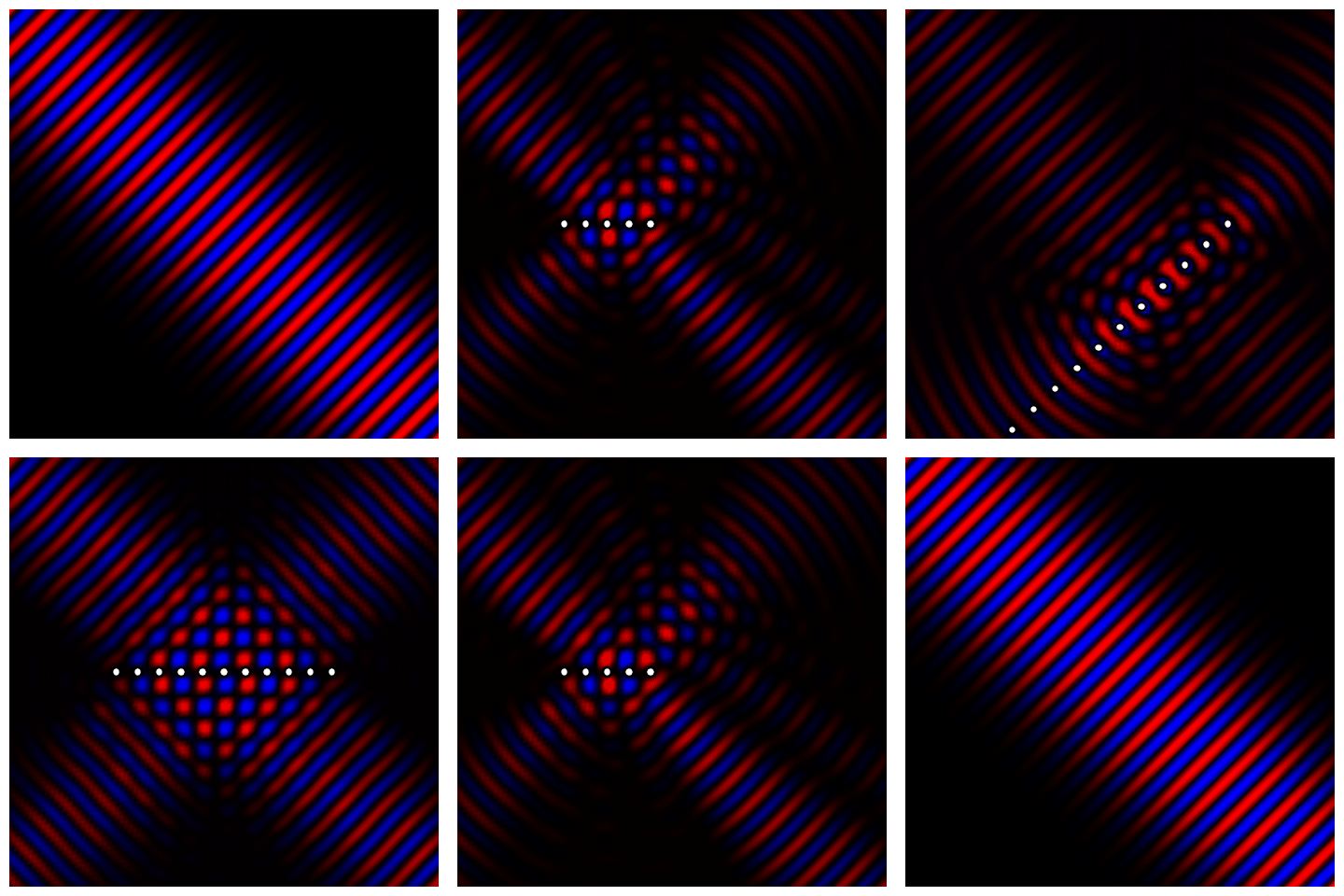
William Lawrence Bragg showed that X-rays reflected from crystal planes reinforce at certain angles, so crystal structure can be read from the pattern.
Why it matters
It made it possible to map the atoms in salts, metals and later proteins.
Henry Moseley measured the X-ray spectra of many elements and found their frequencies rise in a regular pattern with each element's position in the table.
Why it matters
The periodic table is ordered by atomic number, and the gaps pointed to undiscovered elements.
Image: Einstein (gravitational) field equations including the cosmological constant Λ by Albert Einstein from his theory of general relativity (Stephen Weinberg, Gr… · CC BY-SA 4.0, via Wikimedia Commons
Physics
General relativity
Albert Einstein described gravity as the bending of space and time by mass and energy. In 1919, astronomers saw starlight bending around the Sun during an eclipse, just as he had predicted.
Why it matters
It explains black holes, gravitational waves and the expanding universe.
Gilbert Lewis proposed that atoms bond by sharing pairs of electrons until each has a full outer shell of eight. His dot diagrams are still drawn in school chemistry lessons.
Why it matters
It gave chemists a simple picture of why atoms stick together to make molecules.
Shapley finds the Sun far from the Galaxy's centre
Harlow Shapley used globular clusters to map the Milky Way and placed the Sun far out from its centre. The Galaxy turned out to be much bigger than thought.
Why it matters
It moved Earth from the centre of the cosmos to an ordinary spot in a larger galaxy.
Staudinger proposes that plastics are long molecular chains
Hermann Staudinger argued that rubber and similar materials are made of long chains of small units joined by covalent bonds, a view that was then disputed.
Why it matters
The macromolecule idea founded modern polymer science.
Otto Stern and Walther Gerlach sent silver atoms through a magnetic field and saw the beam split in two. The split revealed a quantum property later called spin.
Why it matters
Spin became a basic property of matter and is central to modern technology.
Louis de Broglie suggested that electrons and other particles have wavelengths linked to their momentum. Electron diffraction confirmed it a few years later.
Why it matters
It helped launch wave mechanics and the modern picture of matter.
Edwin Hubble found Cepheid stars in the Andromeda nebula and used them to measure its distance. It lay far outside the Milky Way, so it is a separate galaxy.
Why it matters
It showed that the universe holds many galaxies, not just one.
Georges Lemaître in 1927 and Edwin Hubble in 1929 found that the farther away a galaxy is, the faster it is moving away from us. The universe itself is expanding.
Why it matters
It is key evidence that the universe had a beginning.
Credit is debated. Long credited to Hubble alone; since 2018 astronomers have called it the Hubble–Lemaître law.
Lemaître proposes an expanding universe from a primeval atom
In 1927 Georges Lemaître, a Belgian priest and physicist, derived an expanding universe from general relativity. In 1931 he suggested it had begun from a single compact 'primeval atom'.
Why it matters
His idea became the modern Big Bang model, and Hubble's data later supported it.
Werner Heisenberg showed that position and momentum cannot both be known exactly at the same time. The limit comes from nature, not from poor instruments.
Alexander Fleming noticed that a mould growing on one of his bacteria plates had killed the colonies around it. Howard Florey and Ernst Chain turned it into a usable medicine in the early 1940s.
Why it matters
It was the first widely used antibiotic, and has saved millions of lives.
At Zhoukoudian, near Beijing, the Chinese anthropologist Pei Wenzhong found an almost complete Homo erectus skullcap. Davidson Black had set up the research there.
Why it matters
It showed early humans had spread far into East Asia.
Clyde Tombaugh found Pluto by comparing photographs of the same patch of sky taken days apart and spotting a dot that moved. It was reclassified as a dwarf planet in 2006.
Why it matters
It was the first hint of the Kuiper belt, a vast ring of icy worlds beyond Neptune.
Kurt Gödel proved that any consistent system of arithmetic rules contains true statements that the system itself can never prove. It ended the hope of resting all of mathematics on one complete, self-proving set of axioms.
Why it matters
It set a limit on what formal proof can do, and it fed into the theory of computing.
James Chadwick identified a particle in the atomic nucleus with no electric charge and about the mass of a proton. It explained why atoms weigh more than their protons alone.
Why it matters
Neutrons made nuclear fission possible, and with it nuclear power.
Studying faint earthquake waves that should not have reached certain places, the Danish seismologist Inge Lehmann concluded that Earth's liquid core hides a smaller solid centre. Later instruments confirmed it.
Why it matters
It completed our picture of Earth's layers, down to a solid, iron-rich ball at the centre.
Otto Hahn and Fritz Strassmann bombarded uranium with neutrons and found lighter barium among the products. Lise Meitner and Otto Frisch explained it as the nucleus splitting in two and releasing huge amounts of energy.
Why it matters
It made both nuclear power and nuclear weapons possible.
Credit is debated. Lise Meitner, who helped plan the work and explained the result, was left out of the 1944 Nobel Prize in Chemistry that went to Hahn alone.
Oswald Avery, Colin MacLeod and Maclyn McCarty showed that DNA from one strain of bacteria could change the inherited traits of another. Most biologists had expected proteins, not DNA, to carry genes.
Why it matters
It pointed the search for the secret of heredity at DNA, and so towards the double helix.
John Bardeen and Walter Brattain, in William Shockley's group at Bell Labs, built a transistor that could amplify an electrical signal, a small solid replacement for bulky vacuum tubes.
Why it matters
Transistors are the basis of every modern computer and phone.
Light elements predicted to form in the first minutes
Ralph Alpher and George Gamow, with Hans Bethe added as a joke, proposed that hydrogen and helium formed in the hot early universe and calculated their amounts.
Why it matters
The predicted helium and hydrogen abundances match what we measure today.
James Watson and Francis Crick proposed that DNA is a double helix of two strands linked by paired bases, using X-ray images made by Rosalind Franklin and Raymond Gosling. The pairing suggested how DNA copies itself.
Why it matters
It showed how genetic information is stored and passed on, and founded molecular biology.
Credit is debated. Franklin's X-ray data was shown to Watson without her knowledge; she died in 1958, before the 1962 Nobel Prize.
People: Maurice Wilkins, Francis Crick, James Watson, Rosalind Franklin
Frederick Sanger read the order of amino acids in the two chains of cow insulin in 1951 and 1952, and by 1955 had placed the bonds that link them. It was the first protein sequence ever worked out.
Why it matters
It proved that each protein has a definite sequence, the idea behind reading genes and making insulin in bacteria.
Clair Patterson measured lead isotopes in a meteorite that fell in Arizona and in ocean sediments, and calculated that Earth is about 4.55 billion years old. The figure has barely changed since.
Why it matters
It replaced centuries of guesses with a measured age, giving geology and evolution a fixed timescale.
Maps of the ocean floor showed new crust spreading out from mid-ocean ridges, reviving Alfred Wegener's 1912 idea of drifting continents. By the late 1960s, geologists agreed that Earth's surface is broken into moving plates.
Why it matters
It explains earthquakes, volcanoes, mountain ranges and the shapes of the continents.
Image: Edited by Seth Miller User:arapacana , Original file designed and produced by: Kosi Gramatikoff User:Kosigrim , courtesy of Abgent , also available in print … · Public domain, via Wikimedia Commons
Life sciences
The genetic code is cracked
Marshall Nirenberg and Heinrich Matthaei made a synthetic RNA of one repeated letter and found that it built a protein of a single amino acid. That first match began the decoding of how DNA's letters stand for amino acids.
Why it matters
It showed how the instructions in DNA become the proteins that build and run living things.
Fred Vine and Drummond Matthews, and separately Lawrence Morley, showed that stripes of magnetised rock on the seafloor mirror each other across ridges.
Why it matters
The pattern is strong evidence that the ocean floor spreads and that the magnetic field reverses.
Quasars identified as very distant, bright objects
Maarten Schmidt measured the redshift of a radio source and found it was extremely distant and enormously bright. Others soon found many similar objects.
Why it matters
Quasars showed that some galaxies were powered by supermassive black holes in the early universe.
John Bell derived an inequality that any local hidden-variable theory must obey. Quantum mechanics predicts violations, and experiments confirmed them.
Why it matters
It opened experimental tests of entanglement and underlies quantum cryptography.
Arno Penzias and Robert Wilson picked up a faint microwave hiss coming equally from every direction in the sky. It turned out to be heat left over from the hot, dense early universe.
Why it matters
It is the strongest evidence that the universe began with a Big Bang.
Jocelyn Bell Burnell, a graduate student, noticed a regular radio pulse from one spot in the sky. It came from a rapidly spinning neutron star, a pulsar.
Why it matters
Pulsars are natural clocks, and they have tested general relativity.
The X-ray source Cygnus X-1 was found to orbit an invisible companion too heavy to be a neutron star. Most astronomers came to accept it as a black hole.
Why it matters
It was one of the first strong cases for a real black hole.
Donald Johanson and Tom Gray found about 40 percent of the skeleton of an Australopithecus afarensis in Ethiopia's Afar region. At 3.2 million years old, it showed that our ancestors walked upright long before they had large brains.
Why it matters
It gave strong evidence that walking on two legs came early in the human story.
People: Tom Gray, Maurice Taieb, Yves Coppens, Donald Johanson
Luis and Walter Alvarez found a thin clay layer rich in iridium, rare on Earth but common in asteroids, in rocks laid down 66 million years ago. They argued that a giant impact wiped out the dinosaurs. The Chicxulub crater was identified later.
Why it matters
It showed that sudden catastrophes, not only slow change, have shaped the history of life.
Image: Photo Credit: C. Goldsmith Content Providers: CDC/ C. Goldsmith, P. Feorino, E. L. Palmer, W. R. McManus · Public domain, via Wikimedia Commons
Life sciences
HIV identified as the cause of AIDS
Luc Montagnier's team in Paris, including Françoise Barré-Sinoussi, isolated the virus now called HIV in 1983. In 1984 Robert Gallo's team in the United States showed that it causes AIDS.
Why it matters
Identifying the virus made testing and antiretroviral treatment possible.
Joseph Farman and his colleagues at the British Antarctic Survey reported that the ozone layer above Antarctica had thinned sharply each spring since the 1970s. Chlorine from man-made chemicals was soon blamed.
Why it matters
It led to the Montreal Protocol, which banned the chemicals responsible and let the ozone layer begin to recover.
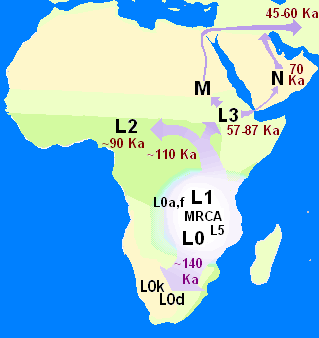
Rebecca Cann, Mark Stoneking and Allan Wilson used mitochondrial DNA from living people to show that all humans share a maternal ancestor who lived in Africa.
Why it matters
It gave strong genetic support for an African origin of modern humans.
A star in the Large Magellanic Cloud exploded and was visible to the naked eye. Detectors on Earth caught a burst of neutrinos hours before the light arrived.
Why it matters
It confirmed the core-collapse model of supernovae and the neutrino emission it predicts.
In 1637 Pierre de Fermat noted that no whole numbers satisfy xⁿ + yⁿ = zⁿ once n is above 2. Andrew Wiles proved it after seven years of secret work, repairing a gap in his first attempt with Richard Taylor in 1994.
Why it matters
Solving a puzzle that stood for over three and a half centuries pushed number theory far forward.
Michel Mayor and Didier Queloz found 51 Pegasi b, a giant planet that circles a Sun-like star in just four days, by spotting the tiny wobble it causes in the star. Thousands more planets have been found since.
Why it matters
It showed that planets are common, and began the search for worlds like ours.
Credit is debated. The first confirmed exoplanets were found around a pulsar in 1992; 51 Pegasi b was the first around a Sun-like star.
Scientists at the Roslin Institute near Edinburgh grew a lamb from a single cell taken from an adult sheep's udder. Dolly was born in 1996, and the news came out in February 1997.
Why it matters
It showed that a specialised adult cell can be reset to make a whole new animal.
Two teams measuring distant exploding stars found them dimmer than expected, meaning the universe's expansion is speeding up. Something later named dark energy seems to be pushing space apart.
Why it matters
It revealed that most of the energy in the universe takes a form we do not yet understand.
Zircon grains show water existed 4.4 billion years ago
Tiny zircon crystals from the Jack Hills in Western Australia were dated to 4.4 billion years old. Their chemistry suggested liquid water existed then.
Why it matters
It pushed back the record for early water and for the early crust.
Jennifer Doudna and Emmanuelle Charpentier showed that a bacterial defence system could be reprogrammed to cut DNA at any chosen spot. Scientists soon used it to edit genes in plants, animals and human cells.
Why it matters
It made editing genes cheap and fast, opening new treatments and raising hard ethical questions.
Physicists at CERN's Large Hadron Collider announced a new particle matching the one predicted in 1964 by Peter Higgs and others. It confirmed how fundamental particles get their mass.
Why it matters
It completed the Standard Model, our best theory of the particles that make up matter.
Image: B. P. Abbott et al. (LIGO Scientific Collaboration and Virgo Collaboration) — full list at the end of the article · CC BY 3.0, via Wikimedia Commons
Astronomy
Gravitational waves detected
The twin LIGO detectors in the United States recorded ripples in space-time from two black holes merging about 1.3 billion light-years away. Einstein had predicted such waves a century earlier.
Why it matters
It opened a new way to study the universe, through its vibrations rather than its light.
Image: Alan Fitzsimmons ( Astrophysics Research Centre , Queen's University Belfast ), Isaac Newton Group ( - Instituto de Astrofísica de Canarias ) Derivative: nag… · Public domain, via Wikimedia Commons
Astronomy
'Oumuamua is the first known interstellar object
The object 1I/ʻOumuamua was seen moving fast on a path that showed it came from outside the Solar System.
Why it matters
It showed that rocks from other star systems pass through ours.
James Webb Space Telescope releases its first deep field
NASA released the first full-colour science image from the James Webb Space Telescope, a deep field of distant galaxies seen in infrared. More images followed the next day.
Why it matters
It can see the earliest galaxies that formed after the Big Bang.