All journeys

Space exploration

From the first rockets to footprints on the Moon, robots on Mars and people living in orbit: the launches, missions and firsts of the space age.

Humans in space right now

10people

  • ISS · 7Pyotr Dubrov (126 d), Anna Kikina (126 d), Anil Menon (126 d), Jessica Watkins (47 d), Luke Delaney (47 d), Joshua Kutryk (47 d), Sergey Teteryatnikov (47 d)
  • Tiangong · 3Zhu Yangzhu (177 d), Zhang Zhiyuan (177 d), Lai Ka-ying (177 d)

As of 9 Nov 2026. Source: People in Space API by Christopher Quaid. Days are days since launch.

Stories
182
Distance
124 years
Route
1903 to present
  1. The rocket pioneers5 stories
  2. The space race53 stories
  3. Shuttles and stations37 stories
  4. A crowded sky87 stories
Begin the journey
  1. Chapter I

    The rocket pioneers

    5 stories in this chapter

  2. Konstantin Tsiolkovsky, the schoolteacher who worked out the mathematics of rocket flight

    Story 1 of 182 · The rocket pioneers

    Rockets and launches

    Tsiolkovsky's rocket equation

    A deaf schoolteacher in Kaluga, Konstantin Tsiolkovsky, published the mathematics showing how a rocket could reach orbit, and proposed liquid fuel and multi-stage rockets.

    Next story1926 · The first liquid-fuelled rocket
  3. Robert Goddard, the American rocket pioneer, in a portrait

    Story 2 of 182 · The rocket pioneers

    Rockets and launches

    The first liquid-fuelled rocket

    On a farm in Auburn, Massachusetts, Robert Goddard launched a rocket burning petrol and liquid oxygen. It flew for 2.5 seconds and rose 12.5 metres.

    Next story1944 · A V-2 crosses into space
  4. A V-2 rocket lifting off at Peenemünde in 1943

    Story 3 of 182 · The rocket pioneers

    Rockets and launches

    A V-2 crosses into space

    A German V-2 missile fired straight up from Peenemünde reached about 176 kilometres, above the edge of space. V-2s were built by concentration camp prisoners, thousands of whom died.

    Next story1947 · Fruit flies in space
  5. The Earth photographed from about 160 kilometres up by a V-2 launched from White Sands in March 1947

    Story 4 of 182 · The rocket pioneers

    People in space

    Fruit flies in space

    American scientists launched fruit flies on a captured V-2 from New Mexico to study the effects of radiation. They came back alive in a capsule under a parachute.

    Next story1957 · The R-7: first ICBM, first space launcher
  6. A drawing of the Soviet R-7 rocket

    Story 5 of 182 · The rocket pioneers

    Rockets and launches

    The R-7: first ICBM, first space launcher

    Sergei Korolev's R-7 flew successfully in August 1957 as the world's first intercontinental ballistic missile. Within weeks the same rocket put Sputnik into orbit, and its descendants, mostly the Soyuz, have flown more than 2,000 times.

    Next story1957 · Sputnik 1
  7. Chapter II

    The space race

    53 stories in this chapter

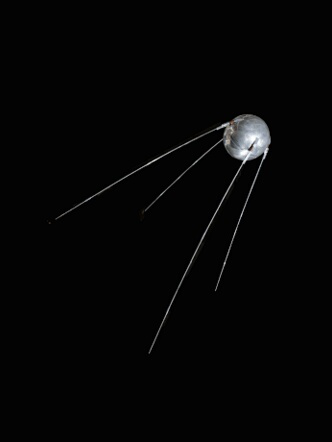
  8. A replica of Sputnik 1, a polished metal sphere with four long antennas

    Story 6 of 182 · The space race

    Rockets and launches

    Sputnik 1

    The Soviet Union launched a polished metal ball with four antennas into orbit. Its radio beeps were picked up around the world.

    Next story1957 · Laika orbits the Earth
  9. Laika, the dog sent into orbit aboard Sputnik 2 in 1957

    Story 7 of 182 · The space race

    People in space

    Laika orbits the Earth

    A stray dog from Moscow's streets became the first animal to orbit the Earth. She died of overheating within hours; there was no plan to bring her back.

    Next story1957 · America's first satellite attempt fails on live TV
  10. The Vanguard rocket exploding on its launch pad on 6 December 1957

    Story 8 of 182 · The space race

    Rockets and launches

    America's first satellite attempt fails on live TV

    Two months after Sputnik, a Vanguard rocket carrying a small US test satellite rose a few feet off its pad at Cape Canaveral, lost thrust and exploded on live television. The press called it Flopnik.

    Next story1958 · Explorer 1
  11. Explorer 1 satellite

    Story 9 of 182 · The space race

    Satellites and telescopes

    Explorer 1

    America's first satellite carried James Van Allen's instruments, which found belts of radiation trapped around the Earth.

    Next story1958 · NASA is founded
  12. NASA Headquarters at 300 E Street SW in Washington D.C

    Story 10 of 182 · The space race

    Rockets and launches

    NASA is founded

    President Eisenhower signed the law creating the National Aeronautics and Space Administration to run America's civilian space programme. It opened for business on 1 October.

    Next story1959 · Luna 2 hits the Moon
  13. A model of Luna 2: a metal sphere with four antennas

    Story 11 of 182 · The space race

    The Moon

    Luna 2 hits the Moon

    Luna 2, the Soviet Union's sixth attempt, crashed east of Mare Imbrium on 13 September 1959, the first human-made object to touch another world. Before impact it released pennants engraved with USSR and the launch date.

    Next story1959 · The far side of the Moon
  14. The first picture of the Moon's far side, taken by Luna 3 in 1959

    Story 12 of 182 · The space race

    The Moon

    The far side of the Moon

    Weeks after Luna 2 became the first craft to hit the Moon, Luna 3 photographed the side that always faces away from Earth.

    Next story1960 · The first weather satellite
  15. One of the first television pictures of Earth's clouds from space, taken by TIROS-1

    Story 13 of 182 · The space race

    Satellites and telescopes

    The first weather satellite

    TIROS-1, launched on 1 April 1960, was the first operational weather satellite, carrying television cameras in low Earth orbit. It sent back pictures of cloud patterns that gave forecasters their first view of weather from above.

    Next story1960 · Belka and Strelka orbit and return
  16. The dogs Belka and Strelka in their space vests after returning from orbit in 1960

    Story 14 of 182 · The space race

    People in space

    Belka and Strelka orbit and return

    The dogs Belka and Strelka spent a day in orbit on Korabl-Sputnik 2 on 19 August 1960, with 42 mice, a rabbit, rats, flies and plants. They were the first higher animals to survive an orbital flight, and every passenger came home alive.

    Next story1961 · Yuri Gagarin
  17. Yuri Gagarin at a press conference in July 1961

    Story 15 of 182 · The space race

    People in space

    Yuri Gagarin

    Yuri Gagarin orbited the Earth once in 108 minutes, then ejected and parachuted down near the Volga. 'Poyekhali!', 'Let's go!', he said at liftoff.

    Next story1961 · Alan Shepard flies Freedom 7
  18. Alan Shepard in his spacesuit during the Freedom 7 flight, in a frame from NASA's film

    Story 16 of 182 · The space race

    People in space

    Alan Shepard flies Freedom 7

    Alan Shepard's Freedom 7 flight on 5 May 1961 lasted 15 minutes, a suborbital hop to show that a man could withstand the forces of launch and re-entry. It came three weeks after Gagarin's orbit of the Earth.

    Next story1962 · John Glenn orbits the Earth
  19. John Glenn inside the Friendship 7 capsule, photographed by a camera aboard the spacecraft

    Story 17 of 182 · The space race

    People in space

    John Glenn orbits the Earth

    John Glenn made three orbits in Friendship 7 on 20 February 1962, the first American to orbit the Earth. It was the fifth human spaceflight, after two Soviet orbital flights and two American suborbital ones.

    Next story1962 · The first live TV across the Atlantic
  20. A replica of Telstar 1, a sphere covered in solar cells

    Story 18 of 182 · The space race

    Satellites and telescopes

    The first live TV across the Atlantic

    Telstar 1, launched on 10 July 1962, was the first telecommunications satellite and carried live television between the United States and Europe. It lasted only about seven months, after the high-altitude nuclear test Starfish Prime damaged it.

    Next story1962 · 'We choose to go to the Moon'
  21. President John F. Kennedy speaking at Rice University on 12 September 1962

    Story 19 of 182 · The space race

    The Moon

    'We choose to go to the Moon'

    At Rice University, President John F. Kennedy promised to land a man on the Moon before the decade was out, 'not because they are easy, but because they are hard'.

    Next story1962 · Canada's Alouette 1
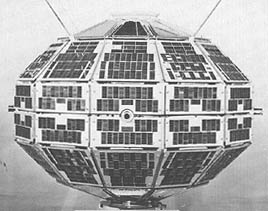
  22. The drum-shaped Alouette 1 satellite with its long antennas extended

    Story 20 of 182 · The space race

    Satellites and telescopes Unverified

    Canada's Alouette 1

    Canadian engineers built Alouette 1 and an American rocket put it in orbit. No country but the two superpowers had built a satellite before. It probed the upper atmosphere from above, using long antennas that sprang out of rolled metal strips like a tape measure.

    Next story1962 · Mariner 2 at Venus
  23. Mariner 2 was the world's first successful interplanetary spacecraft

    Story 21 of 182 · The space race

    Planets and beyond

    Mariner 2 at Venus

    Mariner 2 flew past Venus and found its surface was hundreds of degrees, far too hot for life.

    Next story1963 · Valentina Tereshkova
  24. Valentina Tereshkova, the first woman in space

    Story 22 of 182 · The space race

    People in space

    Valentina Tereshkova

    Valentina Tereshkova, a textile worker and amateur parachutist, orbited the Earth 48 times in three days.

    Next story1964 · Ranger 7 sends close-ups of the Moon
  25. A Ranger lunar probe, with a cone-shaped tower and two long solar panels

    Story 23 of 182 · The space race

    The Moon

    Ranger 7 sends close-ups of the Moon

    After six failures, Ranger 7 was the first fully successful flight of NASA's Ranger programme. In its final minutes before crashing into the Moon on 31 July 1964, its six cameras sent back thousands of close-up pictures.

    Next story1965 · The first spacewalk
  26. A 1980 Soviet stamp sheet showing a cosmonaut spacewalking outside a spacecraft

    Story 24 of 182 · The space race

    People in space

    The first spacewalk

    Alexei Leonov floated outside his spacecraft for about 12 minutes. His suit ballooned and he had to let air out to squeeze back in.

    Next story1965 · Ed White walks in space
  27. Ed White on the first American spacewalk, 3 June 1965

    Story 25 of 182 · The space race

    People in space

    Ed White walks in space

    James McDivitt and Ed White spent four days in orbit on Gemini 4, circling Earth 66 times. On 3 June 1965 White stepped outside and floated for about 20 minutes on a tether, America's first spacewalk.

    Next story1965 · Mariner 4 at Mars
  28. The Mariner 4 spacecraft, with four solar panels and a dish antenna

    Story 26 of 182 · The space race

    Planets and beyond

    Mariner 4 at Mars

    Mariner 4 sent back 21 pictures of a cratered, Moon-like Mars.

    Next story1965 · France's Astérix: a third nation launches
  29. The small Astérix satellite on display at the air and space museum at Le Bourget

    Story 27 of 182 · The space race

    Rockets and launches

    France's Astérix: a third nation launches

    A Diamant A rocket launched from Hammaguir in the Algerian Sahara put Astérix, France's first satellite, into orbit. Its main job was to prove the rocket; it also carried instruments to study the ionosphere.

    Next story1966 · Luna 9 lands
  30. The Luna 9 probe on display in a museum

    Story 28 of 182 · The space race

    The Moon

    Luna 9 lands

    Luna 9 landed gently on the Moon and sent back the first pictures from its surface.

    Next story1966 · Gemini 8 docks, then tumbles
  31. The Agena target vehicle, seen from Gemini 8 as the two craft docked

    Story 29 of 182 · The space race

    People in space

    Gemini 8 docks, then tumbles

    On 16 March 1966 Neil Armstrong and David Scott made the first docking of two spacecraft in orbit, joining Gemini 8 to an uncrewed Agena. A stuck thruster then sent the linked craft spinning, and Armstrong undocked and stopped the spin using the re-entry thrusters.

    Next story1966 · Surveyor 1 soft-lands on the Moon
  32. A Surveyor lunar lander on a test field, with its three legs and a tall mast

    Story 30 of 182 · The space race

    The Moon

    Surveyor 1 soft-lands on the Moon

    Surveyor 1 landed gently on the Ocean of Storms on 2 June 1966, four months after the Soviet Luna 9. It sent back pictures until mid-July and showed that the surface could carry the weight of a lander.

    Next story1967 · The Apollo 1 fire
  33. The Apollo 1 crew in their spacesuits: Gus Grissom, Ed White and Roger Chaffee

    Story 31 of 182 · The space race

    People in space

    The Apollo 1 fire

    Fire swept through the Apollo 1 capsule during a launch rehearsal, killing Gus Grissom, Ed White and Roger Chaffee.

    Next story1967 · Soyuz 1 and the first death in flight
  34. Vladimir Komarov, the pilot of Soyuz 1, in a formal portrait

    Story 32 of 182 · The space race

    People in space

    Soyuz 1 and the first death in flight

    Soyuz 1, launched on 23 April 1967, was the first crewed Soyuz flight and was plagued with technical problems. When its parachute failed on return, the cosmonaut Vladimir Komarov was killed, the first person to die during a spaceflight.

    Next story1967 · Venera 4 samples the air of Venus
  35. The Venera 4 descent capsule in a museum

    Story 33 of 182 · The space race

    Planets and beyond

    Venera 4 samples the air of Venus

    Venera 4's descent probe entered the atmosphere of Venus on 18 October 1967, the first spacecraft to survive entry into another planet's atmosphere. It found air that was mostly carbon dioxide, with a few per cent nitrogen and less than one per cent oxygen.

    Next story1967 · The Saturn V flies for the first time
  36. A chart of every Saturn V rocket flown, standing side by side

    Story 34 of 182 · The space race

    Rockets and launches

    The Saturn V flies for the first time

    The uncrewed Apollo 4 launched the first Saturn V on 9 November 1967. Thirteen Saturn Vs flew until 1973, nine of them sending 24 astronauts toward the Moon, and the last launched the Skylab space station.

    Next story1968 · Tortoises fly around the Moon
  37. A drawing of the Zond circumlunar spacecraft

    Story 35 of 182 · The space race

    The Moon

    Tortoises fly around the Moon

    In September 1968 Zond 5 flew around the Moon and returned safely, carrying two Russian tortoises, fruit-fly eggs and plants. They were the first living creatures from Earth to travel beyond low orbit and come back.

    Next story1968 · Apollo 8 and Earthrise
  38. Earthrise: the Earth rising over the Moon's horizon, photographed by Bill Anders

    Story 36 of 182 · The space race

    The Moon

    Apollo 8 and Earthrise

    Frank Borman, Jim Lovell and Bill Anders were the first people to leave Earth's orbit and circle the Moon. Anders photographed the Earth rising over the lunar horizon.

    Next story1969 · The Soviet Moon rocket explodes
  39. Drawing of the tall, cone-shaped Soviet N1 Moon rocket

    Story 37 of 182 · The space race

    Rockets and launches

    The Soviet Moon rocket explodes

    The N1, the Soviet answer to the Saturn V, had a first stage of thirty engines. On its second launch, two weeks before Apollo 11, it fell back onto the pad and exploded, wrecking the launch complex. All four launches from 1969 to 1972 failed.

    Next story1969 · Apollo 11
  40. Buzz Aldrin standing on the Moon, with Neil Armstrong reflected in his visor

    Story 38 of 182 · The space race

    The Moon

    Apollo 11

    On 20 July Neil Armstrong and Buzz Aldrin landed the Eagle in the Sea of Tranquillity while Michael Collins orbited above. Some 600 million people watched Armstrong step onto the Moon.

    Next story1969 · Apollo 12 lands next to Surveyor 3
  41. The Apollo 12 crew in their spacesuits: Pete Conrad, Richard Gordon and Alan Bean

    Story 39 of 182 · The space race

    The Moon

    Apollo 12 lands next to Surveyor 3

    Apollo 12 launched on 14 November 1969 through a thunderstorm and was struck by lightning twice. Pete Conrad and Alan Bean landed in the Ocean of Storms on 19 November, close to the Surveyor 3 probe, and brought back parts of it.

    Next story1970 · Japan's first satellite
  42. An artist's picture of Japan's Ohsumi satellite in orbit

    Story 40 of 182 · The space race

    Rockets and launches

    Japan's first satellite

    Japan launched Ohsumi on 11 February 1970 from the Kagoshima Space Center, on a Lambda 4S-5 rocket built by the University of Tokyo's space institute, after earlier failures. It made Japan the fourth nation to reach orbit by its own launch.

    Next story1970 · Apollo 13
  43. The Apollo 13 crew: Jim Lovell, Jack Swigert and Fred Haise

    Story 41 of 182 · The space race

    The Moon

    Apollo 13

    An oxygen tank exploded on the way to the Moon. The crew used the lunar module as a lifeboat, looped around the Moon and splashed down safely.

    Next story1970 · China's first satellite plays The East Is Red
  44. A model of China's first satellite, Dong Fang Hong 1

    Story 42 of 182 · The space race

    Rockets and launches

    China's first satellite plays The East Is Red

    China launched Dong Fang Hong 1 on 24 April 1970. At 173 kg it was heavier than the first satellites of the other space powers, and its transmitter broadcast the song The East Is Red.

    Next story1970 · Luna 16 brings back Moon soil by robot
  45. The Luna 16 probe on display in a museum

    Story 43 of 182 · The space race

    The Moon

    Luna 16 brings back Moon soil by robot

    Luna 16 landed in Mare Fecunditatis in September 1970, drilled a core and returned 101 grams of lunar soil to Earth entirely on its own. It was the third lunar sample return, after Apollo 11 and 12.

    Next story1970 · Lunokhod 1 drives on the Moon
  46. A mock-up of the Lunokhod 1 moon rover

    Story 44 of 182 · The space race

    The Moon

    Lunokhod 1 drives on the Moon

    The Soviet rover Lunokhod 1 reached the Moon aboard Luna 17 and began driving across the Sea of Rains in November 1970. Controllers on Earth steered it for nearly eleven months, much longer than planned.

    Next story1970 · Uhuru surveys the X-ray sky
  47. Marjorie Townsend and Bruno Rossi with the Uhuru X-ray satellite during tests before launch

    Story 45 of 182 · The space race

    Satellites and telescopes

    Uhuru surveys the X-ray sky

    Uhuru, launched on 12 December 1970, was built only to observe X-rays. It made the first complete survey of the sky for X-ray sources before its mission ended in 1973.

    Next story1970 · Venera 7 lands on Venus
  48. A 1972 Soviet stamp showing a probe falling on a parachute towards a red planet

    Story 46 of 182 · The space race

    Planets and beyond

    Venera 7 lands on Venus

    Venera 7 parachuted onto Venus and sent signals from the surface for 23 minutes before the heat and pressure overcame it.

    Next story1971 · Salyut 1
  49. A 1972 Soviet stamp showing the Salyut 1 station and a docked Soyuz above Earth

    Story 47 of 182 · The space race

    Space stations

    Salyut 1

    The Soviet Union launched the first space station. Its first crew spent 23 days aboard but died when their Soyuz capsule lost its air on the way home.

    Next story1971 · Soyuz 11, the only deaths in space
  50. Portrait of the Soyuz 11 crew: Georgy Dobrovolsky, Vladislav Volkov and Viktor Patsayev

    Story 48 of 182 · The space race

    People in space

    Soyuz 11, the only deaths in space

    In June 1971 Georgy Dobrovolsky, Vladislav Volkov and Viktor Patsayev became the first crew of a space station, Salyut 1, and stayed for three weeks. Their capsule lost pressure before re-entry and all three died, the only people known to have died above the Kármán line.

    Next story1971 · Apollo 15 drives the Moon buggy
  51. The Apollo 15 crew: David Scott, Alfred Worden and James Irwin

    Story 49 of 182 · The space race

    The Moon

    Apollo 15 drives the Moon buggy

    Apollo 15 was the first J mission, with a longer stay and more science. David Scott and James Irwin landed near Hadley Rille in July 1971 and explored in the electric Lunar Roving Vehicle, far beyond walking distance from the lander.

    Next story1971 · Britain launches Prospero on Black Arrow
  52. The flight spare of the Prospero satellite in London's Science Museum

    Story 50 of 182 · The space race

    Rockets and launches Unverified

    Britain launches Prospero on Black Arrow

    Prospero, also called X-3, was the first British satellite put into orbit by a British rocket, Black Arrow, fired from Woomera in Australia. It tested how the space environment affected parts for communications satellites.

    Next story1971 · Mariner 9 orbits Mars
  53. The Mariner 9 spacecraft, with four solar panels and a dish antenna

    Story 51 of 182 · The space race

    Planets and beyond

    Mariner 9 orbits Mars

    Mariner 9 arrived during a planet-wide dust storm, then mapped Mars, revealing giant volcanoes, the Valles Marineris canyon and dry riverbeds.

    Next story1971 · Mars 3 lands, then falls silent
  54. A model of the Soviet Mars 3 probe on display in a museum

    Story 52 of 182 · The space race

    Planets and beyond

    Mars 3 lands, then falls silent

    Mars 3's lander touched down on Mars on 2 December 1971, the first soft landing on the planet. It failed 110 seconds later, after sending only a grey, featureless image.

    Next story1972 · Pioneer 10
  55. Pioneer 10 spacecraft in the outer Solar System

    Story 53 of 182 · The space race

    Planets and beyond

    Pioneer 10

    Pioneer 10 crossed the asteroid belt and flew past Jupiter in 1973, carrying a plaque showing a man and a woman and where Earth is.

    Next story1972 · Landsat begins watching the Earth
  56. An artist's picture of the Landsat 1 satellite in orbit

    Story 54 of 182 · The space race

    Satellites and telescopes

    Landsat begins watching the Earth

    Landsat 1, first called the Earth Resources Technology Satellite, was launched on 23 July 1972. It carried the first multispectral scanner and sent pictures used to study farms, forests, rocks and water.

    Next story1972 · Apollo 17
  57. Eugene Cernan test-driving the lunar rover on the Moon, 12 December 1972

    Story 55 of 182 · The space race

    The Moon

    Apollo 17

    Gene Cernan and the geologist Harrison Schmitt spent three days exploring the Taurus–Littrow valley. On the way the crew took the 'Blue Marble' photograph of the whole Earth.

    Next story1972 · The Blue Marble photograph
  58. The Blue Marble: the whole Earth, photographed by the Apollo 17 crew

    Story 56 of 182 · The space race

    Satellites and telescopes

    The Blue Marble photograph

    On 7 December 1972, on the way to the Moon, the Apollo 17 crew photographed the whole Earth from about 29,400 km. The picture, known as the Blue Marble, became one of the most reproduced images in history.

    Next story1973 · Skylab
  59. Skylab seen from the departing Skylab 4 crew in 1974

    Story 57 of 182 · The space race

    Space stations

    Skylab

    America's first space station was built from a leftover Saturn V stage. Three crews lived aboard for up to 84 days, studying the Sun and their own bodies.

    Next story1974 · Mariner 10 visits Mercury
  60. A model of the Mariner 10 spacecraft

    Story 58 of 182 · The space race

    Planets and beyond

    Mariner 10 visits Mercury

    Launched in November 1973, Mariner 10 was the first spacecraft to visit Mercury and the first to fly past more than one planet. It used Venus's gravity to swing onto Mercury's path, then passed Mercury three times in 1974 and 1975.

    Next story1975 · India's first satellite
  61. Chapter III

    Shuttles and stations

    37 stories in this chapter

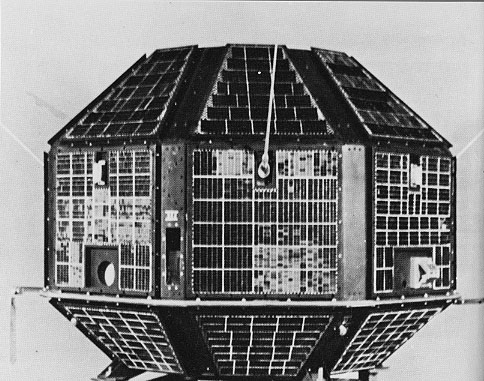
  62. Aryabhata, India's first satellite, a many-sided metal drum covered in solar cells

    Story 59 of 182 · Shuttles and stations

    Rockets and launches

    India's first satellite

    Aryabhata, India's first satellite, was built by ISRO and put into orbit on 19 April 1975 by a Soviet Kosmos-3M rocket from Kapustin Yar. It flew under Interkosmos, a Soviet scheme that offered friendly countries a ride to space.

    Next story1975 · Apollo–Soyuz
  63. An artist's picture of the Apollo and Soyuz craft docked together

    Story 60 of 182 · Shuttles and stations

    Space stations

    Apollo–Soyuz

    An American Apollo and a Soviet Soyuz docked in orbit, and the commanders shook hands through the hatch.

    Next story1975 · Venera 9 photographs the surface of Venus
  64. An artist's picture of the Venera 9 lander on the surface of Venus

    Story 61 of 182 · Shuttles and stations

    Planets and beyond

    Venera 9 photographs the surface of Venus

    Venera 9's lander touched down on Venus on 22 October 1975 and sent back the first picture from the surface of another planet, showing boulders on a steep slope near Beta Regio. Its orbiter was the first spacecraft to orbit Venus.

    Next story1976 · Viking 1 lands on Mars
  65. The Viking spacecraft: an orbiter with a lander inside its white shell

    Story 62 of 182 · Shuttles and stations

    Planets and beyond

    Viking 1 lands on Mars

    The Viking 1 lander touched down on Mars and worked for more than six years, testing the soil for signs of life.

    Next story1977 · Voyager 1 and 2
  66. Artist's impression of the Voyager space probes (1977—) with the outer worlds they passed

    Story 63 of 182 · Shuttles and stations

    Planets and beyond

    Voyager 1 and 2

    Two probes used a rare line-up of the outer planets to fly past Jupiter, Saturn, Uranus and Neptune. Each carries a golden record of sounds and images from Earth.

    Next story1977 · Salyut 6, the first station with visiting crews
  67. A museum model of the Salyut 6 space station with a Soyuz craft docked

    Story 64 of 182 · Shuttles and stations

    Space stations

    Salyut 6, the first station with visiting crews

    Launched on 29 September 1977, Salyut 6 was the first space station to host a stream of visiting crews and cargo ships, among them cosmonauts from other countries. It was brought down on 29 July 1982, nearly five years after launch.

    Next story1978 · GPS begins with Navstar 1
  68. A drawing of the main parts of a first-generation Block I Navstar GPS satellite

    Story 65 of 182 · Shuttles and stations

    Satellites and telescopes

    GPS begins with Navstar 1

    The first satellite of the Global Positioning System, a prototype, went up in 1978, and a full constellation of 24 was working by 1993. After Korean Air Lines Flight 007 was shot down in 1983, President Reagan opened GPS to civilians.

    Next story1978 · Vladimír Remek flies for Czechoslovakia
  69. The re-entry capsule of Soyuz 28, which carried Vladimír Remek

    Story 66 of 182 · Shuttles and stations

    People in space

    Vladimír Remek flies for Czechoslovakia

    On 2 March 1978 Soyuz 28 carried the Czechoslovak Vladimír Remek to the station Salyut 6, making him the first person launched into space who was not a US or Soviet citizen. The Intercosmos programme went on to fly crews from Eastern Bloc and other friendly countries.

    Next story1979 · Europe's Ariane rocket flies
  70. A model of the Ariane 1 rocket at the air and space museum in Le Bourget, France

    Story 67 of 182 · Shuttles and stations

    Rockets and launches

    Europe's Ariane rocket flies

    Ariane 1, developed by the European Space Agency, which was formed in 1973, first flew on 24 December 1979. It was designed mainly to put commercial satellites into geosynchronous orbit, two at a time on a single launch.

    Next story1980 · India launches a satellite on its own rocket
  71. Story 68 of 182 · Shuttles and stations

    Rockets and launches

    India launches a satellite on its own rocket

    ISRO's four-stage solid-fuel SLV-3 put the 35 kg Rohini RS-1 satellite into orbit from Sriharikota, a year after the rocket's first, only partly successful flight. The rocket was built largely in India, at Thumba.

    Next story1981 · The first Space Shuttle flight
  72. Space Shuttle Columbia lifting off on its first flight, STS-1, in April 1981

    Story 69 of 182 · Shuttles and stations

    People in space

    The first Space Shuttle flight

    John Young and Robert Crippen flew Columbia into orbit and landed it like a glider.

    Next story1983 · IRAS maps the infrared sky
  73. An artist's picture of the Infrared Astronomical Satellite in orbit

    Story 70 of 182 · Shuttles and stations

    Satellites and telescopes

    IRAS maps the infrared sky

    The Infrared Astronomical Satellite, launched on 25 January 1983, made the first survey of the whole night sky in infrared. In ten months it observed over 250,000 infrared sources at four wavelengths.

    Next story1983 · Sally Ride
  74. Sally Ride at work on the flight deck of the Space Shuttle Challenger, 21 June 1983

    Story 71 of 182 · Shuttles and stations

    People in space

    Sally Ride

    Sally Ride, a physicist, flew on Challenger and operated its robotic arm.

    Next story1983 · Guion Bluford flies on STS-8
  75. Guion Bluford in his orange launch suit, holding his helmet

    Story 72 of 182 · Shuttles and stations

    People in space

    Guion Bluford flies on STS-8

    Guion Bluford became the first African American in space on STS-8, launched on 30 August 1983. It was the Shuttle programme's first night launch and night landing, and it achieved all its research goals.

    Next story1983 · Spacelab, Europe's laboratory in the Shuttle bay
  76. The Spacelab module in the open payload bay of the Space Shuttle Columbia

    Story 73 of 182 · Shuttles and stations

    Space stations

    Spacelab, Europe's laboratory in the Shuttle bay

    STS-9, launched on 28 November 1983, carried the first Spacelab, a pressurised laboratory module built in Europe, into orbit in the Shuttle's payload bay. The ten-day mission carried the first non-American on a Shuttle, Ulf Merbold of West Germany.

    Next story1984 · Rakesh Sharma is the first Indian in space
  77. Rakesh Sharma in his Indian Air Force uniform

    Story 74 of 182 · Shuttles and stations

    People in space

    Rakesh Sharma is the first Indian in space

    Rakesh Sharma, an Indian Air Force pilot, flew to the Salyut 7 station on Soyuz T-11 on 3 April 1984, as part of the Soviet Intercosmos programme. Asked by Indira Gandhi how India looked from space, he replied: better than all the world.

    Next story1984 · Svetlana Savitskaya walks in space
  78. A 1985 Soviet stamp showing the Soyuz T-12 crew: Vladimir Dzhanibekov, Svetlana Savitskaya and Igor Volk

    Story 75 of 182 · Shuttles and stations

    People in space

    Svetlana Savitskaya walks in space

    On 25 July 1984, during the Soyuz T-12 visit to Salyut 7, Svetlana Savitskaya became the first woman to perform a spacewalk, nearly twenty years after the first man's. She had already flown in 1982, as the second woman in space.

    Next story1985 · Cosmonauts revive a dead space station
  79. The Soyuz T-13 crew, Vladimir Dzhanibekov and Viktor Savinykh, inside the Salyut 7 station

    Story 76 of 182 · Shuttles and stations

    Space stations

    Cosmonauts revive a dead space station

    Salyut 7 lost power and fell silent in early 1985. On 6 June, Soyuz T-13 reached the dark, frozen station, docked with it and began repairs, the first time a spacecraft had docked with a dead station and returned it to service.

    Next story1986 · The Challenger disaster
  80. The smoke trail left by the Space Shuttle Challenger's explosion, 28 January 1986

    Story 77 of 182 · Shuttles and stations

    People in space

    The Challenger disaster

    Challenger broke apart 73 seconds after launch when a seal failed in the cold, killing all seven crew, including the teacher Christa McAuliffe.

    Next story1986 · Mir
  81. The Mir space station in June 1998, seen from a visiting Space Shuttle

    Story 78 of 182 · Shuttles and stations

    Space stations

    Mir

    The Soviet Union began assembling the modular station Mir. Valeri Polyakov spent 437 days aboard, still the record for a single stay.

    Next story1986 · Giotto meets Halley's Comet
  82. The Giotto spacecraft being prepared for launch, with its dish antenna on top

    Story 79 of 182 · Shuttles and stations

    Planets and beyond

    Giotto meets Halley's Comet

    On the night of 13–14 March 1986 ESA's Giotto flew within 596 km of the nucleus of Halley's Comet, the first spacecraft to observe a comet nucleus close up. Dust impacts damaged it, but it kept working.

    Next story1988 · Buran flies once, with no crew
  83. The Buran shuttle riding on an Antonov An-225 aircraft at Le Bourget in 1989

    Story 80 of 182 · Shuttles and stations

    Rockets and launches

    Buran flies once, with no crew

    The Soviet shuttle Buran made its only flight on 15 November 1988, launched by the Energia rocket. It orbited the Earth twice and landed automatically at Baikonur, without a crew.

    Next story1989 · COBE measures the afterglow of the Big Bang
  84. An artist's picture of the Cosmic Background Explorer in orbit

    Story 81 of 182 · Shuttles and stations

    Satellites and telescopes

    COBE measures the afterglow of the Big Bang

    COBE, launched in 1989, showed that the cosmic microwave background has the spectrum of a near-perfect blackbody and found tiny variations in its temperature across the sky. Both results supported the Big Bang theory.

    Next story1990 · The Pale Blue Dot
  85. Earth as a tiny pale dot in a band of sunlight, photographed by Voyager 1

    Story 82 of 182 · Shuttles and stations

    Planets and beyond

    The Pale Blue Dot

    From six billion kilometres away, Voyager 1 turned back and photographed Earth as a tiny speck in a beam of sunlight.

    Next story1990 · The Hubble Space Telescope
  86. The Hubble Space Telescope in orbit in 2009, photographed from the Space Shuttle

    Story 83 of 182 · Shuttles and stations

    Satellites and telescopes

    The Hubble Space Telescope

    The Space Shuttle Discovery launched Hubble. A flaw in its mirror blurred its vision until astronauts fixed it in 1993.

    Next story1990 · Magellan maps Venus with radar
  87. An artist's picture of the Magellan spacecraft orbiting Venus

    Story 84 of 182 · Shuttles and stations

    Planets and beyond

    Magellan maps Venus with radar

    Magellan, launched from the Space Shuttle in May 1989, reached Venus in August 1990 and used radar to see through its clouds. It mapped nearly the whole surface and tested aerobraking, a new way to shape an orbit.

    Next story1991 · Compton finds gamma-ray bursts everywhere
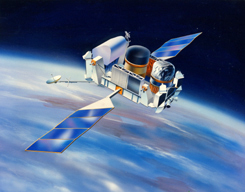
  88. An illustration of the Compton Gamma Ray Observatory

    Story 85 of 182 · Shuttles and stations

    Satellites and telescopes

    Compton finds gamma-ray bursts everywhere

    The Compton Gamma Ray Observatory, released from Space Shuttle Atlantis on 5 April 1991, carried four instruments covering X-rays and gamma rays. It showed that gamma-ray bursts arrive from all directions in the sky, far beyond our galaxy.

    Next story1992 · Mae Jemison flies on Endeavour
  89. The STS-47 crew in launch suits, including Mae Jemison, the first Black woman in space

    Story 86 of 182 · Shuttles and stations

    People in space

    Mae Jemison flies on Endeavour

    Mae Jemison became the first African American woman in space on STS-47, in September 1992, Endeavour's second flight. The Spacelab-J mission with Japan also carried Mamoru Mohri and the only married couple ever to fly together on the Shuttle.

    Next story1994 · Valeri Polyakov spends 437 days on Mir
  90. Valeri Polyakov looking out of a porthole of the Mir space station

    Story 87 of 182 · Shuttles and stations

    People in space

    Valeri Polyakov spends 437 days on Mir

    The physician and cosmonaut Valeri Polyakov lived on Mir from January 1994 to March 1995, for 437 days and 18 hours, still the longest single stay in space. He wanted to show that a human could survive a journey to Mars.

    Next story1995 · Eileen Collins pilots the Shuttle
  91. Eileen Collins at the pilot's seat of Space Shuttle Discovery on 3 February 1995, the first day of STS-63

    Story 88 of 182 · Shuttles and stations

    People in space

    Eileen Collins pilots the Shuttle

    Eileen Collins became the first woman to pilot the Space Shuttle on STS-63, launched on 3 February 1995. The mission made the first rendezvous of a Shuttle with the Russian space station Mir. In 1999 she became the first woman to command a Shuttle mission.

    Next story1995 · The Shuttle docks with Mir
  92. The American and Russian crews of STS-71 posing together at a table

    Story 89 of 182 · Shuttles and stations

    Space stations

    The Shuttle docks with Mir

    Space Shuttle Atlantis launched on 27 June 1995 and became the first Shuttle to dock with the Russian space station Mir. It delivered a relief crew of two cosmonauts and brought home the American astronaut Norman Thagard.

    Next story1995 · SOHO watches the Sun
  93. An illustration of the SOHO solar observatory with its two solar panels

    Story 90 of 182 · Shuttles and stations

    Satellites and telescopes

    SOHO watches the Sun

    SOHO, launched on 2 December 1995, has watched the Sun almost continuously since. It has also discovered more than 5,000 comets, most of them sungrazers that fall into the Sun.

    Next story1995 · Galileo orbits Jupiter
  94. An artist's picture of the Galileo spacecraft flying past Jupiter's moon Io

    Story 91 of 182 · Shuttles and stations

    Planets and beyond

    Galileo orbits Jupiter

    After flybys of Venus and Earth, Galileo arrived at Jupiter on 7 December 1995 and became the first spacecraft to circle an outer planet. A probe it released plunged into Jupiter's atmosphere, and the orbiter surveyed Europa, Ganymede and Io.

    Next story1997 · Sojourner rolls across Mars
  95. The Sojourner rover measuring a rock called Yogi with its X-ray spectrometer

    Story 92 of 182 · Shuttles and stations

    Planets and beyond

    Sojourner rolls across Mars

    Mars Pathfinder landed in Ares Vallis on 4 July 1997, cushioned by airbags. Its 10.6 kg rover, Sojourner, was the first wheeled vehicle to operate outside the Earth–Moon system.

    Next story1998 · John Glenn flies again at 77
  96. The STS-95 crew in orange launch suits, including John Glenn at 77

    Story 93 of 182 · Shuttles and stations

    People in space

    John Glenn flies again at 77

    John Glenn, the first American to orbit the Earth, returned to space aboard Discovery on STS-95, launched on 29 October 1998, at the age of 77. The mission included experiments on ageing.

    Next story1998 · The International Space Station
  97. The International Space Station seen from a departing SpaceX Crew Dragon in 2021

    Story 94 of 182 · Shuttles and stations

    Space stations

    The International Space Station

    The first module, Zarya, was launched. Since November 2000 people have lived aboard without a break.

    Next story1999 · Chandra sees the X-ray universe
  98. An illustration of the Chandra X-ray Observatory

    Story 95 of 182 · Shuttles and stations

    Satellites and telescopes

    Chandra sees the X-ray universe

    Launched aboard Space Shuttle Columbia on 23 July 1999, Chandra can detect X-ray sources 100 times fainter than any earlier X-ray telescope. It studies black holes, exploded stars and clusters of galaxies.

    Next story2000 · The first crew moves into the ISS
  99. Chapter IV

    A crowded sky

    87 stories in this chapter

  100. The Expedition 1 crew: William Shepherd, Yuri Gidzenko and Sergei Krikalev

    Story 96 of 182 · A crowded sky

    People in space

    The first crew moves into the ISS

    Expedition 1, with Bill Shepherd, Yuri Gidzenko and Sergei Krikalev, docked with the International Space Station on 2 November 2000 and stayed for 136 days. People have lived aboard the station without a break ever since.

    Next story2001 · NEAR lands on the asteroid Eros
  101. An artist's picture of the NEAR Shoemaker spacecraft

    Story 97 of 182 · A crowded sky

    Planets and beyond

    NEAR lands on the asteroid Eros

    NEAR Shoemaker orbited the asteroid Eros for a year from February 2000. On 12 February 2001 it touched down on the surface, though it had not been designed to land, and went on sending data.

    Next story2001 · The first space tourist
  102. Dennis Tito, the first paying space tourist

    Story 98 of 182 · A crowded sky

    People in space

    The first space tourist

    The American businessman Dennis Tito paid about $20 million to fly to the International Space Station on a Russian Soyuz.

    Next story2003 · The Columbia disaster
  103. The seven STS-107 astronauts floating together in orbit

    Story 99 of 182 · A crowded sky

    People in space

    The Columbia disaster

    Columbia broke apart re-entering the atmosphere, killing its seven crew. Foam had punched a hole in its wing at launch.

    Next story2003 · Mars Express, Europe's first planetary mission
  104. Artwork of Mars Express above Mars, with its long radar antenna extended

    Story 100 of 182 · A crowded sky

    Planets and beyond Unverified

    Mars Express, Europe's first planetary mission

    ESA's first mission to another planet carried an orbiter and the British lander Beagle 2, which reached the surface but never worked. The orbiter has mapped Mars since early 2004 and found water ice in the south polar cap that year.

    Next story2003 · Spitzer opens the infrared sky
  105. The Spitzer Space Telescope in an illustration

    Story 101 of 182 · A crowded sky

    Satellites and telescopes

    Spitzer opens the infrared sky

    Spitzer, launched in 2003 for a planned 2.5 years, worked until 2020. It was the third infrared space telescope, after IRAS and ISO, and the first in an Earth-trailing orbit, which kept it cold and away from Earth's heat.

    Next story2003 · Yang Liwei
  106. Yang Liwei in space aboard Shenzhou 5, holding the Chinese and UN flags

    Story 102 of 182 · A crowded sky

    People in space

    Yang Liwei

    Yang Liwei orbited the Earth 14 times, making China the third country to launch a person into space on its own.

    Next story2004 · Spirit and Opportunity roll across Mars
  107. An artist's picture of a Mars Exploration Rover on the surface of Mars

    Story 103 of 182 · A crowded sky

    Planets and beyond

    Spirit and Opportunity roll across Mars

    Two rovers, Spirit and Opportunity, landed on opposite sides of Mars in January 2004 for a planned 90-day mission. Spirit worked until March 2010 and Opportunity until June 2018, and both found rocks shaped by water.

    Next story2004 · Gravity Probe B tests Einstein in orbit
  108. An artist's picture of the Gravity Probe B spacecraft in orbit

    Story 104 of 182 · A crowded sky

    Satellites and telescopes

    Gravity Probe B tests Einstein in orbit

    Gravity Probe B, launched on 20 April 2004, carried four near-perfect gyroscopes to test two predictions of general relativity, the geodetic effect and frame-dragging. The final analysis, published in 2011, confirmed both.

    Next story2004 · SpaceShipOne
  109. SpaceShipOne on the runway at Mojave, California, with its twin tails

    Story 105 of 182 · A crowded sky

    Rockets and launches

    SpaceShipOne

    Mike Melvill flew a privately built rocket plane above 100 kilometres. Later flights won the $10 million Ansari X Prize.

    Next story2004 · Cassini arrives at Saturn
  110. An illustration of the Cassini spacecraft

    Story 106 of 182 · A crowded sky

    Planets and beyond

    Cassini arrives at Saturn

    Cassini entered orbit around Saturn on 1 July 2004, the first spacecraft to do so, and studied the planet, its rings and moons for 13 years. It carried ESA's Huygens probe to Titan, and ended its mission by diving into Saturn on 15 September 2017.

    Next story2005 · Huygens lands on Titan
  111. A full-size model of the Huygens probe

    Story 107 of 182 · A crowded sky

    Planets and beyond

    Huygens lands on Titan

    Carried by Cassini, the European Huygens probe parachuted through Titan's haze and landed on a plain of ice pebbles.

    Next story2006 · Stardust brings home comet dust
  112. The Stardust spacecraft before launch

    Story 108 of 182 · A crowded sky

    Planets and beyond

    Stardust brings home comet dust

    Stardust flew through the cloud around comet Wild 2 in 2004 and collected dust particles on a gel-like material. Its capsule returned them to Earth on 15 January 2006.

    Next story2007 · China's first lunar probe
  113. A mock-up of the Chang'e-1 lunar orbiter at a Beijing museum

    Story 109 of 182 · A crowded sky

    The Moon

    China's first lunar probe

    China's Chang'e 1, launched on 24 October 2007, entered lunar orbit on 5 November and sent its first picture of the Moon on 26 November. It was the first stage of the Chinese Lunar Exploration Program.

    Next story2008 · Phoenix touches water ice on Mars
  114. An illustration of the Phoenix Mars lander

    Story 110 of 182 · A crowded sky

    Planets and beyond

    Phoenix touches water ice on Mars

    Phoenix landed in the far north of Mars on 25 May 2008 and worked for 157 sols, or Martian days, until November. Its robotic arm dug into the soil and uncovered water ice just beneath the surface.

    Next story2008 · Japan's Kibō laboratory joins the ISS
  115. The Kibō module and its exposed experiment platform on the ISS, seen from a Shuttle

    Story 111 of 182 · A crowded sky

    Space stations Unverified

    Japan's Kibō laboratory joins the ISS

    Japan's Experiment Module, Kibō, or Hope, was carried up in pieces on three Shuttle flights. Its main laboratory was attached to the station on 3 June 2008, and an outside platform for experiments in open space followed in 2009.

    Next story2008 · Fermi surveys the gamma-ray sky
  116. An illustration of the Fermi Gamma-ray Space Telescope

    Story 112 of 182 · A crowded sky

    Satellites and telescopes

    Fermi surveys the gamma-ray sky

    The Fermi telescope, launched on 11 June 2008, surveys the whole sky for gamma rays from active galaxies, pulsars and other violent sources. It also studies gamma-ray bursts and looks for signs of dark matter.

    Next story2008 · China's first spacewalk
  117. A drawing of a Shenzhou spacecraft with its solar panels

    Story 113 of 182 · A crowded sky

    People in space

    China's first spacewalk

    On 25 September 2008 Shenzhou 7 carried Zhai Zhigang, Liu Boming and Jing Haipeng to orbit. Zhai made China's first spacewalk, with Liu helping from the hatch, making China the third country to walk in space.

    Next story2008 · A private rocket reaches orbit
  118. A Falcon 1 rocket lifting off on its fourth flight, the first to reach orbit

    Story 114 of 182 · A crowded sky

    Rockets and launches

    A private rocket reaches orbit

    After three failed launches, SpaceX's small Falcon 1 reached orbit on 28 September 2008, the first privately developed fully liquid-fuelled rocket to do so. It flew only five times.

    Next story2008 · India's first Moon probe finds water
  119. A map from NASA's Moon Mineralogy Mapper on Chandrayaan-1 showing water at the Moon's high latitudes

    Story 115 of 182 · A crowded sky

    The Moon

    India's first Moon probe finds water

    India launched Chandrayaan-1 on 22 October 2008, its first lunar mission, with an orbiter and an impactor. Instruments on board, including NASA's Moon Mineralogy Mapper, found signs of water molecules on the lunar surface.

    Next story2009 · Iran's first satellite
  120. A model of the box-shaped Omid satellite on display

    Story 116 of 182 · A crowded sky

    Rockets and launches

    Iran's first satellite

    Iran's Safir 1 rocket put Omid, a small research and telecommunications satellite built in Iran, into low Earth orbit, on the 30th anniversary of the Iranian Revolution. NASA confirmed the launch the next day.

    Next story2009 · Kepler finds a galaxy of planets
  121. An illustration of the Kepler Space Telescope

    Story 117 of 182 · A crowded sky

    Satellites and telescopes

    Kepler finds a galaxy of planets

    Kepler, launched on 6 March 2009, stared at one patch of the Milky Way and watched for stars dimming as planets crossed their faces. It worked for nine and a half years, until its fuel ran out, and NASA retired it on 30 October 2018.

    Next story2009 · Planck maps the oldest light
  122. A model of the Planck satellite

    Story 118 of 182 · A crowded sky

    Satellites and telescopes

    Planck maps the oldest light

    Planck, launched in 2009, mapped the cosmic microwave background with more sensitivity and detail than NASA's earlier WMAP. It operated until 2013.

    Next story2009 · LRO maps the Moon
  123. An artist's picture of the Lunar Reconnaissance Orbiter above the Moon

    Story 119 of 182 · A crowded sky

    The Moon

    LRO maps the Moon

    NASA's Lunar Reconnaissance Orbiter, launched on 18 June 2009, has orbited the Moon in a polar mapping orbit ever since. Its detailed maps identify safe landing sites and resources, and it has photographed the Apollo landing sites.

    Next story2010 · Hayabusa brings back asteroid dust
  124. A computer picture of Hayabusa hovering above the asteroid Itokawa

    Story 120 of 182 · A crowded sky

    Planets and beyond

    Hayabusa brings back asteroid dust

    Hayabusa reached the asteroid Itokawa in 2005 and collected tiny grains, despite engine trouble and the loss of a small lander. Its capsule re-entered over Australia on 13 June 2010, with the first samples ever returned from an asteroid.

    Next story2011 · MESSENGER orbits Mercury
  125. An artist's picture of the MESSENGER spacecraft orbiting Mercury

    Story 121 of 182 · A crowded sky

    Planets and beyond

    MESSENGER orbits Mercury

    MESSENGER entered orbit around Mercury on 18 March 2011, the first spacecraft ever to do so, and mapped the whole planet. It ended its mission by crashing into Mercury on 30 April 2015.

    Next story2011 · Dawn orbits two protoplanets
  126. An artist's picture of the Dawn spacecraft near two protoplanets

    Story 122 of 182 · A crowded sky

    Planets and beyond

    Dawn orbits two protoplanets

    Dawn entered orbit around the asteroid Vesta on 16 July 2011 and, after leaving it, around the dwarf planet Ceres on 6 March 2015. It was the first spacecraft to orbit two different bodies beyond Earth, and its mission ended on 1 November 2018 when its fuel ran out.

    Next story2011 · Tiangong-1: China's first space station
  127. A drawing of the Tiangong-1 space laboratory

    Story 123 of 182 · A crowded sky

    Space stations

    Tiangong-1: China's first space station

    Tiangong-1, launched uncrewed on 29 September 2011, was China's first prototype space station and a test bed for rendezvous and docking. It hosted two crews and made an uncontrolled re-entry over the South Pacific on 2 April 2018.

    Next story2012 · Shenzhou 9 and Liu Yang
  128. The three Shenzhou 9 crew members in blue flight suits, Liu Yang among them

    Story 124 of 182 · A crowded sky

    People in space

    Shenzhou 9 and Liu Yang

    Three taikonauts flew Shenzhou 9 to the Tiangong-1 laboratory and docked on 18 June 2012, China's first crewed docking. The crew included Liu Yang, the first Chinese woman in space. They landed in Inner Mongolia on 29 June.

    Next story2012 · Curiosity lands on Mars
  129. A self-portrait of the Curiosity rover on Mars at the John Klein drill site

    Story 125 of 182 · A crowded sky

    Planets and beyond

    Curiosity lands on Mars

    A rocket-powered 'sky crane' lowered the car-sized Curiosity rover into Gale crater on cables.

    Next story2012 · Voyager 1 reaches interstellar space
  130. Artist's concept of Voyager in flight

    Story 126 of 182 · A crowded sky

    Planets and beyond

    Voyager 1 reaches interstellar space

    Thirty-five years after launch, Voyager 1 crossed the heliopause, where the Sun's wind gives way to interstellar space.

    Next story2013 · Chang'e 3 and the Yutu rover
  131. The Yutu rover on the grey lunar surface, seen from the Chang'e 3 lander

    Story 127 of 182 · A crowded sky

    The Moon

    Chang'e 3 and the Yutu rover

    Chang'e 3 landed on the Moon on 14 December 2013 with China's first lunar rover, Yutu, or Jade Rabbit, named after an online poll. It was the first soft landing on the Moon since Luna 24 in 1976.

    Next story2013 · Gaia charts a billion stars
  132. A model of the Gaia space telescope at the Paris Air Show in 2013

    Story 128 of 182 · A crowded sky

    Satellites and telescopes

    Gaia charts a billion stars

    Gaia, launched in 2013 and retired in March 2025, measured the positions, distances and motions of stars with extraordinary precision. Its data are building the largest and most precise three-dimensional catalogue of about a billion objects.

    Next story2014 · Rosetta orbits a comet
  133. An artist's picture of the Rosetta spacecraft

    Story 129 of 182 · A crowded sky

    Planets and beyond

    Rosetta orbits a comet

    ESA's Rosetta, launched in 2004, reached comet 67P/Churyumov–Gerasimenko on 6 August 2014 and studied it from orbit, releasing the lander Philae. It ended its mission on 30 September 2016 by landing on the comet.

    Next story2014 · India reaches Mars on its first try
  134. An artist's picture of India's Mars Orbiter Mission spacecraft

    Story 130 of 182 · A crowded sky

    Planets and beyond

    India reaches Mars on its first try

    India's Mars Orbiter Mission, or Mangalyaan, entered orbit around Mars on 24 September 2014, after its launch in November 2013. It made ISRO the fourth space agency to reach Mars orbit, and India the first Asian nation to do so.

    Next story2014 · Philae lands on a comet
  135. Artist's impression of the Philae lander, on a transparent background

    Story 131 of 182 · A crowded sky

    Planets and beyond

    Philae lands on a comet

    The Philae lander, released by the Rosetta spacecraft, bounced twice before coming to rest on comet 67P/Churyumov–Gerasimenko.

    Next story2015 · New Horizons at Pluto
  136. Artist's concept of the New Horizons spacecraft during its planned encounter with Pluto and its moon, Charon

    Story 132 of 182 · A crowded sky

    Planets and beyond

    New Horizons at Pluto

    After nine years in flight, New Horizons sped past Pluto and found mountains of water ice and a vast heart-shaped plain.

    Next story2015 · A rocket flies to space and lands upright
  137. A New Shepard booster on display at an air show in Oshkosh, Wisconsin, in 2017

    Story 133 of 182 · A crowded sky

    Rockets and launches

    A rocket flies to space and lands upright

    On 23 November 2015 Blue Origin's New Shepard rose past the edge of space and its booster flew back to land upright on the pad. The vehicle is named for Alan Shepard, the first American in space.

    Next story2015 · Akatsuki gets a second chance at Venus
  138. Artwork of the box-shaped Akatsuki spacecraft with its solar panels above Venus

    Story 134 of 182 · A crowded sky

    Planets and beyond Unverified

    Akatsuki gets a second chance at Venus

    Japan's Venus probe failed to enter orbit in 2010 when its main engine broke. After five years circling the Sun, engineers fired its small attitude thrusters for 20 minutes and put it into an orbit around Venus. It studied the planet's clouds until contact was lost in 2024.

    Next story2015 · A rocket lands itself
  139. A Falcon 9 rocket on its launch pad at dusk before the ORBCOMM-2 mission

    Story 135 of 182 · A crowded sky

    Rockets and launches

    A rocket lands itself

    After launching satellites, the first stage of a SpaceX Falcon 9 flew back and landed upright at Cape Canaveral.

    Next story2016 · An inflatable room is added to the ISS
  140. The BEAM expandable module attached to the International Space Station, seen from a Soyuz

    Story 136 of 182 · A crowded sky

    Space stations

    An inflatable room is added to the ISS

    The Bigelow Expandable Activity Module arrived at the ISS on 10 April 2016 and was inflated and pressurised on 28 May. It was meant as a two-year test of a room that launches small and expands in orbit.

    Next story2016 · Juno arrives at Jupiter
  141. An artist's picture of the Juno spacecraft at Jupiter

    Story 137 of 182 · A crowded sky

    Planets and beyond

    Juno arrives at Jupiter

    NASA's Juno entered a polar orbit around Jupiter on 5 July 2016, having launched in 2011. It studies the planet's gravity, magnetic field and deep atmosphere, and its mission has since been extended: it was still in contact with Earth in August 2026.

    Next story2018 · Electron makes small launches routine
  142. A Rocket Lab Electron rocket lifting off from New Zealand's Mahia Peninsula in 2023

    Story 138 of 182 · A crowded sky

    Rockets and launches

    Electron makes small launches routine

    Rocket Lab's Electron, built to launch small satellites, reached orbit on its second flight in January 2018. It is the first orbital rocket with electric-pump-fed engines and became the third most launched small-lift rocket in history.

    Next story2018 · Falcon Heavy flies a car to space
  143. A Falcon Heavy rocket on its launch pad before its first flight

    Story 139 of 182 · A crowded sky

    Rockets and launches

    Falcon Heavy flies a car to space

    SpaceX's Falcon Heavy lifted off on 6 February 2018 with 22 MN of thrust, more than twice the next most powerful rocket then flying. Elon Musk's own Tesla Roadster, with a mannequin at the wheel, rode it into orbit around the Sun.

    Next story2018 · TESS hunts for nearby planets
  144. An illustration of the TESS planet-hunting satellite

    Story 140 of 182 · A crowded sky

    Satellites and telescopes

    TESS hunts for nearby planets

    TESS launched on 18 April 2018 on a Falcon 9 to search for exoplanets by watching stars dim as planets cross them, over an area of sky 400 times larger than Kepler's. Its targets are nearby bright stars, ideal for follow-up study.

    Next story2018 · Parker touches the Sun's atmosphere
  145. An artist's picture of the Parker Solar Probe approaching the Sun

    Story 141 of 182 · A crowded sky

    Planets and beyond

    Parker touches the Sun's atmosphere

    Launched in 2018, Parker Solar Probe uses repeated Venus flybys to dive ever closer to the Sun. In 2021 it first flew through the corona, and in 2024 it came within about 6.9 million km of the Sun at 690,000 km/h.

    Next story2018 · BepiColombo sets off for Mercury
  146. Artwork of the BepiColombo spacecraft stack, with its long solar panels

    Story 142 of 182 · A crowded sky

    Planets and beyond Unverified

    BepiColombo sets off for Mercury

    A joint European and Japanese mission left for Mercury carrying two orbiters stacked with a transfer module that used electric propulsion. After flybys of Earth, Venus and Mercury, the orbiters were due to enter orbit around Mercury on 21 November 2026.

    Next story2019 · Chang'e 4 lands on the far side
  147. The Chang’e-4 lander imaged by the Yutu-2 rover on the lunar far side

    Story 143 of 182 · A crowded sky

    The Moon

    Chang'e 4 lands on the far side

    China landed a craft and the Yutu-2 rover in a crater on the far side of the Moon, talking to Earth through a relay satellite.

    Next story2019 · Israel's Beresheet crashes on the Moon
  148. A full-size model of the Beresheet Moon lander in Tel Aviv

    Story 144 of 182 · A crowded sky

    The Moon

    Israel's Beresheet crashes on the Moon

    Beresheet, a small Israeli lander, was the first privately funded spacecraft to reach lunar orbit. On 11 April 2019 its gyroscopes failed during the descent and the main engine shut off, and it crashed on the surface.

    Next story2019 · Starlink fills the sky
  149. Starlink satellites stacked together after launch, with Earth below

    Story 145 of 182 · A crowded sky

    Rockets and launches

    Starlink fills the sky

    SpaceX began launching Starlink broadband satellites in 2019. By October 2026 about 11,150 of them were in orbit and served customers in around 160 countries and territories.

    Next story2020 · Solar Orbiter looks at the Sun's poles
  150. An artist's picture of Solar Orbiter facing the Sun

    Story 146 of 182 · A crowded sky

    Satellites and telescopes

    Solar Orbiter looks at the Sun's poles

    Launched in February 2020, Solar Orbiter flies close to the Sun to study where the solar wind comes from. Its orbit is tilting out of the plane of the planets, so it can image the Sun's poles, which are hard to see from Earth.

    Next story2020 · Crew Dragon Demo-2
  151. A Falcon 9 lifting off with the Crew Dragon Demo-2 spacecraft, 30 May 2020

    Story 147 of 182 · A crowded sky

    People in space

    Crew Dragon Demo-2

    Bob Behnken and Doug Hurley flew to the International Space Station on a SpaceX capsule, the first crewed launch from the United States since 2011.

    Next story2020 · Chang'e 5 returns Moon rock
  152. A Long March 5 rocket launching Chang'e 5 in November 2020

    Story 148 of 182 · A crowded sky

    The Moon

    Chang'e 5 returns Moon rock

    Chang'e 5 launched on 23 November 2020, landed on 1 December and collected about 1,731 grams of lunar samples, some from a core a metre deep. It returned to Earth on 16 December.

    Next story2020 · Hayabusa2 brings back asteroid samples
  153. An artist's picture of the Hayabusa 2 spacecraft

    Story 149 of 182 · A crowded sky

    Planets and beyond

    Hayabusa2 brings back asteroid samples

    Japan's Hayabusa2 dropped a capsule into the Australian outback holding samples from the asteroid Ryugu, including material dug from below its surface.

    Next story2021 · The UAE's Hope probe reaches Mars
  154. A mock-up of the Emirates Mars Mission probe at a 2021 space congress in Dubai

    Story 150 of 182 · A crowded sky

    Planets and beyond

    The UAE's Hope probe reaches Mars

    The UAE's Hope probe, launched on 20 July 2020, entered orbit around Mars on 9 February 2021. Built with US partners by about 200 Emirati scientists and engineers, it studies the planet's weather and atmosphere.

    Next story2021 · Perseverance explores Jezero crater
  155. A self-portrait of the Perseverance rover against the ancient river delta of Jezero Crater

    Story 151 of 182 · A crowded sky

    Planets and beyond

    Perseverance explores Jezero crater

    Perseverance landed in Jezero Crater on 18 February 2021, a site chosen for its ancient river delta, which may preserve signs of past life. It is collecting rock and soil samples for a future mission to bring them to Earth.

    Next story2021 · Ingenuity flies on Mars
  156. Ingenuity flies on Mars

    Story 152 of 182 · A crowded sky

    Planets and beyond

    Ingenuity flies on Mars

    A small helicopter carried by the Perseverance rover rose three metres into the thin Martian air and hovered for 39 seconds. It flew 72 times.

    Next story2021 · Tiangong
  157. An illustration of the Tiangong space station, with long solar panels above Earth

    Story 153 of 182 · A crowded sky

    Space stations

    Tiangong

    China launched the core module of its own space station, completed in 2022. Its crews rotate every six months.

    Next story2021 · China lands a rover on Mars
  158. Tianwen 1 during a ground test

    Story 154 of 182 · A crowded sky

    Planets and beyond

    China lands a rover on Mars

    China's Tianwen-1 reached Mars orbit in February 2021, and its lander, carrying the Zhurong rover, touched down on 14 May 2021. It made China the second country to operate a rover on Mars.

    Next story2021 · Jeff Bezos flies to the edge of space
  159. A New Shepard crew capsule, with its large windows

    Story 155 of 182 · A crowded sky

    People in space

    Jeff Bezos flies to the edge of space

    On 20 July 2021 New Shepard flew its first passengers: Jeff Bezos, his brother Mark, the aviator Wally Funk and the student Oliver Daemen. At 82, Funk became the oldest person to fly in space.

    Next story2021 · Inspiration4 flies four civilians
  160. The Inspiration4 crew visiting NASA's Johnson Space Center in 2022

    Story 156 of 182 · A crowded sky

    People in space

    Inspiration4 flies four civilians

    Inspiration4 launched on 16 September 2021 aboard Crew Dragon Resilience, with Jared Isaacman, who paid for the flight, and three others. It was the first orbital spaceflight with only private citizens aboard and splashed down after three days.

    Next story2021 · The James Webb Space Telescope
  161. An illustration of the James Webb Space Telescope, with its gold mirror and sunshield

    Story 157 of 182 · A crowded sky

    Satellites and telescopes

    The James Webb Space Telescope

    The largest space telescope ever built was launched on an Ariane 5, then unfolded its gold mirror 1.5 million kilometres from Earth. Its first images were released in July 2022.

    Next story2022 · South Korea's Nuri reaches orbit
  162. Story 158 of 182 · A crowded sky

    Rockets and launches

    South Korea's Nuri reaches orbit

    On its second flight, Nuri, the first orbital rocket designed and built entirely in South Korea, put a test satellite and several small satellites into a 700 km orbit. Its first launch, in 2021, had fallen just short of orbital speed.

    Next story2022 · DART hits an asteroid
  163. An illustration of NASA's DART spacecraft

    Story 159 of 182 · A crowded sky

    Planets and beyond

    DART hits an asteroid

    A spacecraft deliberately crashed into the small asteroid Dimorphos and shortened its orbit around a larger asteroid by 33 minutes.

    Next story2022 · Artemis I
  164. The Artemis I rocket and Orion capsule rolling out to the launch pad in March 2022

    Story 160 of 182 · A crowded sky

    The Moon

    Artemis I

    NASA's new Moon rocket sent an uncrewed Orion capsule around the Moon and back.

    Next story2023 · ESA's Juice heads for Jupiter's moons
  165. An illustration of the Juice spacecraft at Jupiter

    Story 161 of 182 · A crowded sky

    Planets and beyond

    ESA's Juice heads for Jupiter's moons

    ESA's Juice, launched on 14 April 2023, is on its way to Jupiter's icy moons Ganymede, Callisto and Europa, which are thought to hold liquid water below their surfaces. It is due at Jupiter in 2031 and will later orbit Ganymede.

    Next story2023 · Euclid sets out to map the dark universe
  166. An artist's picture of the Euclid space telescope

    Story 162 of 182 · A crowded sky

    Satellites and telescopes

    Euclid sets out to map the dark universe

    Euclid, launched on 1 July 2023, carries a 600-megapixel visible-light camera and a near-infrared spectrometer. It is mapping the shapes and distances of billions of galaxies to study dark matter and dark energy.

    Next story2023 · A methane rocket reaches orbit
  167. An illustration of the Zhuque-2 rocket

    Story 163 of 182 · A crowded sky

    Rockets and launches

    A methane rocket reaches orbit

    On 12 July 2023 LandSpace's Zhuque-2, built by a private Chinese company, became the first rocket burning liquid methane to reach orbit.

    Next story2023 · Luna 25 crashes: Russia's return to the Moon fails
  168. A model of the Luna 25 lander shown at the 2015 Paris Air Show

    Story 164 of 182 · A crowded sky

    The Moon

    Luna 25 crashes: Russia's return to the Moon fails

    Luna 25 was Russia's first lunar mission since the Soviet Luna 24 in 1976 and was meant to be the first spacecraft to land near the Moon's south pole. A thruster burn went wrong during manoeuvres and it crashed on 19 August 2023.

    Next story2023 · Chandrayaan-3 lands near the south pole
  169. The Vikram lander on the Moon, photographed by the Pragyan rover

    Story 165 of 182 · A crowded sky

    The Moon

    Chandrayaan-3 lands near the south pole

    India's Vikram lander touched down near the Moon's south pole, and the Pragyan rover drove across the surface.

    Next story2023 · Aditya-L1 watches the Sun
  170. A model of the Aditya-L1 spacecraft with its solar panels, at a science exhibition in Kolkata

    Story 166 of 182 · A crowded sky

    Satellites and telescopes Unverified

    Aditya-L1 watches the Sun

    India's first solar mission was launched on a PSLV and reached a halo orbit around the Lagrange point L1, about 1.5 million km towards the Sun, on 6 January 2024. It studies the Sun's atmosphere and the storms that reach Earth.

    Next story2023 · OSIRIS-REx delivers pieces of Bennu
  171. An artist's picture of the OSIRIS-REx spacecraft

    Story 167 of 182 · A crowded sky

    Planets and beyond

    OSIRIS-REx delivers pieces of Bennu

    OSIRIS-REx collected samples from the carbon-rich asteroid Bennu in 2020 and sent them to Earth in a capsule in September 2023. The material may reveal how the Solar System formed and where the ingredients of life came from.

    Next story2024 · Japan's SLIM lands within metres of its target
  172. A half-scale model of the SLIM lander in its landing posture

    Story 168 of 182 · A crowded sky

    The Moon

    Japan's SLIM lands within metres of its target

    Japan's SLIM, nicknamed the Moon Sniper, soft-landed on 19 January 2024, making Japan the fifth country to land on the Moon. It aimed to touch down within 100 metres of its target and succeeded, though it came to rest on its nose, with its solar cells pointing the wrong way.

    Next story2024 · Odysseus: the first private Moon landing
  173. The Odysseus lander, built by Intuitive Machines, before launch

    Story 169 of 182 · A crowded sky

    The Moon

    Odysseus: the first private Moon landing

    Intuitive Machines' Odysseus landed near Malapert-A crater, close to the lunar south pole, on 22 February 2024. It was the first soft landing on the Moon by a private company and the first US landing since Apollo 17 in 1972.

    Next story2024 · Starliner's crew test strands two astronauts
  174. Boeing's Starliner docked at the International Space Station in July 2024

    Story 170 of 182 · A crowded sky

    People in space

    Starliner's crew test strands two astronauts

    Boeing's Starliner carried Butch Wilmore and Suni Williams to the ISS on 5 June 2024 for an eight-day test. After thruster failures NASA sent the capsule home empty, and the pair stayed nine months, returning on SpaceX Crew-9 on 18 March 2025.

    Next story2024 · Chang'e 6 brings back far-side rock
  175. A mock-up of the Chang'e 6 spacecraft shown at a 2024 space congress

    Story 171 of 182 · A crowded sky

    The Moon

    Chang'e 6 brings back far-side rock

    China's Chang'e 6 scooped up about two kilograms of rock and soil from the far side and returned them to Earth.

    Next story2024 · Europe's Ariane 6 flies
  176. An Ariane 6 rocket on its launch pad in French Guiana as the mobile gantry is rolled back

    Story 172 of 182 · A crowded sky

    Rockets and launches Unverified

    Europe's Ariane 6 flies

    After four years of delays, Europe's new heavy rocket made its first flight from French Guiana. It reached orbit, but its upper stage failed to make its final burn. The second launch, in March 2025, delivered its first customer payload.

    Next story2024 · Polaris Dawn
  177. Polaris Dawn Crew in 2023

    Story 173 of 182 · A crowded sky

    People in space

    Polaris Dawn

    A privately funded crew flew higher than anyone since Apollo, and the billionaire Jared Isaacman and engineer Sarah Gillis stepped out in new spacesuits.

    Next story2024 · A booster caught in mid-air
  178. The booster returning to the tower during Starship flight test 5

    Story 174 of 182 · A crowded sky

    Rockets and launches

    A booster caught in mid-air

    The giant Super Heavy booster of SpaceX's Starship flew back to its launch tower in Texas, where two mechanical arms caught it.

    Next story2024 · Europa Clipper sets off for Jupiter's ocean moon
  179. An illustration of the Europa Clipper spacecraft

    Story 175 of 182 · A crowded sky

    Planets and beyond

    Europa Clipper sets off for Jupiter's ocean moon

    Launched on a Falcon Heavy on 14 October 2024, Europa Clipper is heading for Jupiter's icy moon Europa, which has an ocean beneath its crust. It is due to reach Jupiter in April 2030 and fly past Europa repeatedly from 2031.

    Next story2025 · Blue Ghost completes a clean landing
  180. An artist's picture of the Blue Ghost lander on the Moon

    Story 176 of 182 · A crowded sky

    The Moon

    Blue Ghost completes a clean landing

    Firefly's Blue Ghost landed on the Moon on 2 March 2025, the first company to complete a fully successful soft landing. It delivered ten experiments for NASA and kept working until the lunar sunset on 16 March.

    Next story2025 · Tianwen-2 reaches a quasi-moon of Earth
  181. An artist's picture of the Tianwen-2 asteroid probe

    Story 177 of 182 · A crowded sky

    Planets and beyond

    Tianwen-2 reaches a quasi-moon of Earth

    Tianwen-2 launched on 28 May 2025 to bring back samples from the near-Earth asteroid Kamoʻoalewa, a quasi-satellite of Earth, and then to visit a main-belt comet. It arrived at the asteroid on 4 July 2026, and plans to return samples in 2027.

    Next story2025 · Ax-4 takes India, Poland and Hungary to the ISS
  182. A SpaceX Dragon spacecraft carrying the Axiom Mission 4 crew approaching the space station

    Story 178 of 182 · A crowded sky

    People in space

    Ax-4 takes India, Poland and Hungary to the ISS

    Axiom Mission 4 carried Peggy Whitson, India's Shubhanshu Shukla, Poland's Sławosz Uznański-Wiśniewski and Hungary's Tibor Kapu to the ISS on Crew Dragon Grace, for an 18-day stay. For all three countries it was the first government-sponsored flight in over 40 years.

    Next story2025 · New Glenn lands its first booster
  183. A New Glenn rocket lifting off with the BlueBird 7 satellite

    Story 179 of 182 · A crowded sky

    Rockets and launches

    New Glenn lands its first booster

    Blue Origin's heavy rocket New Glenn first flew on 16 January 2025. On its second flight, on 13 November 2025, its first stage made a successful landing, putting Blue Origin alongside SpaceX in flying reusable orbital rockets.

    Next story2025 · Space debris damages a Chinese crew ship
  184. The Shenzhou 20 rocket at its launch site in April 2025

    Story 180 of 182 · A crowded sky

    Space stations

    Space debris damages a Chinese crew ship

    Suspected space-debris damage meant the crew of Shenzhou 20 could not safely use their ship. They returned on 14 November 2025 aboard the newly arrived Shenzhou 21, and Shenzhou 22 launched uncrewed on 25 November, six months early, to restore Tiangong's emergency return.

    Next story2026 · Artemis II
  185. The Space Launch System rocket lifting off with the Artemis II crew, 1 April 2026

    Story 181 of 182 · A crowded sky

    The Moon

    Artemis II

    Reid Wiseman, Victor Glover, Christina Koch and the Canadian Jeremy Hansen flew around the Moon and back on the first crewed Orion flight.

    Next story2026 · Starship reaches orbit
  186. A Starship lifting off from Starbase in Texas, during an earlier flight test

    Story 182 of 182 · A crowded sky

    Rockets and launches

    Starship reaches orbit

    Starship's fourteenth flight, on 28 September 2026, was its first operational one. The ship entered a sustained low Earth orbit for the first time and deployed 26 Starlink V3 satellites, in the longest Starship flight so far.

    NextJourney's end

Journey complete

You travelled 124 years

182 stories, 1903 to present. More missions are being researched and added.

Choose another journeyBack to the start