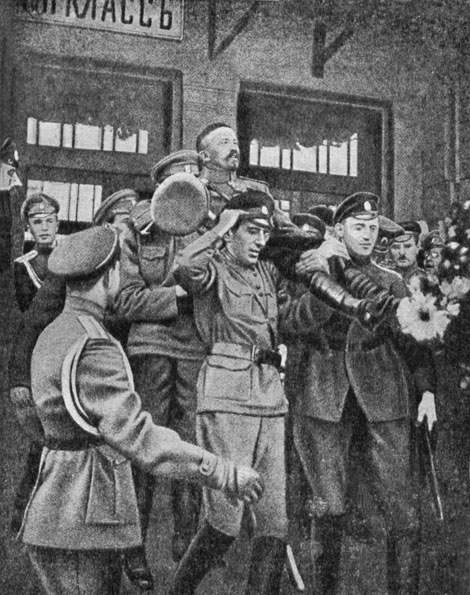
After the capture of the Winter Palace

All major events

The Russian Revolution

In 1917 the Russian Empire, worn down by war and hunger, collapsed. Within months the Bolsheviks under Lenin had seized power, and after a brutal civil war they founded the Soviet Union, a state that shaped the rest of the century.

Ended in 1922 with the founding of the Soviet Union.

Stories
19
Distance
18 years
Route
1905 to 1922
  1. The first revolution4 stories
  2. Two revolutions in 19178 stories
  3. Civil war and the new state7 stories
Begin the journey

The October Revolution, 1917. Image: Pyotr Novitsky · Public domain, via Wikimedia Commons

  1. Chapter I

    The first revolution

    4 stories in this chapter

  2. Drawing of Cossacks charging a crowd of workers in St Petersburg on Bloody Sunday

    Story 1 of 19 · The first revolution

    People and society

    Bloody Sunday

    Thousands of workers led by a priest, Georgy Gapon, marched to the Winter Palace in St Petersburg to petition Tsar Nicholas II for better conditions. Soldiers fired on them, killing at least a hundred.

    Next story1905 · The revolution of 1905
  3. Barricades built by factory workers across Arbat Street, Moscow, December 1905

    Story 2 of 19 · The first revolution

    Revolt and resistance Unverified

    The revolution of 1905

    After Bloody Sunday, strikes, peasant revolts and mutinies, among them the battleship Potemkin's, spread across the empire. A general strike in October forced the tsar to grant a Duma and civil rights, before troops crushed the last risings.

    Next story1905 · The October Manifesto
  4. The October Manifesto issued by Nicholas II of Russia in 1905

    Story 3 of 19 · The first revolution

    Politics and diplomacy

    The October Manifesto

    After a general strike paralysed Russia, Nicholas II promised civil liberties and an elected parliament, the Duma. He later took back much of what he had given.

    Next story1912 · The Lena goldfields massacre
  5. Stone memorial obelisk at the site of the 1912 Lena goldfields shooting

    Story 4 of 19 · The first revolution

    Revolt and resistance Unverified

    The Lena goldfields massacre

    At British-owned gold mines on the Lena river in Siberia, striking workers marched to protest the arrest of their strike committee. Soldiers opened fire, killing and wounding hundreds.

    Next story1917 · The February Revolution
  6. Chapter II

    Two revolutions in 1917

    8 stories in this chapter

  7. Painting of soldiers arresting tsarist generals during the February Revolution

    Story 5 of 19 · Two revolutions in 1917

    Revolt and resistance

    The February Revolution

    Strikes and bread riots in Petrograd, begun by women workers on International Women's Day, grew until soldiers refused to fire on the crowds. Within a week Tsar Nicholas II abdicated, ending 300 years of Romanov rule.

    Next story1917 · Lenin's April Theses
  8. Lenin's April Theses

    Story 6 of 19 · Two revolutions in 1917

    Ideas and culture

    Lenin's April Theses

    Lenin returned from exile in a sealed train across Germany and told the Bolsheviks to give no support to the Provisional Government. He called for peace, land for the peasants, bread for the cities, and all power to the soviets.

    Next story1917 · The July Days
  9. Petrograd (Saint Petersburg), July 4, 1917 2PM

    Story 7 of 19 · Two revolutions in 1917

    Revolt and resistance

    The July Days

    Over five days soldiers and workers in Petrograd, impatient for change, rose in armed protests. The government used loyal troops against them and accused the Bolsheviks of treason. Lenin fled to Finland.

    Next story1917 · The Kornilov affair
  10. Russian general Lavr Kornilov greeted by his officers, 1 July 1917

    Story 8 of 19 · Two revolutions in 1917

    Politics and diplomacy

    The Kornilov affair

    General Kornilov, commander of the army, ordered troops towards Petrograd in what many saw as a coup. The government armed the workers, including the Bolsheviks, and railway workers stopped his trains. The coup collapsed.

    Next story1917 · The October Revolution
  11. After the capture of the Winter Palace

    Story 9 of 19 · Two revolutions in 1917

    Revolt and resistance

    The October Revolution

    Bolshevik Red Guards and soldiers took over the key points of Petrograd and arrested the ministers of the Provisional Government in the Winter Palace. Lenin announced a government of soviets, and a decree promising peace and land.

    Next story1918 · The Russian Civil War
  12. The Russian Civil War

    Story 10 of 19 · Two revolutions in 1917

    Battles and campaigns

    The Russian Civil War

    The Red Army of the Bolsheviks fought the anti-Communist Whites, nationalists, peasant armies and foreign intervention from Britain, France, Japan and others. Battle, famine and disease killed millions. The Reds won.

    Next story1918 · The Constituent Assembly is dissolved
  13. Soldiers guarding the Tauride Palace in Petrograd in 1917, where the Constituent Assembly later met

    Story 11 of 19 · Two revolutions in 1917

    Politics and diplomacy

    The Constituent Assembly is dissolved

    Elected in free elections, the Assembly, in which the Bolsheviks had a minority, met for a single day. The Bolsheviks dissolved it by force the next morning.

    Next story1918 · The Treaty of Brest-Litovsk
  14. Photocopy of the first page of Brest-Litovsk Peace Treaty between Soviet Russia and Germany, Austria-Hungary, Bulgaria and Turkey, March 1918

    Story 12 of 19 · Two revolutions in 1917

    Politics and diplomacy

    The Treaty of Brest-Litovsk

    To end the war with Germany, the Bolsheviks signed away Poland, the Baltic lands, Ukraine and Finland, about a third of Russia's population. The treaty was cancelled after Germany's defeat that autumn.

    Next story1918 · The Romanovs are executed
  15. Chapter III

    Civil war and the new state

    7 stories in this chapter

  16. The basement of the Ipatiev house where the Romanov family was killed

    Story 13 of 19 · Civil war and the new state

    Politics and diplomacy

    The Romanovs are executed

    As anti-Bolshevik forces approached Yekaterinburg, local Bolsheviks shot the former tsar, his wife, their five children and several servants in a cellar. The bodies were hidden; most were found in 1979 and the last two in 2007.

    Next story1918 · The Red Terror
  17. Mourners at the funeral of the Bolshevik official Moisei Uritsky in 1918, under a banner calling for Red Terror

    Story 14 of 19 · Civil war and the new state

    People and society

    The Red Terror

    After an attempt on Lenin's life, the Bolsheviks formally began a campaign of terror, using the Cheka secret police to arrest and execute suspected opponents without trial. Estimates of the dead run from tens of thousands to about 140,000.

    Next story1920 · The Battle of Warsaw
  18. Polish soldiers holding up captured Soviet banners after the battle of Warsaw, 1920

    Story 15 of 19 · Civil war and the new state

    Battles and campaigns

    The Battle of Warsaw

    With the Red Army at the gates of Warsaw, Józef Piłsudski counter-attacked from the south on 16 August and broke it. The Soviets lost about 66,000 men as prisoners alone, and fell back to the Neman.

    Next story1921 · The famine of 1921
  19. Children being washed at a relief station during the Nansen aid effort in the Russian famine of 1921

    Story 16 of 19 · Civil war and the new state

    People and society

    The famine of 1921

    A drought, on top of years of war and grain requisitions, caused a famine in the Volga region and Ukraine. About five million people died, despite a large international relief effort.

    Next story1921 · The Kronstadt rebellion
  20. Suppression of the Kronstadt mutiny

    Story 17 of 19 · Civil war and the new state

    Revolt and resistance

    The Kronstadt rebellion

    The sailors of the Kronstadt naval base, once heroes of the Revolution, rose against Bolshevik rule, demanding free soviets and an end to grain seizures. The Red Army crushed them.

    Next story1921 · The New Economic Policy
  21. Chervonetz - early soviet money bill, 1922

    Story 18 of 19 · Civil war and the new state

    Trade, technology and economy

    The New Economic Policy

    Lenin replaced the forced seizure of grain with a tax on peasants and allowed small private trade and business to return. The economy recovered, while the state kept the 'commanding heights' of heavy industry.

    Next story1922 · The Soviet Union is founded
  22. The Soviet Union is founded

    Story 19 of 19 · Civil war and the new state

    Politics and diplomacy

    The Soviet Union is founded

    Russia, Ukraine, Belarus and the Transcaucasian republic signed a treaty creating the Union of Soviet Socialist Republics. In practice, power lay with the Communist Party in Moscow.

    NextJourney's end

Journey complete

You travelled 18 years

19 stories, 1905 to 1922. More turning points are being researched and added.

Choose another eventBack to the start