An early model British Mark I "male" tank, named C-15, near Thiepval, 25 September 1916

All major events

World War I

A shooting in Sarajevo set off a chain of alliances that pulled Europe, then much of the world, into four years of industrial war. It ended four empires and killed millions of soldiers and civilians.

Ended with the armistice of 11 November 1918 and the Treaty of Versailles in 1919.

Stories
34
Distance
5 years
Route
1914 to 1919
  1. From Sarajevo to the trenches7 stories
  2. Stalemate and attrition10 stories
  3. Revolution and America9 stories
  4. The last year and the peace8 stories
Begin the journey

Battle of the Somme, 1916. Image: Ernest Brooks · Public domain, via Wikimedia Commons

  1. Chapter I

    From Sarajevo to the trenches

    7 stories in this chapter

  2. The assassination in Sarajevo

    Story 1 of 34 · From Sarajevo to the trenches

    Politics and diplomacy

    The assassination in Sarajevo

    A 19-year-old Bosnian Serb, Gavrilo Princip, shot Archduke Franz Ferdinand, heir to the Austro-Hungarian throne, and his wife Sophie in Sarajevo. Austria blamed Serbia.

    Next story1914 · The July Crisis
  3. Mapa de les aliances militars a Europa el 1914

    Story 2 of 34 · From Sarajevo to the trenches

    Politics and diplomacy

    The July Crisis

    Austria-Hungary sent Serbia an ultimatum, then declared war on it. Within days Russia, Germany, France and Britain had mobilised or declared war, pulled in by alliances, war plans and, for Britain, the invasion of Belgium.

    Next story1914 · Germany invades Belgium
  4. German advance through Belgium, August 1914

    Story 3 of 34 · From Sarajevo to the trenches

    Battles and campaigns

    Germany invades Belgium

    Germany's plan to knock out France quickly sent its armies through neutral Belgium. Britain, which had guaranteed Belgian neutrality, declared war the same day. German troops killed thousands of civilians and burned the university library at Leuven.

    Next story1914 · Battle of Tannenberg
  5. Map of the fighting in East Prussia, 17 to 23 August 1914

    Story 4 of 34 · From Sarajevo to the trenches

    Battles and campaigns

    Battle of Tannenberg

    A German army under Hindenburg and Ludendorff surrounded and destroyed a Russian army in East Prussia, taking about 90,000 prisoners. It made the two generals national heroes.

    Next story1914 · Japan takes Tsingtao
  6. Japanese gunners beside a heavy siege gun in the batteries before Tsingtao, 1914

    Story 5 of 34 · From Sarajevo to the trenches

    Battles and campaigns

    Japan takes Tsingtao

    Japan, allied to Britain, joined the war and besieged Germany's leased naval base at Qingdao on the Chinese coast, with a small British force beside it. The garrison surrendered after ten weeks.

    Next story1914 · First Battle of the Marne
  7. Paris taxis that carried French reinforcements to the front in September 1914

    Story 6 of 34 · From Sarajevo to the trenches

    Battles and campaigns

    First Battle of the Marne

    French and British armies counter-attacked a German advance on Paris and forced it back to the river Aisne. Reinforcements were rushed to the front in Paris taxis. Both sides then dug in.

    Next story1914 · The Christmas Truce
  8. 1914-es karácsonyi fegyverszünet illusztráció

    Story 7 of 34 · From Sarajevo to the trenches

    People and society

    The Christmas Truce

    On parts of the Western Front, British and German soldiers stopped fighting on Christmas Eve and Christmas Day, sang carols, swapped small gifts and buried their dead in no man's land. Some played football. It did not happen everywhere.

    Next story1915 · Chlorine gas at Ypres
  9. Chapter II

    Stalemate and attrition

    10 stories in this chapter

  10. Chlorine gas at Ypres

    Story 8 of 34 · Stalemate and attrition

    Battles and campaigns

    Chlorine gas at Ypres

    German forces released chlorine gas from cylinders against French colonial troops at Ypres, in the first large-scale gas attack on the Western Front. A gap opened in the line, but the Germans failed to exploit it.

    Next story1915 · The Armenian genocide
  11. The Armenian Genocide Memorial at Tsitsernakaberd in Yerevan

    Story 9 of 34 · Stalemate and attrition

    People and society

    The Armenian genocide

    Beginning with the arrest of Armenian leaders in Constantinople, the Ottoman government deported and killed Armenians across Anatolia. Estimates of the dead run from about 600,000 to over a million. Turkey still rejects the word genocide, which most historians use.

    Next story1915 · The Gallipoli campaign
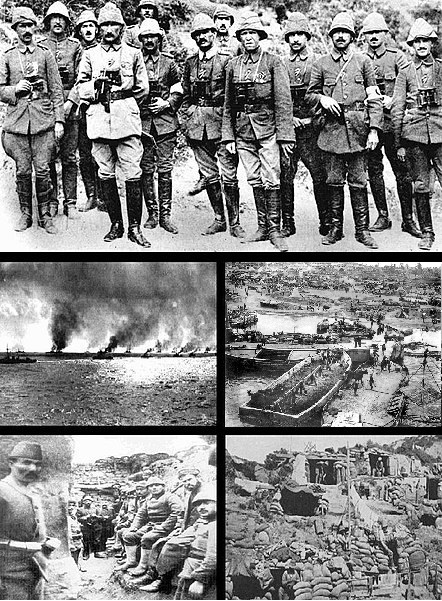
  12. The Gallipoli campaign

    Story 10 of 34 · Stalemate and attrition

    Battles and campaigns

    The Gallipoli campaign

    British, French, Australian and New Zealand troops landed on the Gallipoli peninsula to open the Dardanelles and knock the Ottoman Empire out of the war. Ottoman defenders under Mustafa Kemal held the ridges. The Allies withdrew after eight months.

    Next story1915 · The Lusitania is sunk
  13. RMS Lusitania coming into port, possibly in New York, 1907-13

    Story 11 of 34 · Stalemate and attrition

    Battles and campaigns

    The Lusitania is sunk

    A German U-boat torpedoed the British liner off the coast of Ireland. About 1,200 people died, including 128 Americans. Germany said she carried munitions, which was partly true.

    Next story1915 · The siege of Kut
  14. General Townshend seated with Khalil Pasha and Ottoman and British officers after the surrender of Kut

    Story 12 of 34 · Stalemate and attrition

    Battles and campaigns

    The siege of Kut

    A British Indian force advancing on Baghdad fell back to the river town of Kut, where the Ottoman army surrounded it for nearly five months. Relief attempts failed, and about 13,000 soldiers and followers surrendered; about a third died in captivity.

    Next story1916 · Battle of Verdun
  15. Battle of Verdun

    Story 13 of 34 · Stalemate and attrition

    Battles and campaigns

    Battle of Verdun

    Germany attacked the fortress-ring around Verdun hoping to bleed France white. France held for ten months, fed by a road nicknamed the Sacred Way. About 300,000 men were killed, and total casualties are often put at around 700,000.

    Next story1916 · Battle of Jutland
  16. Map of the Battle of Jutland

    Story 14 of 34 · Stalemate and attrition

    Battles and campaigns

    Battle of Jutland

    The British Grand Fleet and Germany's High Seas Fleet fought the war's only great fleet action, in the North Sea. Britain lost more ships and men, but the German fleet went back to port and rarely came out again.

    Next story1916 · The Brusilov Offensive
  17. Eastern Front prior to the Brusilov Offensive

    Story 15 of 34 · Stalemate and attrition

    Battles and campaigns

    The Brusilov Offensive

    Russian forces under General Alexei Brusilov broke through the Austro-Hungarian lines on a wide front. It is often called the most successful Allied attack of the war, though Russia lost hundreds of thousands of men.

    Next story1916 · The Arab Revolt
  18. Soldiers in the Arab Army during the Arab Revolt of 1916-1918, carrying the Arab Flag of the Arab Revolt and pictured in the Hejaz

    Story 16 of 34 · Stalemate and attrition

    Revolt and resistance

    The Arab Revolt

    Sharif Hussein of Mecca led an Arab uprising against Ottoman rule, with British money and arms. His son Faisal's forces, with T. E. Lawrence as liaison, took Aqaba in 1917 and entered Damascus in 1918.

    Next story1916 · Battle of the Somme
  19. An early model British Mark I "male" tank, named C-15, near Thiepval, 25 September 1916

    Story 17 of 34 · Stalemate and attrition

    Battles and campaigns

    Battle of the Somme

    A British and French offensive meant to break the German line began with the bloodiest day in British Army history: nearly 20,000 killed on the first day. Tanks appeared in September. Over about 140 days, more than a million men were killed or wounded.

    Next story1917 · The Zimmermann Telegram
  20. Chapter III

    Revolution and America

    9 stories in this chapter

  21. The Zimmermann Telegram as decoded by British intelligence

    Story 18 of 34 · Revolution and America

    Politics and diplomacy

    The Zimmermann Telegram

    Germany's foreign minister secretly proposed an alliance to Mexico, promising it lost territory in the American Southwest if the United States entered the war. British codebreakers intercepted the message and showed it to Washington.

    Next story1917 · The February Revolution
  22. Painting of soldiers arresting tsarist generals during the February Revolution

    Story 19 of 34 · Revolution and America

    Revolt and resistance

    The February Revolution

    Strikes and bread riots in Petrograd, begun by women workers on International Women's Day, grew until soldiers refused to fire on the crowds. Within a week Tsar Nicholas II abdicated, ending 300 years of Romanov rule.

    Next story1917 · The United States enters the war
  23. Part of front page of The New York Times with article "Lusitania Sunk By a Submarine ..."

    Story 20 of 34 · Revolution and America

    Politics and diplomacy

    The United States enters the war

    After Germany resumed unrestricted submarine warfare and sank American ships, President Wilson asked Congress to make the world safe for democracy. Congress declared war on Germany.

    Next story1917 · Battle of Passchendaele
  24. Battle of Passchendaele

    Story 21 of 34 · Revolution and America

    Battles and campaigns

    Battle of Passchendaele

    A British offensive in Flanders was bogged down by rain and mud and the wrecked drainage of the battlefield. After three and a half months, the ridge at Passchendaele was taken at a cost of hundreds of thousands of casualties.

    Next story1917 · Battle of Caporetto
  25. Map of the Italian Front , en:Battle of Caporetto

    Story 22 of 34 · Revolution and America

    Battles and campaigns

    Battle of Caporetto

    Austro-Hungarian and German troops, using gas and fast infiltration tactics, broke through the Italian front. Hundreds of thousands of Italian soldiers were captured or deserted, and the army retreated more than 100 kilometres.

    Next story1917 · The Balfour Declaration
  26. The text of the Balfour Declaration

    Story 23 of 34 · Revolution and America

    Politics and diplomacy

    The Balfour Declaration

    Britain's foreign secretary wrote that his government favoured a national home for the Jewish people in Palestine, without harming the rights of its existing non-Jewish communities, who were then the great majority.

    Next story1917 · The October Revolution
  27. After the capture of the Winter Palace

    Story 24 of 34 · Revolution and America

    Revolt and resistance

    The October Revolution

    Bolshevik Red Guards and soldiers took over the key points of Petrograd and arrested the ministers of the Provisional Government in the Winter Palace. Lenin announced a government of soviets, and a decree promising peace and land.

    Next story1917 · Tanks at Cambrai
  28. For documentary purposes the German Federal Archive often retained the original image captions , which may be erroneous, biased, obsolete or politically extreme

    Story 25 of 34 · Revolution and America

    Battles and campaigns

    Tanks at Cambrai

    Nearly 500 British tanks attacked at dawn without an artillery barrage and tore through the German lines. The gains were largely lost in a German counter-attack ten days later.

    Next story1917 · Allenby takes Jerusalem
  29. Map of the Palestine campaign of the First World War

    Story 26 of 34 · Revolution and America

    Battles and campaigns

    Allenby takes Jerusalem

    After taking Beersheba and Gaza, General Allenby's British forces captured Jerusalem from the Ottomans. He entered the Old City on foot two days later, a gesture of respect.

    Next story1918 · The Treaty of Brest-Litovsk
  30. Chapter IV

    The last year and the peace

    8 stories in this chapter

  31. Photocopy of the first page of Brest-Litovsk Peace Treaty between Soviet Russia and Germany, Austria-Hungary, Bulgaria and Turkey, March 1918

    Story 27 of 34 · The last year and the peace

    Politics and diplomacy

    The Treaty of Brest-Litovsk

    To end the war with Germany, the Bolsheviks signed away Poland, the Baltic lands, Ukraine and Finland, about a third of Russia's population. The treaty was cancelled after Germany's defeat that autumn.

    Next story1918 · The German Spring Offensive
  32. For documentary purposes the German Federal Archive often retained the original image captions , which may be erroneous, biased, obsolete or politically extreme

    Story 28 of 34 · The last year and the peace

    Battles and campaigns

    The German Spring Offensive

    With troops freed up by Russia's exit, Germany launched a great series of attacks on the Western Front, using new infiltration tactics. It advanced farther than anyone since 1914 but could not break the Allies, and lost irreplaceable men.

    Next story1918 · Battle of Amiens
  33. IWM description : " 60 pounder guns in action during the Battle of Amiens in August 1918."

    Story 29 of 34 · The last year and the peace

    Battles and campaigns

    Battle of Amiens

    British, Australian, Canadian and French forces attacked with tanks, aircraft and heavy artillery, and advanced several miles in a day. General Ludendorff called it the black day of the German army.

    Next story1918 · The Meuse–Argonne offensive
  34. American soldiers firing a light gun among shattered trees, France, 1918

    Story 30 of 34 · The last year and the peace

    Battles and campaigns

    The Meuse–Argonne offensive

    In the last weeks of the war more than a million American soldiers, with French troops, attacked through the Argonne forest and along the Meuse. Inexperience and the flu made it costly: over 26,000 Americans were killed in 47 days.

    Next story1918 · The Kaiser abdicates
  35. A vast crowd before the Reichstag as Philipp Scheidemann proclaims the German republic, 9 November 1918

    Story 31 of 34 · The last year and the peace

    Politics and diplomacy Unverified

    The Kaiser abdicates

    With sailors in mutiny and revolution spreading across Germany, Chancellor Max von Baden announced on his own authority that Wilhelm II had given up the throne. A republic was proclaimed the same day, and the Kaiser fled to the Netherlands.

    Next story1918 · The Armistice
  36. The Armistice

    Story 32 of 34 · The last year and the peace

    Politics and diplomacy

    The Armistice

    Germany signed an armistice in a railway carriage in the forest of Compiègne, taking effect at 11 am. After four years and three months, the guns on the Western Front fell silent.

    Next story1919 · The Paris Peace Conference
  37. The Paris Peace Conference

    Story 33 of 34 · The last year and the peace

    Politics and diplomacy

    The Paris Peace Conference

    Leaders of the victorious powers met in Paris to remake the world. Woodrow Wilson proposed a League of Nations, Georges Clemenceau wanted Germany held in check, and new states and borders were drawn from the ruins of four empires.

    Next story1919 · The Treaty of Versailles
  38. The Treaty of Versailles

    Story 34 of 34 · The last year and the peace

    Politics and diplomacy

    The Treaty of Versailles

    Germany was made to accept responsibility for the war, lose territory and colonies, limit its army and pay reparations. Many Germans saw it as a humiliating diktat.

    NextJourney's end

Journey complete

You travelled 5 years

34 stories, 1914 to 1919. More turning points are being researched and added.

Choose another eventBack to the start