A Communist cadre leader addressing survivors

All major events

The Chinese Revolution

In the first half of the twentieth century China went from an imperial dynasty to a republic, through warlord rule, a decade of Nationalist government, invasion by Japan and civil war. It ended with the Communist victory and the People's Republic.

Ended in 1949, with the People's Republic on the mainland and the Nationalist government on Taiwan.

Stories
21
Distance
38 years
Route
1911 to 1949
  1. The end of the empire3 stories
  2. Republic, party and warlords8 stories
  3. War with Japan5 stories
  4. The civil war5 stories
Begin the journey

The Long March, 1934. Image: Unknown author · Public domain, via Wikimedia Commons

  1. Chapter I

    The end of the empire

    3 stories in this chapter

  2. The Wuchang Uprising

    Story 1 of 21 · The end of the empire

    Revolt and resistance

    The Wuchang Uprising

    Soldiers in the city of Wuchang rebelled against the Qing dynasty after an accidental explosion exposed a revolutionary plot. Province after province then declared independence from the Qing.

    Next story1912 · The last emperor abdicates
  3. Nanjing Road during Xinhai Revolution

    Story 2 of 21 · The end of the empire

    Politics and diplomacy

    The last emperor abdicates

    The child emperor Puyi gave up the throne on behalf of the Qing dynasty, after months of revolt and negotiation. Sun Yat-sen had already been inaugurated as provisional president of the new Republic of China. He stepped aside for the general Yuan Shikai.

    Next story1915 · Yuan Shikai makes himself emperor
  4. Map of China showing the provinces that rose against Yuan Shikai, December 1915 to May 1916

    Story 3 of 21 · The end of the empire

    Politics and diplomacy Unverified

    Yuan Shikai makes himself emperor

    President Yuan Shikai had a handpicked assembly vote him emperor and declared a new dynasty. Provinces in the south-west rose against him, his own generals deserted him, and in March 1916 he gave the throne up. He died that June.

    Next story1919 · The May Fourth Movement
  5. Chapter II

    Republic, party and warlords

    8 stories in this chapter

  6. Protestors at the May Fourth Movement , dissatisfied with Article 156 of the Treaty of Versailles for China ( Shandong Problem )

    Story 4 of 21 · Republic, party and warlords

    Ideas and culture

    The May Fourth Movement

    Thousands of students in Beijing protested after the Paris Peace Conference gave Germany's rights in Shandong to Japan, not China. The protests grew into a movement for modern science, democracy and a new literature.

    Next story1921 · The Chinese Communist Party is founded
  7. The Chinese Communist Party is founded

    Story 5 of 21 · Republic, party and warlords

    Politics and diplomacy

    The Chinese Communist Party is founded

    About a dozen delegates, among them the young Mao Zedong, met in secret in Shanghai, and later on a boat, to found the party with Soviet help. It had fewer than sixty members.

    Next story1926 · The Northern Expedition
  8. The route taken by the Northern Expedition during 1926–28

    Story 6 of 21 · Republic, party and warlords

    Battles and campaigns

    The Northern Expedition

    The Nationalist army under Chiang Kai-shek, with Communists at first beside it, marched north from Guangzhou to defeat the warlords who held most of China. By 1928 the Nationalists nominally controlled the whole country.

    Next story1927 · The Shanghai massacre
  9. Communists being rounded up in one of the purges

    Story 7 of 21 · Republic, party and warlords

    People and society

    The Shanghai massacre

    Chiang Kai-shek turned on his Communist partners. Troops and gangsters killed hundreds of Communists and union members in Shanghai, and thousands more elsewhere. The alliance ended.

    Next story1931 · The Mukden incident
  10. Japanese cavalry riding into Mukden in 1931

    Story 8 of 21 · Republic, party and warlords

    Battles and campaigns Unverified

    The Mukden incident

    Japanese officers set off a small charge beside a Japanese-owned railway near Mukden, now Shenyang, so weak that a train passed over it minutes later. The army blamed Chinese saboteurs and occupied all of Manchuria, setting up the puppet state of Manchukuo.

    Next story1934 · The Long March
  11. A Communist cadre leader addressing survivors

    Story 9 of 21 · Republic, party and warlords

    Battles and campaigns

    The Long March

    Pursued by the Nationalist army, the Red Army broke out of its base in Jiangxi and marched about 10,000 kilometres by the usual count (some researchers say nearer 6,000) through mountains and swamps to the north-west. Of around 86,000 who set out, only a small fraction arrived.

    Next story1936 · The Xi'an Incident
  12. Photo of the high-ranking officials in the en:Kuomintang at the time of the en:Xi'an Incident

    Story 10 of 21 · Republic, party and warlords

    Politics and diplomacy

    The Xi'an Incident

    Two of his own generals kidnapped Chiang Kai-shek in Xi'an and refused to release him until he agreed to stop fighting the Communists and join them against Japan. He agreed.

    Next story1937 · The Marco Polo Bridge Incident
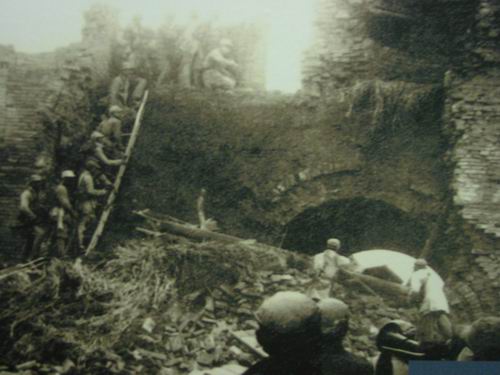
  13. Japanese troops shelling the walled town of Wanping near the Marco Polo Bridge

    Story 11 of 21 · Republic, party and warlords

    Battles and campaigns

    The Marco Polo Bridge Incident

    A skirmish between Japanese and Chinese troops near Beijing escalated within weeks into full-scale war. For many in Asia, the Second World War began here, two years before Poland.

    Next story1937 · The Battle of Shanghai
  14. Chapter III

    War with Japan

    5 stories in this chapter

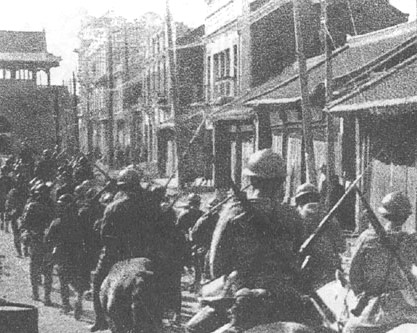
  15. The Imperial Japanese Navy (IJN) Special Naval Landing Forces troops in gas masks prepare for an advance in the rubble of Shanghai, China

    Story 12 of 21 · War with Japan

    Battles and campaigns

    The Battle of Shanghai

    Chinese forces defended China's largest city for three months against Japanese troops, in the biggest battle of the Sino-Japanese War. They lost most of their best units. Japan took the city and marched on Nanjing.

    Next story1937 · The Nanjing Massacre
  16. Memorial to the victims of the Nanjing Massacre, in Nanjing

    Story 13 of 21 · War with Japan

    People and society

    The Nanjing Massacre

    After taking Nanjing, Japanese troops killed large numbers of Chinese civilians and surrendered soldiers and raped many thousands of women over six weeks. Most estimates of the dead run from about 100,000 to more than 300,000; Japanese studies give lower figures.

    Next story1938 · Battle of Taierzhuang
  17. Chinese soldiers fighting among ruined houses in Taierzhuang, 1938

    Story 14 of 21 · War with Japan

    Battles and campaigns

    Battle of Taierzhuang

    In close street fighting in a walled town on the Grand Canal, Chinese troops held the Japanese for two weeks, then nearly encircled them and drove them out with heavy losses.

    Next story1944 · Operation Ichi-Go
  18. Japanese tanks and trucks on a dirt road towards Luoyang, 1944

    Story 15 of 21 · War with Japan

    Battles and campaigns Unverified

    Operation Ichi-Go

    Japan's largest offensive of the war swept through the Chinese provinces of Henan, Hunan and Guangxi, seeking a land route to Indochina and the airfields from which American bombers struck Japan. Nationalist armies collapsed before it.

    Next story1945 · The Soviet Union attacks Japan
  19. Soviet Invasion of Manchuria (1945), based on Glantz's maps in Levenworth Paper No 7 - Feb 1983

    Story 16 of 21 · War with Japan

    Battles and campaigns

    The Soviet Union attacks Japan

    Three months after Germany's surrender, the Soviet Union ended its neutrality pact with Japan and attacked its army in Manchuria with well over a million men. The weakened Japanese forces could offer little resistance.

    Next story1946 · The civil war resumes
  20. Chapter IV

    The civil war

    5 stories in this chapter

  21. Communist troops besieging the city of Changzhi in the Shangdang campaign of 1945

    Story 17 of 21 · The civil war

    Battles and campaigns

    The civil war resumes

    After Japan's surrender, American-brokered talks between the Nationalists and the Communists failed. The Nationalists launched a large offensive. The Communist army, backed by peasants and by Soviet-held Manchuria, turned it back.

    Next story1948 · The Huaihai Campaign
  22. People's Liberation Army tanks and infantry attacking during the Huaihai Campaign

    Story 18 of 21 · The civil war

    Battles and campaigns

    The Huaihai Campaign

    In two months of fighting in eastern China around Xuzhou, with more than half a million troops on each side, the Communists destroyed much of the Nationalists' best forces. The Nationalist cause collapsed soon afterwards.

    Next story1949 · The Communists cross the Yangtze
  23. PLA soldiers on the roof of the Presidential Palace in Nanjing, 1949

    Story 19 of 21 · The civil war

    Battles and campaigns Unverified

    The Communists cross the Yangtze

    On the night of 20 April, the People's Liberation Army crossed the Yangtze on a wide front. Nanjing, the Nationalist capital, fell within days and Shanghai in May.

    Next story1949 · The People's Republic is proclaimed
  24. The Gate of Heavenly Peace in Beijing, from which Mao Zedong proclaimed the People's Republic in 1949

    Story 20 of 21 · The civil war

    Politics and diplomacy

    The People's Republic is proclaimed

    From the gate of Tiananmen, Mao Zedong announced the founding of the People's Republic of China. Days earlier he had told a political conference that the Chinese people had stood up.

    Next story1949 · The Nationalists retreat to Taiwan
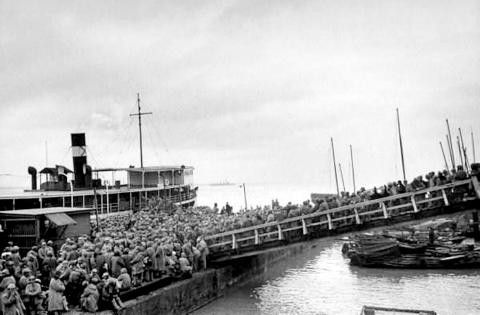
  25. Members of the Republic of China Army board a ship bound for Taiwan in 1949

    Story 21 of 21 · The civil war

    Politics and diplomacy

    The Nationalists retreat to Taiwan

    Chiang Kai-shek moved the Republic of China's government to Taipei, followed by its army and large numbers of civilians. Its status, and the question whether Taiwan is part of China, remains one of the region's central disputes.

    NextJourney's end

Journey complete

You travelled 38 years

21 stories, 1911 to 1949. More turning points are being researched and added.

Choose another eventBack to the start