Berlin Wall at the Potsdamer Platz 1975 looking southeastwards into Stresemannstraße

All major events

The Cold War

For 45 years after World War II the United States and the Soviet Union, with their allies, confronted each other without fighting directly. They built arsenals able to end the world, raced into space, and backed rival sides in wars across the globe.

Ended in 1991 with the dissolution of the Soviet Union.

Stories
57
Distance
47 years
Route
1945 to 1991
  1. Origins6 stories
  2. Containment and the arms race25 stories
  3. Brink and détente13 stories
  4. The last confrontation8 stories
  5. The end5 stories
Begin the journey

The Berlin Wall is built, 1961. Image: Edward Valachovic · CC BY-SA 2.0, via Wikimedia Commons

  1. Chapter I

    Origins

    6 stories in this chapter

  2. Churchill, Roosevelt and Stalin seated together at the Yalta Conference

    Story 1 of 57 · Origins

    Politics and diplomacy

    The Yalta Conference

    Roosevelt, Churchill and Stalin met in Crimea to plan the end of the war and the shape of Europe. They agreed on zones of occupation in Germany, a United Nations, and free elections in Poland, which Stalin did not allow.

    Next story1945 · The Trinity test
  3. PA-98-0520 — Trinity Site explosion , 0.016 second after explosion, July 16, 1945

    Story 2 of 57 · Origins

    Trade, technology and economy

    The Trinity test

    In the New Mexico desert, scientists of the Manhattan Project exploded the first nuclear weapon. J. Robert Oppenheimer later recalled a line from Hindu scripture about becoming death.

    Next story1945 · The Potsdam Conference
  4. The Potsdam Conference

    Story 3 of 57 · Origins

    Politics and diplomacy

    The Potsdam Conference

    Truman, Stalin and Churchill, later replaced by Attlee, met near Berlin to settle postwar Europe. The US, Britain and China called on Japan to surrender or face destruction. The Allies were already disagreeing.

    Next story1945 · Hiroshima and Nagasaki
  5. Hiroshima and Nagasaki

    Story 4 of 57 · Origins

    Battles and campaigns

    Hiroshima and Nagasaki

    American aircraft dropped atomic bombs on Hiroshima and, three days later, Nagasaki. Exact numbers are unknown, but between about 150,000 and 246,000 people are estimated to have died, most of them civilians. They remain the only use of nuclear weapons in war.

    Next story1945 · The United Nations is founded
  6. The United Nations is founded

    Story 5 of 57 · Origins

    Politics and diplomacy

    The United Nations is founded

    Fifty-one countries, mostly Allies, joined the new organisation when its charter came into force. It was set up to keep the peace, with a Security Council on which the great powers had a veto.

    Next story1946 · The Iron Curtain speech
  7. Map of the Iron Curtain in Europe

    Story 6 of 57 · Origins

    Ideas and culture

    The Iron Curtain speech

    In Fulton, Missouri, with President Truman on the platform, Winston Churchill said an iron curtain had descended across Europe from the Baltic to the Adriatic. He urged a close alliance of Britain and the United States. Moscow called it a declaration of war.

    Next story1947 · The Truman Doctrine
  8. Chapter II

    Containment and the arms race

    25 stories in this chapter

  9. President Harry S. Truman speaking at a microphone

    Story 7 of 57 · Containment and the arms race

    Politics and diplomacy

    The Truman Doctrine

    President Truman asked Congress for $400 million to help Greece and Turkey resist Communist pressure, and said the United States must support free peoples resisting outside pressure. It began the policy of containment.

    Next story1948 · The Marshall Plan
  10. A poster promoting the Marshall Plan in Western Europe

    Story 8 of 57 · Containment and the arms race

    Trade, technology and economy

    The Marshall Plan

    The United States gave about $13 billion in grants and loans to rebuild Western Europe, offered to the East too. The Soviet Union refused it and made its allies refuse. Western European economies recovered fast.

    Next story1948 · The Malayan Emergency
  11. An Australian Avro Lincoln bomber flying over the Malayan jungle, 1950

    Story 9 of 57 · Containment and the arms race

    Battles and campaigns Unverified

    The Malayan Emergency

    Communist guerrillas, many of them veterans of the fight against Japan, waged a jungle war against British rule in Malaya. Britain answered with troops, bombing and the forced resettlement of rural Chinese villagers. Malaya became independent in 1957; the emergency ended in 1960.

    Next story1948 · The Berlin Blockade and Airlift
  12. For documentary purposes the German Federal Archive often retained the original image captions , which may be erroneous, biased, obsolete or politically extreme

    Story 10 of 57 · Containment and the arms race

    Politics and diplomacy

    The Berlin Blockade and Airlift

    The Soviet Union cut road and rail links to West Berlin, hoping to force the Western allies out. They flew in food, coal and other supplies, with more than a quarter of a million flights. Stalin lifted the blockade after nearly a year.

    Next story1949 · NATO is founded
  13. NATO is founded

    Story 11 of 57 · Containment and the arms race

    Politics and diplomacy

    NATO is founded

    Twelve countries, including the United States, Canada, Britain and France, signed the North Atlantic Treaty, agreeing that an attack on one would be an attack on all. It was the first peacetime military alliance the United States had joined outside the Americas.

    Next story1949 · The Soviet Union tests an atomic bomb
  14. The Soviet Union tests an atomic bomb

    Story 12 of 57 · Containment and the arms race

    Trade, technology and economy

    The Soviet Union tests an atomic bomb

    The USSR exploded its first nuclear weapon in Kazakhstan, years ahead of Western predictions, helped by espionage and by its own scientists. The American monopoly on atomic weapons had lasted four years.

    Next story1949 · The People's Republic is proclaimed
  15. The Gate of Heavenly Peace in Beijing, from which Mao Zedong proclaimed the People's Republic in 1949

    Story 13 of 57 · Containment and the arms race

    Politics and diplomacy

    The People's Republic is proclaimed

    From the gate of Tiananmen, Mao Zedong announced the founding of the People's Republic of China. Days earlier he had told a political conference that the Chinese people had stood up.

    Next story1950 · McCarthyism
  16. McCarthyism

    Story 14 of 57 · Containment and the arms race

    People and society

    McCarthyism

    Senator Joseph McCarthy claimed in a speech that Communists had infiltrated the US State Department. Fear of Communists in government, entertainment and schools led to hearings, blacklists and ruined careers, often on slender evidence.

    Next story1950 · The Korean War
  17. Montage of images from the Korean War

    Story 15 of 57 · Containment and the arms race

    Battles and campaigns

    The Korean War

    North Korea invaded South Korea. A UN force led by the United States pushed back, until China entered in October 1950 and fighting settled near the original border. An armistice, never a peace treaty, ended it. Millions died, many of them civilians.

    Next story1950 · The Inchon landing
  18. The Inchon landing

    Story 16 of 57 · Containment and the arms race

    Battles and campaigns

    The Inchon landing

    General MacArthur landed UN forces at Incheon, behind the North Korean armies that had nearly overrun the south. Seoul was recaptured within two weeks, and the North Korean army collapsed.

    Next story1953 · Stalin dies
  19. Funeral of Joseph Stalin, caught on camera by US assistant army attaché Major Martin Manhoff from the embassy balcony

    Story 17 of 57 · Containment and the arms race

    Politics and diplomacy

    Stalin dies

    After 29 years in power, Joseph Stalin died. Millions mourned in the Soviet Union, and some were crushed to death in the crowds. His successors began to ease tensions with the West and to relax the terror at home.

    Next story1953 · The coup in Iran
  20. Crowds and military trucks in a Tehran street during the August 1953 coup

    Story 18 of 57 · Containment and the arms race

    Politics and diplomacy

    The coup in Iran

    After Prime Minister Mohammad Mosaddegh nationalised Iran's oil, British and American intelligence organised a coup that removed him and strengthened the rule of the Shah.

    Next story1955 · The Bandung Conference
  21. Delegates at the Asian–African Conference in Bandung, April 1955

    Story 19 of 57 · Containment and the arms race

    Politics and diplomacy

    The Bandung Conference

    Delegates of 29 newly independent or emerging Asian and African states met in Indonesia to oppose colonialism and avoid taking sides in the Cold War. Leaders included Nehru, Zhou Enlai, Nasser and Sukarno.

    Next story1955 · The Warsaw Pact
  22. The Warsaw Pact treaty document of 1955

    Story 20 of 57 · Containment and the arms race

    Politics and diplomacy

    The Warsaw Pact

    The Soviet Union and seven allies in Eastern Europe signed a treaty of friendship and mutual defence, days after West Germany joined NATO. It gave Moscow a legal basis for stationing troops in its satellites.

    Next story1956 · Khrushchev's Secret Speech
  23. "O kulcie jednostki i jego konsekwencjach", Warsaw, March 1956, Polish print of the Secret Speech for the inner use in the PUWP

    Story 21 of 57 · Containment and the arms race

    Ideas and culture

    Khrushchev's Secret Speech

    At a closed session of the Soviet Communist Party congress, Nikita Khrushchev denounced Stalin's terror, show trials and the cult of his personality. The speech leaked to the West and shocked Communists everywhere.

    Next story1956 · The Hungarian Revolution
  24. Montage of the Hungarian Revolution of 1956

    Story 22 of 57 · Containment and the arms race

    Revolt and resistance

    The Hungarian Revolution

    A student demonstration in Budapest grew into a nationwide revolt against Soviet-backed rule. Imre Nagy's government promised to leave the Warsaw Pact. Soviet tanks crushed the revolution within two weeks, and about 200,000 Hungarians fled.

    Next story1956 · The Suez Crisis
  25. Damaged tank M-4 Sherman and vehicles, Sinai War, 1956

    Story 23 of 57 · Containment and the arms race

    Politics and diplomacy

    The Suez Crisis

    After Egypt's Nasser nationalised the Suez Canal, Israel, Britain and France invaded in a secret plan. The United States and the Soviet Union both opposed it, and the three had to withdraw.

    Next story1957 · Sputnik
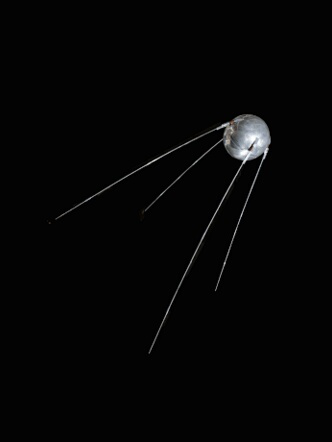
  26. A replica of Sputnik 1, the first artificial satellite in the world to be put into outer space: the replica is stored in the National Air and Space Museum

    Story 24 of 57 · Containment and the arms race

    Trade, technology and economy

    Sputnik

    The Soviet Union launched the first artificial satellite, a beeping metal sphere the size of a beach ball. Americans were shocked that they were behind in technology, and the space race began.

    Next story1959 · The Cuban Revolution
  27. Fidel Castro arrives MATS Terminal, Washington, D.C

    Story 25 of 57 · Containment and the arms race

    Revolt and resistance

    The Cuban Revolution

    Fidel Castro's rebels overthrew the US-backed dictator Fulgencio Batista, who fled on New Year's Day. Castro soon nationalised American property and turned to the Soviet Union for help.

    Next story1960 · The Sino-Soviet split
  28. Mao Zedong standing beside Stalin at Stalin's 70th birthday celebration in Moscow, 1949

    Story 26 of 57 · Containment and the arms race

    Politics and diplomacyUnverified

    The Sino-Soviet split

    Mao rejected Khrushchev's denunciation of Stalin and his peaceful coexistence with the West. In 1960 Moscow withdrew its advisers from China, the two parties traded public insults, and by 1969 their troops were fighting on the border.

    Next story1960 · The U-2 incident
  29. Wreckage of a Lockheed U-2 shot down over the Soviet Union in 1960

    Story 27 of 57 · Containment and the arms race

    Politics and diplomacy

    The U-2 incident

    The Soviet Union shot down an American U-2 spy plane over its territory and captured its pilot, Gary Powers. The US first denied that it was spying. Khrushchev walked out of the summit meeting in Paris.

    Next story1960 · The Congo Crisis
  30. The Congo Crisis

    Story 28 of 57 · Containment and the arms race

    Politics and diplomacy

    The Congo Crisis

    Belgium left the Congo with almost no preparation. Within days the army mutinied, Katanga seceded, and the Cold War powers and the UN were drawn in. Prime Minister Patrice Lumumba was overthrown and killed. Mobutu took power in 1965.

    Next story1961 · The Angolan war of independence
  31. Portuguese soldiers on patrol along a forest track in Angola

    Story 29 of 57 · Containment and the arms race

    Battles and campaigns

    The Angolan war of independence

    Revolts against forced cotton growing began a guerrilla war against Portuguese rule in Angola, fought by three rival movements, the MPLA, FNLA and UNITA. It dragged on until the 1974 coup in Lisbon, after which Portugal agreed to leave.

    Next story1961 · The Bay of Pigs
  32. A Brigade 2506 landing craft in the water off the Bay of Pigs, April 1961

    Story 30 of 57 · Containment and the arms race

    Battles and campaigns

    The Bay of Pigs

    About 1,500 Cuban exiles trained and armed by the CIA landed on Cuba's southern coast to overthrow Castro. Cuban forces beat them in three days, and most were captured.

    Next story1961 · The Berlin Wall is built
  33. Berlin Wall at the Potsdamer Platz 1975 looking southeastwards into Stresemannstraße

    Story 31 of 57 · Containment and the arms race

    Politics and diplomacy

    The Berlin Wall is built

    East Germany, which was losing citizens by the thousand each week to the West, sealed its border in Berlin with barbed wire, then a concrete wall. At least 140 people were killed trying to cross it over the next 28 years.

    Next story1962 · The Cuban Missile Crisis
  34. Chapter III

    Brink and détente

    13 stories in this chapter

  35. CIA reference photograph of Soviet medium-range ballistic missile (SS-4 in U.S

    Story 32 of 57 · Brink and détente

    Politics and diplomacy

    The Cuban Missile Crisis

    American spy planes found Soviet nuclear missiles in Cuba. Kennedy imposed a naval blockade and the world waited for thirteen days. Khrushchev agreed to withdraw the missiles, and the US secretly promised to remove its own from Turkey.

    Next story1963 · The Partial Test Ban Treaty
  36. Soviet stamp of 1963 marking the treaty banning nuclear tests in the atmosphere, in space and under water

    Story 33 of 57 · Brink and détente

    Politics and diplomacy

    The Partial Test Ban Treaty

    The United States, Britain and the Soviet Union agreed to stop testing nuclear weapons in the atmosphere, under water and in space. Underground tests continued.

    Next story1963 · Diệm is overthrown
  37. The former Gia Long Palace in Saigon, now the Ho Chi Minh City Museum

    Story 34 of 57 · Brink and détente

    Politics and diplomacy Unverified

    Diệm is overthrown

    South Vietnamese generals overthrew President Ngô Đình Diệm, with the knowledge of the Kennedy administration, which had let them know it would not stand in the way. Diệm and his brother were captured and killed the next day.

    Next story1964 · The Gulf of Tonkin incident
  38. The US destroyer USS Maddox at sea

    Story 35 of 57 · Brink and détente

    Politics and diplomacy

    The Gulf of Tonkin incident

    American destroyers reported being attacked by North Vietnamese torpedo boats. Congress passed a resolution letting President Johnson use force. It later became clear that the second attack, on 4 August, never happened.

    Next story1968 · The Prague Spring
  39. During the Soviet invasion of Czechoslovakia, Czechoslovaks carry their national flag past a burning tank in Prague

    Story 36 of 57 · Brink and détente

    Revolt and resistance

    The Prague Spring

    Czechoslovakia's new Communist leader, Alexander Dubček, promised socialism with a human face, with free speech and an end to censorship. In August, hundreds of thousands of Warsaw Pact troops invaded and ended the reforms.

    Next story1968 · The Non-Proliferation Treaty
  40. World map of states party to the Non-Proliferation Treaty, nearly all shaded as members

    Story 37 of 57 · Brink and détente

    Politics and diplomacy Unverified

    The Non-Proliferation Treaty

    Opened for signature in 1968, the treaty let the five states that had already tested a bomb keep their weapons, while others promised not to build them in return for help with nuclear power and a pledge of disarmament.

    Next story1969 · Apollo 11 lands on the Moon
  41. The Apollo 11 lunar landing mission crew, pictured from left to right, Neil A

    Story 38 of 57 · Brink and détente

    Trade, technology and economy

    Apollo 11 lands on the Moon

    Neil Armstrong and Buzz Aldrin landed on the Moon while Michael Collins orbited above. Armstrong stepped onto the surface and said the step was a small one for a man and a giant leap for mankind.

    Next story1972 · Nixon goes to China
  42. Nixon goes to China

    Story 39 of 57 · Brink and détente

    Politics and diplomacy

    Nixon goes to China

    President Nixon, a lifelong anti-Communist, visited Beijing and met Mao Zedong. The two countries, at odds since 1949, agreed to open relations. It took advantage of the split between China and the Soviet Union.

    Next story1972 · The first arms limitation treaty
  43. President Jimmy Carter and Soviet General Secretary Leonid Brezhnev sign the Strategic Arms Limitation Talks (SALT II) treaty, June 18, 1979, in Vienna

    Story 40 of 57 · Brink and détente

    Politics and diplomacy

    The first arms limitation treaty

    Nixon and Brezhnev signed treaties capping the number of strategic missiles and nearly banning missile defences. It was the high point of détente, the easing of tension.

    Next story1973 · The coup in Chile
  44. Coup of September 11, 1973

    Story 41 of 57 · Brink and détente

    Politics and diplomacy

    The coup in Chile

    The army overthrew Chile's elected Marxist president, Salvador Allende, who died in the palace as it was bombed. General Augusto Pinochet ruled for 17 years. The US had worked to undermine Allende, though its role in the coup itself is disputed.

    Next story1975 · The fall of Phnom Penh
  45. Map of Phnom Penh divided into the Khmer Rouge occupation zones of April 1975

    Story 42 of 57 · Brink and détente

    Battles and campaigns Unverified

    The fall of Phnom Penh

    Two weeks before Saigon fell, the Khmer Rouge took Cambodia's capital, ending the civil war. They executed captured officers and drove the whole city's people into the countryside.

    Next story1975 · The fall of Saigon
  46. Map showing NVA movements around Saigon before 30 April 1975, the day South Vietnam fell

    Story 43 of 57 · Brink and détente

    Battles and campaigns

    The fall of Saigon

    North Vietnamese tanks crashed through the gates of the presidential palace, and South Vietnam surrendered. Americans and thousands of Vietnamese were evacuated by helicopter from the US embassy's roof. Vietnam was reunified under Communist rule in 1976.

    Next story1975 · The Helsinki Accords
  47. The Helsinki Accords

    Story 44 of 57 · Brink and détente

    Politics and diplomacy

    The Helsinki Accords

    Thirty-five countries, including the US, Canada, the USSR and most of Europe, signed an agreement recognising postwar borders and promising respect for human rights. Dissidents in the East later used the human-rights clauses against their own governments.

    Next story1979 · The Soviet–Afghan War
  48. Chapter IV

    The last confrontation

    8 stories in this chapter

  49. Scenes from the Afghan-Soviet War

    Story 45 of 57 · The last confrontation

    Battles and campaigns

    The Soviet–Afghan War

    The Soviet Union sent troops to prop up a Communist government in Afghanistan. Afghan guerrillas, the mujahideen, backed by the United States, Pakistan and Saudi Arabia, fought on for nine years. Perhaps a million Afghans died and millions fled. The Soviets withdrew in defeat.

    Next story1980 · Solidarity
  50. Widok z góry na Bramę nr 2 Stoczni Gdańskiej im

    Story 46 of 57 · The last confrontation

    Revolt and resistance

    Solidarity

    Shipyard workers in Gdańsk, led by Lech Wałęsa, went on strike and won the right to form an independent trade union, the first in the Soviet bloc. Solidarity grew to ten million members before martial law was imposed in 1981.

    Next story1983 · The Evil Empire speech
  51. The Evil Empire speech

    Story 47 of 57 · The last confrontation

    Ideas and culture

    The Evil Empire speech

    President Reagan called the Soviet Union an evil empire and the focus of evil in the modern world, in a speech to evangelical Christians in Florida. Two weeks later he announced the Strategic Defense Initiative.

    Next story1983 · Able Archer 83
  52. First page of the US Air Force report on the NATO exercise Able Archer 83

    Story 48 of 57 · The last confrontation

    Politics and diplomacy

    Able Archer 83

    A NATO command exercise simulating the move to nuclear war was so realistic that some Soviet leaders feared it was cover for a real attack, and their forces went on alert. Some later called it the most dangerous moment since 1962; historians dispute how close it came.

    Next story1985 · Gorbachev takes power
  53. Mikhail Gorbachev at the Geneva summit in November 1985

    Story 49 of 57 · The last confrontation

    Politics and diplomacy

    Gorbachev takes power

    Mikhail Gorbachev, at 54 the youngest member of the Politburo, became leader of the Soviet Union. He launched perestroika, restructuring, and glasnost, openness, and sought to end the arms race.

    Next story1986 · Chernobyl
  54. Aerial photograph of the wrecked reactor building at Chernobyl in 1986

    Story 50 of 57 · The last confrontation

    Trade, technology and economy Unverified

    Chernobyl

    During a safety test, reactor 4 of the Chernobyl power station in Soviet Ukraine went out of control and exploded, spreading radioactive material across Europe. Moscow was slow to admit it; a zone around the plant was evacuated and remains closed.

    Next story1986 · The Reykjavík Summit
  55. The Reykjavík Summit

    Story 51 of 57 · The last confrontation

    Politics and diplomacy

    The Reykjavík Summit

    Reagan and Gorbachev met in Iceland and came close to agreeing to abolish all nuclear weapons. The talks broke down over Reagan's missile-defence programme, but the two leaders had come to trust one another.

    Next story1987 · The INF Treaty
  56. President Reagan (1911–2004) and General Secretary Gorbachev (1931–2022) signing the INF Treaty in the East Room of the White House on 8 December 1987

    Story 52 of 57 · The last confrontation

    Politics and diplomacy

    The INF Treaty

    Reagan and Gorbachev signed a treaty eliminating an entire class of nuclear missiles, those with ranges of 500 to 5,500 kilometres. More than 2,600 were destroyed under inspection.

    Next story1989 · The revolutions of 1989
  57. Chapter V

    The end

    5 stories in this chapter

  58. The Eastern Bloc - after the annexations and installations

    Story 53 of 57 · The end

    Revolt and resistance

    The revolutions of 1989

    In ten months, Communist governments fell in Poland, Hungary, East Germany, Czechoslovakia, Bulgaria and Romania, mostly peacefully, helped by Gorbachev's refusal to send troops. Romania's dictator was executed on Christmas Day.

    Next story1989 · Tiananmen Square
  59. Tiananmen Square

    Story 54 of 57 · The end

    People and society

    Tiananmen Square

    After weeks of student-led demonstrations for political reform in Beijing, China's government sent troops and tanks into the city. The official death toll was 241, but outside estimates are far higher, from several hundred to several thousand. The topic is censored in China.

    Next story1989 · The Berlin Wall falls
  60. People atop the Berlin Wall near the Brandenburg Gate on 9 November 1989

    Story 55 of 57 · The end

    Politics and diplomacy

    The Berlin Wall falls

    After weeks of protests, an East German official mistakenly announced that citizens could cross the border at once. Crowds poured through checkpoints, and people climbed on and chipped away at the Wall as it fell.

    Next story1990 · German reunification
  61. For documentary purposes the German Federal Archive often retained the original image captions , which may be erroneous, biased, obsolete or politically extreme

    Story 56 of 57 · The end

    Politics and diplomacy

    German reunification

    East Germany joined the Federal Republic, ending the division of Germany after 45 years. Gorbachev accepted that the united Germany would remain in NATO.

    Next story1991 · The Soviet Union ends
  62. “Signing of Protocol on Establishing Commonwealth of Independent States”

    Story 57 of 57 · The end

    Politics and diplomacy

    The Soviet Union ends

    After a failed coup in August, Soviet republics declared independence one after another. Gorbachev resigned as president on Christmas Day, and the USSR officially ceased to exist the next day, leaving fifteen independent countries.

    NextJourney's end

Journey complete

You travelled 47 years

57 stories, 1945 to 1991. More turning points are being researched and added.

Choose another eventBack to the start