Parade in Accra marking the fiftieth anniversary of Ghana's independence

All major events

Decolonization

After 1945 the European empires came apart. In a few decades dozens of colonies in Asia, Africa, the Caribbean and the Pacific became independent, some peacefully and others after long and bloody wars.

Most colonies were independent by the 1970s; the last great handovers were Hong Kong and Macau in 1997 and 1999.

Stories
27
Distance
52 years
Route
1945 to 1997
  1. After the war12 stories
  2. The years of independence10 stories
  3. The last empires5 stories
Begin the journey

Ghana becomes independent, 1957. Image: Niyyie · CC BY 2.0, via Wikimedia Commons

  1. Chapter I

    After the war

    12 stories in this chapter

  2. Indonesia declares independence

    Story 1 of 27 · After the war

    Politics and diplomacy

    Indonesia declares independence

    Two days after Japan's surrender, Sukarno and Mohammad Hatta declared Indonesia independent. The Netherlands fought to keep its colony for four years, until international pressure forced it to recognise independence in 1949.

    Next story1945 · Vietnam declares independence
  3. Vietnam declares independence

    Story 2 of 27 · After the war

    Politics and diplomacy

    Vietnam declares independence

    Ho Chi Minh told a crowd in Hanoi that Vietnam was independent. France sent forces to reclaim its colony, and the First Indochina War began in 1946.

    Next story1945 · The United Nations is founded
  4. The United Nations is founded

    Story 3 of 27 · After the war

    Politics and diplomacy

    The United Nations is founded

    Fifty-one countries, mostly Allies, joined the new organisation when its charter came into force. It was set up to keep the peace, with a Security Council on which the great powers had a veto.

    Next story1946 · The Royal Indian Navy mutiny
  5. Portrait photograph of Balai Chand Dutt, one of the leaders of the 1946 naval mutiny

    Story 4 of 27 · After the war

    Revolt and resistance Unverified

    The Royal Indian Navy mutiny

    Indian sailors in Bombay mutinied against pay, food and racism, and over six days the revolt spread to some 56 ships and shore bases, from Karachi to Calcutta, with strikes in support. Congress and the Muslim League urged them to surrender, and they did.

    Next story1946 · The Philippines becomes independent
  6. Crowds watch the Philippine flag raised as the American flag is lowered, Manila, 4 July 1946

    Story 5 of 27 · After the war

    Politics and diplomacy Unverified

    The Philippines becomes independent

    In Manila, the American high commissioner and President Manuel Roxas signed a treaty by which the United States gave up sovereignty over the Philippines, after almost half a century of American rule. The Stars and Stripes came down and the Philippine flag went up.

    Next story1947 · A tryst with destiny
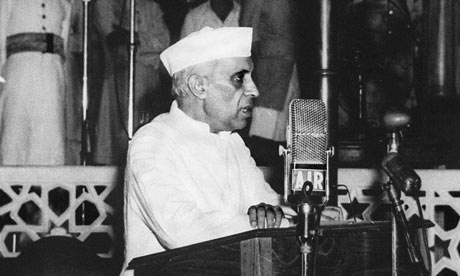
  7. Jawaharlal Nehru gives his "tryst with destiny" speech at Parliament House in New Delhi in 1947

    Story 6 of 27 · After the war

    Ideas and culture

    A tryst with destiny

    At the stroke of midnight, Jawaharlal Nehru told India's Constituent Assembly that the nation was awakening to life and freedom. At midnight India became independent; Pakistan marks its own independence on 14 August.

    Next story1947 · The Partition of India
  8. Map of the partition of India (1947)

    Story 7 of 27 · After the war

    People and society

    The Partition of India

    British India was divided into India and Pakistan along religious lines, with the border drawn in weeks by a commission that few Indians trusted. Perhaps 15 million people were displaced, and hundreds of thousands to two million killed.

    Next story1948 · The British Mandate in Palestine ends
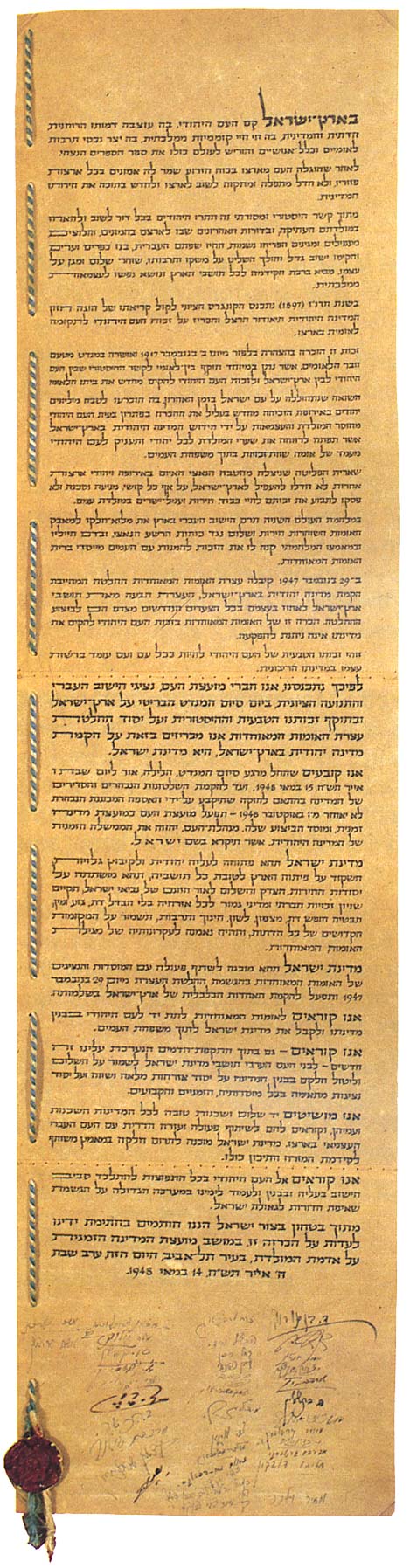
  9. Israeli Declaration of Independence

    Story 8 of 27 · After the war

    Politics and diplomacy

    The British Mandate in Palestine ends

    As Britain's Mandate in Palestine ended, Israel declared independence and the neighbouring Arab states entered the war. More than 600,000 and probably over 700,000 Palestinians fled or were expelled, and no Palestinian state emerged. Its meaning is still disputed.

    Next story1948 · The Malayan Emergency
  10. An Australian Avro Lincoln bomber flying over the Malayan jungle, 1950

    Story 9 of 27 · After the war

    Battles and campaigns Unverified

    The Malayan Emergency

    Communist guerrillas, many of them veterans of the fight against Japan, waged a jungle war against British rule in Malaya. Britain answered with troops, bombing and the forced resettlement of rural Chinese villagers. Malaya became independent in 1957; the emergency ended in 1960.

    Next story1952 · The Mau Mau uprising
  11. Troops of the King's African Rifles carry supplies while on watch for Mau Mau fighters

    Story 10 of 27 · After the war

    Revolt and resistance

    The Mau Mau uprising

    In Kenya, the Mau Mau, mostly Kikuyu people, rose against British rule and settler land seizures. Britain declared an emergency, held tens of thousands in detention camps, and tortured many detainees. In 2013 it paid compensation to survivors.

    Next story1954 · Battle of Dien Bien Phu
  12. An image of Viet Minh troops planting their flag over the captured French headquarters at Dien Bien Phu, 1954

    Story 11 of 27 · After the war

    Battles and campaigns

    Battle of Dien Bien Phu

    The Viet Minh surrounded and overran a French base deep in the hills of north-west Vietnam, hauling artillery by hand to the heights above it. More than 10,000 French soldiers were captured.

    Next story1954 · The Algerian War
  13. Collage made by me using screenshots from two Public Domain videos

    Story 12 of 27 · After the war

    Battles and campaigns

    The Algerian War

    The National Liberation Front launched an uprising against French rule in Algeria, which France treated as part of France. The war was marked by torture, massacres and mass displacement. Hundreds of thousands died. Independence followed in July 1962.

    Next story1955 · The Bandung Conference
  14. Chapter II

    The years of independence

    10 stories in this chapter

  15. Delegates at the Asian–African Conference in Bandung, April 1955

    Story 13 of 27 · The years of independence

    Politics and diplomacy

    The Bandung Conference

    Delegates of 29 newly independent or emerging Asian and African states met in Indonesia to oppose colonialism and avoid taking sides in the Cold War. Leaders included Nehru, Zhou Enlai, Nasser and Sukarno.

    Next story1956 · The Suez Crisis
  16. Damaged tank M-4 Sherman and vehicles, Sinai War, 1956

    Story 14 of 27 · The years of independence

    Politics and diplomacy

    The Suez Crisis

    After Egypt's Nasser nationalised the Suez Canal, Israel, Britain and France invaded in a secret plan. The United States and the Soviet Union both opposed it, and the three had to withdraw.

    Next story1957 · Ghana becomes independent
  17. Parade in Accra marking the fiftieth anniversary of Ghana's independence

    Story 15 of 27 · The years of independence

    Politics and diplomacy

    Ghana becomes independent

    The Gold Coast became Ghana, the first sub-Saharan African colony to win independence from European rule, after a campaign by Kwame Nkrumah. Crowds in Accra celebrated at midnight.

    Next story1958 · The West Indies Federation
  18. Princess Margaret opening the federal parliament of the West Indies before a packed hall in Port of Spain

    Story 16 of 27 · The years of independence

    Politics and diplomacy Unverified

    The West Indies Federation

    Britain joined ten of its Caribbean colonies, from Jamaica to Trinidad, into a federation meant to become independent as one state. Jamaica voted to leave in a 1961 referendum, and the federation was dissolved in 1962.

    Next story1960 · The Year of Africa
  19. Countries of Africa , with date of independence

    Story 17 of 27 · The years of independence

    Politics and diplomacy

    The Year of Africa

    Seventeen African countries became independent in 1960, including Nigeria, Senegal, Mali, Somalia, Madagascar and the Congo. It was the largest number in a single year.

    Next story1960 · The Wind of Change speech
  20. Portrait of Prime Minister Harold Macmillan, 1961

    Story 18 of 27 · The years of independence

    Ideas and culture

    The Wind of Change speech

    Speaking to South Africa's parliament in Cape Town, British Prime Minister Harold Macmillan said a wind of change was blowing through Africa and that the growth of national consciousness was a political fact. He told his white audience to accept it.

    Next story1960 · The Congo Crisis
  21. The Congo Crisis

    Story 19 of 27 · The years of independence

    Politics and diplomacy

    The Congo Crisis

    Belgium left the Congo with almost no preparation. Within days the army mutinied, Katanga seceded, and the Cold War powers and the UN were drawn in. Prime Minister Patrice Lumumba was overthrown and killed. Mobutu took power in 1965.

    Next story1960 · Nigeria becomes independent
  22. Prime Minister Sir Abubakar Tafawa Balewa on Independence Day, 1 October 1960

    Story 20 of 27 · The years of independence

    Politics and diplomacy

    Nigeria becomes independent

    Britain's most populous African colony became independent. A federation of three large regions, it was the most populous country in Africa from the start. A republic followed in 1963.

    Next story1960 · The UN declares colonialism wrong
  23. Delegates in the UN General Assembly during its fifteenth session, 1960

    Story 21 of 27 · The years of independence

    Politics and diplomacy

    The UN declares colonialism wrong

    The UN General Assembly voted, with no country opposed, to say that subjecting peoples to foreign domination was a denial of fundamental human rights. It called for an immediate end to colonialism.

    Next story1961 · The Angolan war of independence
  24. Portuguese soldiers on patrol along a forest track in Angola

    Story 22 of 27 · The years of independence

    Battles and campaigns

    The Angolan war of independence

    Revolts against forced cotton growing began a guerrilla war against Portuguese rule in Angola, fought by three rival movements, the MPLA, FNLA and UNITA. It dragged on until the 1974 coup in Lisbon, after which Portugal agreed to leave.

    Next story1974 · Portugal's Carnation Revolution
  25. Chapter III

    The last empires

    5 stories in this chapter

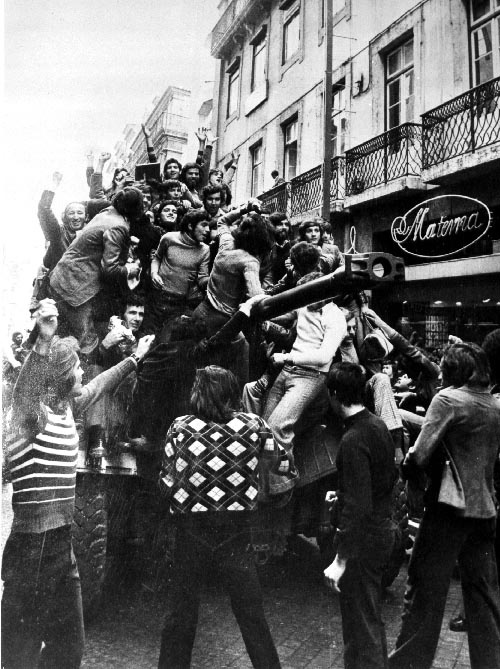
  26. Populares em festa num carro de combate em Lisboa, durante a Revolução dos Cravos

    Story 23 of 27 · The last empires

    Politics and diplomacy

    Portugal's Carnation Revolution

    Portuguese officers, tired of fighting colonial wars in Africa, overthrew the dictatorship in a nearly bloodless coup. Within eighteen months Angola, Mozambique, Guinea-Bissau, Cape Verde and São Tomé were independent.

    Next story1979 · The Lancaster House Agreement
  27. Lancaster House in London, where the talks on Rhodesia were held in 1979

    Story 24 of 27 · The last empires

    Politics and diplomacy

    The Lancaster House Agreement

    After a long guerrilla war, the white-minority government of Rhodesia and the nationalist leaders agreed in London on a constitution and elections. In April 1980 Rhodesia became independent Zimbabwe.

    Next story1990 · Namibia becomes independent
  28. Huge dune in Km 39, Sossusvlei , Namibia

    Story 25 of 27 · The last empires

    Politics and diplomacy

    Namibia becomes independent

    After more than a century of colonial rule, first by Germany and then by South Africa, and a long liberation war, Namibia became independent under SWAPO and its president Sam Nujoma.

    Next story1994 · South Africa's first democratic election
  29. Nelson Mandela casting his vote in South Africa's first democratic election in 1994

    Story 26 of 27 · The last empires

    Politics and diplomacy

    South Africa's first democratic election

    Millions of South Africans of all races voted for the first time. The African National Congress won, and Nelson Mandela became president. It ended the last system of white minority rule in Africa.

    Next story1997 · Hong Kong returns to China
  30. The display in front is a countdown clock for the pending handover of Hong Kong by the British

    Story 27 of 27 · The last empires

    Politics and diplomacy

    Hong Kong returns to China

    Britain gave Hong Kong back to China at midnight under an agreement that promised it a high degree of autonomy for 50 years. Macau followed in 1999.

    NextJourney's end

Journey complete

You travelled 52 years

27 stories, 1945 to 1997. More turning points are being researched and added.

Choose another eventBack to the start